
In short: At the start of year 1 (first grade), it matters less how far a child can count than whether they understand what numbers mean: comparing amounts, counting on from any number, seeing small amounts at a glance, splitting numbers into parts. In other words: number sense. Everyday talk about numbers helps, and calm parents help more than lots of practice. Maths anxiety starts early, but it can be avoided.
An invented but familiar scene: the first day of school is over. At dinner, a girl proudly counts to 100. Her parents are relieved: maths will be fine. Then her dad asks: “How many potatoes are on your plate?” She counts and gets to seven. “And if I give you one more?” She starts again from one.
Counting to 100 is a lovely achievement. But what really carries a child through the start of school is something else. This article shows which basics research considers important and how you can support them at home, without pressure.
Why does the start of school maths matter so much?
Because early maths skills say a lot about later achievement. An analysis of six longitudinal studies found that of all the skills children bring to school, early maths skills were the strongest predictor of later school achievement, ahead of reading and attention (Duncan et al., 2007). In another study, kindergarten number competence predicted how fast children progressed in maths up to year 3 (Jordan et al., 2009).
These are associations, not destinies. A child who starts more slowly can catch up. But it is worth looking closely at the start and supporting the right things.
Which basics really matter?
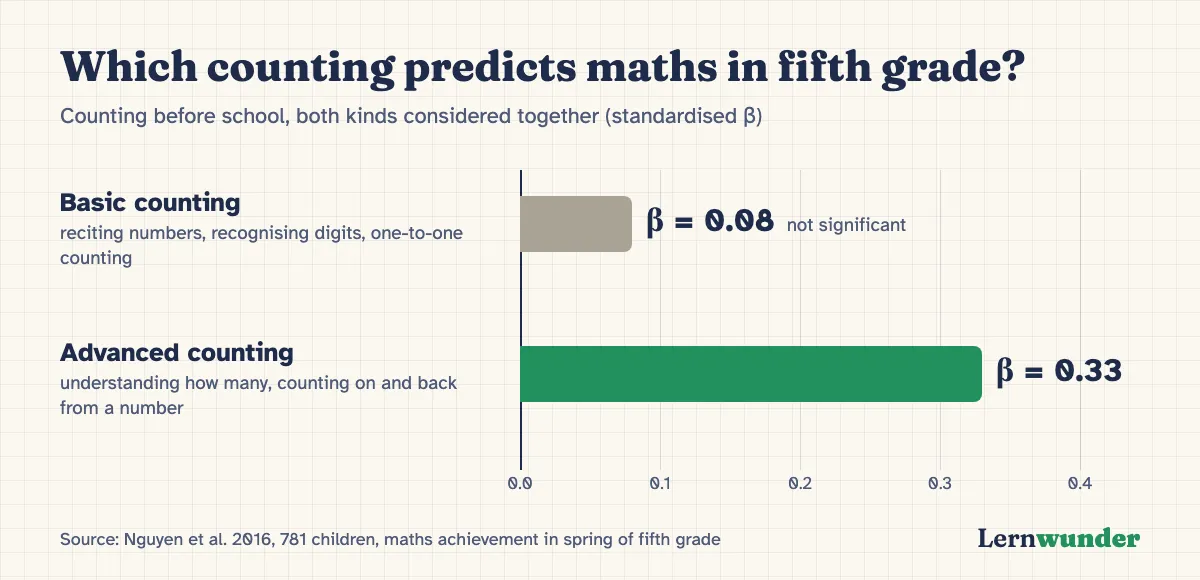
Not everything that looks like maths is equally important. A study with 781 children examined which preschool skills best predicted maths achievement in fifth grade. The strongest area was counting and cardinality. But not reciting the number sequence: when both kinds of counting were considered together, basic counting added almost nothing (β = .08), while advanced counting added a lot (β = .33) (Nguyen et al., 2016). Advanced means knowing that the last number counted tells you how many there are, and being able to count on or back from any number, for example “count from 4 to 10”.
That gives four basics for the start of school:
- Numbers stand for amounts. “Seven” is not just a word but seven things.
- Comparing amounts. Where is more, where is less, how many more? More in More, less or the same?
- Counting on instead of starting over. Seven potatoes plus one is “eight”, not “one, two, three …”.
- Number bonds. 7 is 5 and 2, or 4 and 3. This is the basis for all later calculation (see our article on the maths learning path).
Counting or seeing structure?
Counting is the beginning. The goal is not to have to count amounts one by one. In a study with 378 children from kindergarten to year 3, children recognised dot sets faster when the dots were arranged in small groups. Kindergarten children did not yet show this advantage, first graders did, and it grew year by year. How well children used the groups was also linked to their arithmetic fluency (Starkey & McCandliss, 2014).
For the start of school this means: children should be allowed to count. But they also need pictures in which they can see structure: rows of five, dice patterns, fingers, ten frames. How that works is explained in The power of five. Why counting everything becomes a burden later is covered in Counting-based calculation.

What does maths talk at home achieve?
More than you might think, but not in the way many expect. It is not about worksheets but about conversation. In one study, parents’ number talk predicted children’s later understanding of “how many” when parents counted or named things that were right in front of the child, especially sets of four to ten (Gunderson & Levine, 2011).
A meta-analysis of 64 studies found a small but reliable link between the home maths environment and children’s maths achievement (r = .13) (Daucourt et al., 2021). And in an experiment with 587 first graders, parents and children solved short maths story problems together in the evening. These children learned more maths over the school year than a comparison group with reading stories, especially when parents themselves were anxious about maths (Berkowitz et al., 2015).
How can you prevent maths anxiety from the start?
Maths anxiety does not start in secondary school. In a large study of children in first and second grade, children of maths-anxious parents learned less maths over the school year and were more anxious by the end, but only if those parents often helped with maths homework (Maloney et al., 2015). Where they rarely helped, there was no link.
That does not mean parents should stay out of it. It means the kind of help matters. Calm, short, playful maths in everyday life is better than strained explaining at the desk. More in our articles on maths anxiety and on why mistakes should not be red.
What you can do
- Practise counting on. “Here are seven, I’ll add one.” Wait to see whether your child says “eight” instead of counting again.
- Count from any number. “Count from 4 to 10.” “Now back from 10 to 6.” On the stairs, while laying the table, in the car.
- Count real things. Potatoes, buttons, steps. Amounts between four and ten that are right in front of the child work best.
- Compare. “Who has more grapes? How many more?”
- Offer structure. Egg boxes, dice patterns, fingers in groups of five: “How many can you see without counting?”
- Play number bonds. Seven pebbles, some hidden under your hand: how many are missing? More games in Number bonds at home.
- Stay relaxed. Avoid “I was never good at maths either”. Try: “How interesting, how did you do that?”
Where our apps can help
At the start of school your child mainly needs people, materials and conversation. If you would also like to use an app, two of ours fit the first stations: Mengenpiraten practises comparing amounts, Zahlzerlegung practises number bonds to 10 (in German only). How they connect on the learning path is explained in Two new apps, one learning path. An app does not replace teaching or a diagnosis.
Frequently asked questions
Does my child need to count to 100 when starting school? No. It matters more that they know what numbers up to 10 mean, can compare amounts and can count on from a given number (Nguyen et al., 2016).
Is finger counting a problem at the start of year 1? No, it is normal. The goal is that your child gradually sees structure and recalls number bonds. If they are still counting everything halfway through the year, see Halfway through year one: when a child is still counting.
How much should we practise at home? A few minutes in everyday life are enough. The mood matters more than the amount (Maloney et al., 2015; Berkowitz et al., 2015).
How do I know my child needs support? If comparing and counting on are still very hard after a few months, talk to the teacher. Signs are described in Recognising maths difficulties.
Sources
- Berkowitz, T., Schaeffer, M. W., Maloney, E. A., Peterson, L., Gregor, C., Levine, S. C. & Beilock, S. L. (2015). Math at home adds up to achievement in school. Science, 350(6257), 196–198. https://doi.org/10.1126/science.aac7427
- Daucourt, M. C., Napoli, A. R., Quinn, J. M., Wood, S. G. & Hart, S. A. (2021). The home math environment and math achievement: A meta-analysis. Psychological Bulletin, 147(6), 565–596. https://doi.org/10.1037/bul0000330
- Duncan, G. J., Dowsett, C. J., Claessens, A., Magnuson, K., Huston, A. C., Klebanov, P., Pagani, L. S., Feinstein, L., Engel, M., Brooks-Gunn, J., Sexton, H., Duckworth, K. & Japel, C. (2007). School readiness and later achievement. Developmental Psychology, 43(6), 1428–1446. https://doi.org/10.1037/0012-1649.43.6.1428
- Gunderson, E. A. & Levine, S. C. (2011). Some types of parent number talk count more than others: Relations between parents’ input and children’s cardinal-number knowledge. Developmental Science, 14(5), 1021–1032. https://doi.org/10.1111/j.1467-7687.2011.01050.x
- Jordan, N. C., Kaplan, D., Ramineni, C. & Locuniak, M. N. (2009). Early math matters: Kindergarten number competence and later mathematics outcomes. Developmental Psychology, 45(3), 850–867. https://doi.org/10.1037/a0014939
- Maloney, E. A., Ramirez, G., Gunderson, E. A., Levine, S. C. & Beilock, S. L. (2015). Intergenerational effects of parents’ math anxiety on children’s math achievement and anxiety. Psychological Science, 26(9), 1480–1488. https://doi.org/10.1177/0956797615592630
- Nguyen, T., Watts, T. W., Duncan, G. J., Clements, D. H., Sarama, J. S., Wolfe, C. & Spitler, M. E. (2016). Which preschool mathematics competencies are most predictive of fifth grade achievement? Early Childhood Research Quarterly, 36, 550–560. https://doi.org/10.1016/j.ecresq.2016.02.003
- Starkey, G. S. & McCandliss, B. D. (2014). The emergence of “groupitizing” in children’s numerical cognition. Journal of Experimental Child Psychology, 126, 120–137. https://doi.org/10.1016/j.jecp.2014.03.006
Lernwunder editorial team · Chaolan Lu