In short: It is normal for a child halfway through their first school year to solve many addition facts by counting. Quick recall of basic facts develops over several school years, and the German curriculum standards set it as a goal for the end of primary school. It’s worth a closer look if your child only ever counts everything from 1, often miscounts, and shows no faster strategies over several weeks.
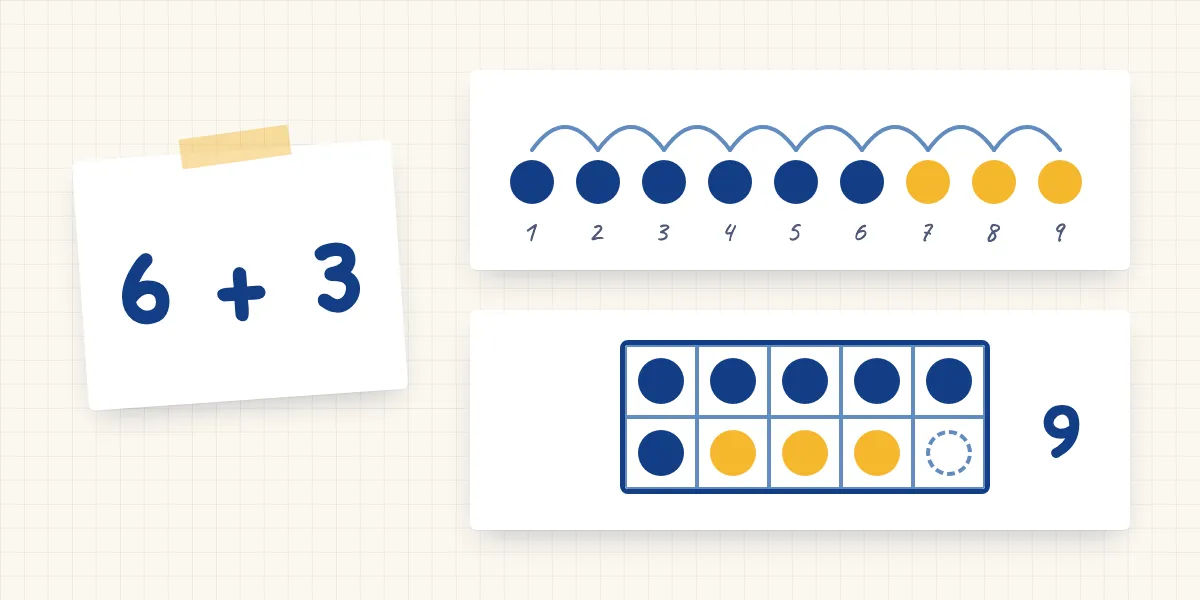
A made-up scene that plays out in many homes: late February, homework is 6 + 3. Fingers move under the table, lips silently count along. The answer is right. Still, the parents feel uneasy: shouldn’t she just know this by now?
Midway through the school year is a good time for this question. Many schools hold progress conversations around now, and you’ve seen half a year of school. This post looks at what’s typical at this point (first grade in Germany, Year 1 in the UK) and what you can do over the coming weeks.
What’s typical halfway through the first school year?
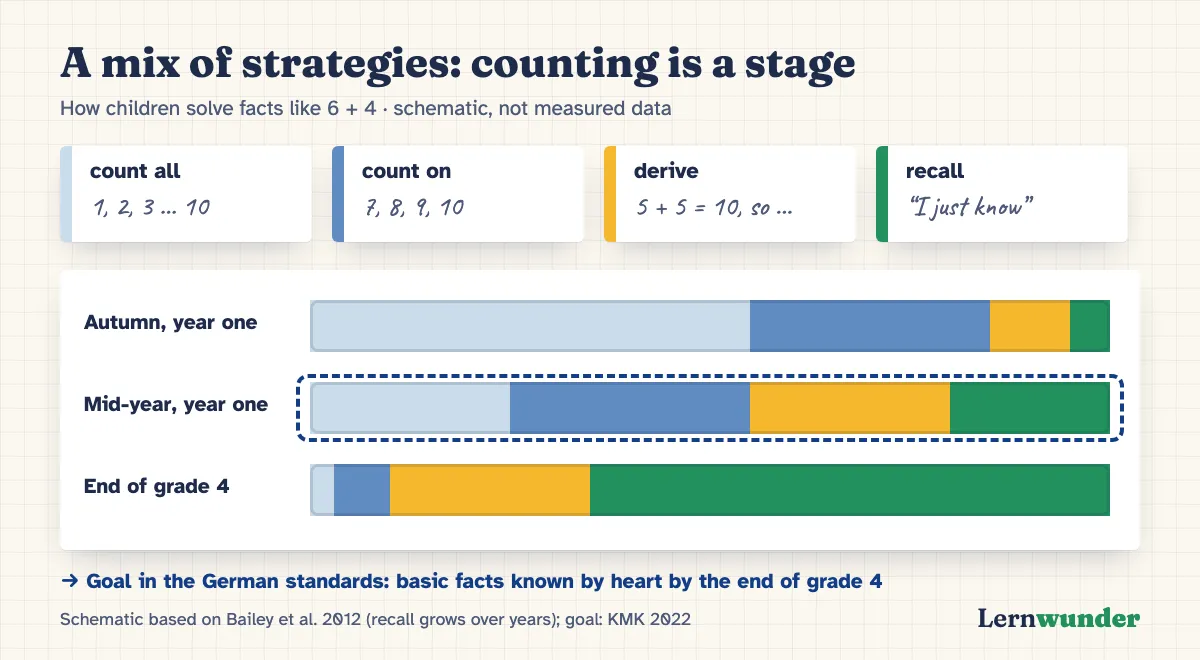
Children don’t solve addition facts with one strategy but with a mix: sometimes they count all, sometimes they count on from the larger number, sometimes they derive a fact from one they know, and some facts they simply know. As we explained in our post on counting-based calculation, counting is a step along the way, not a mistake.
How long that path takes is shown by a longitudinal study that followed 311 children from first to sixth grade. Their preference for retrieving addition facts from memory instead of working them out grew slowly over all those years. Children who could already retrieve accurately in first grade preferred retrieval more often in second grade, and later, practice and skill reinforced each other (Bailey et al., 2012).
The German curriculum standards don’t set the goal in the first year either. They describe knowing the basic facts by heart – explicitly including number bonds and addition facts – as a competence for the end of fourth grade (KMK, 2022).
In short: a child who still counts a lot in February of their first school year is in the middle of a normal development.
When is it worth taking a closer look?
What matters is not whether a child counts but how. In a study of children in first, third and fifth grade, first graders with maths learning difficulties used less sophisticated strategies and made more errors than their classmates. The differences were linked, among other things, to working memory and to children’s understanding of counting (Geary et al., 2004).
Signs worth noticing:
| Typical halfway through year one | Worth a closer look |
|---|---|
| counts on from 6 for 6 + 3 | always counts everything from 1 for 6 + 3 |
| sometimes miscounts | often miscounts, answers vary a lot |
| knows a few facts by heart (e.g. 5 + 5) | needs to count even for 1 + 1 or 5 + 5 |
| sees small quantities at a glance | has to count three or four dots one by one |
| calculates slowly but willingly | avoids maths tasks, seems anxious |
Importantly, a single observation tells you little. A longitudinal study found that children who met the criteria for a maths learning disability at one point quite often no longer met them later – even with the same tests. The authors explicitly caution against basing a diagnosis on a single test at a single point in time (Mazzocco & Myers, 2003). What stays the same over weeks says more than one bad homework day.
We explained how dyscalculia differs from general maths difficulties in this post. A diagnosis is made by specialists – not by an app and not by a blog post.
What helps now?
The good news: counting-based calculation can be developed further, with a manageable amount of effort. In a study with children who had maths difficulties, simply teaching efficient counting strategies already helped. The biggest gains came when each session added four to six minutes of deliberate practice with those strategies (Fuchs et al., 2010). The study ran as a tutoring programme over 16 weeks, three sessions a week, for children with maths difficulties. The principle transfers well all the same: short, regular, targeted practice.
What you can do
- Observe for two weeks – don’t test. During a few homework tasks, ask casually: “How did you work that out?” Note whether your child counts all, counts on, derives or just knows. That’s the best basis for a conversation with the school.
- Count on from the larger number. For 2 + 7: “Which number is bigger? Start there.” That saves counting steps and mistakes.
- One number relationship a week. For example, the bonds to 10, then doubles (3 + 3, 4 + 4), then “near doubles”. You’ll find games for this in our post number bonds games at home.
- Show quantities in a structured way. Egg boxes, ten frames, fingers as whole pictures (“show me seven without counting”). Why the five helps so much is explained in the power of five.
- Five minutes, not fifty. Better a little every day than a long session at the weekend. Stop while it’s still fun.
- Talk to the teacher. Bring your notes and ask: “How does my child calculate in class? Which strategy are you working on at the moment? What can we do at home to support it?”
- Take the pressure off. Phrases like “You should know that by now!” do more harm than good. We wrote about why pressure slows children down in our post on maths anxiety.
How Zahlzerlegung can help
Zahlzerlegung practises exactly the number relationships from which deriving and recalling later grow: the number bonds to 10. The ring around the tangram animal runs for five seconds and shows whether a bond is already being recalled. It never cuts a task short, though: a child who is still counting can finish counting. If you sit alongside, you can see which bonds are secure and which aren’t yet.
The app is a practice tool. It doesn’t diagnose and it doesn’t replace learning therapy or a conversation with the school. It is available in German only, for iPhone and iPad.
Frequently asked questions
My child still counts on their fingers in February of year one. Is that a problem? Usually not. What matters is whether faster strategies, such as counting on or deriving, appear over the weeks.
When should a child know addition facts to 10 by heart? The German standards set fluent recall as a goal for the end of primary school (KMK, 2022). Many children know the facts to 10 much earlier – the pace varies a lot.
Should I have my child tested now? If the signs in the right-hand column persist over weeks, talk to the teacher first. A single test at a single point in time has limited value (Mazzocco & Myers, 2003).
Does it help to ban finger counting? No. Children then just count in secret. It’s better to offer faster strategies until counting becomes less frequent on its own.
Sources
- Bailey, D. H., Littlefield, A. & Geary, D. C. (2012). The codevelopment of skill at and preference for use of retrieval-based processes for solving addition problems: Individual and sex differences from first to sixth grades. Journal of Experimental Child Psychology, 113(1), 78–92. https://doi.org/10.1016/j.jecp.2012.04.014
- Fuchs, L. S., Powell, S. R., Seethaler, P. M., Cirino, P. T., Fletcher, J. M., Fuchs, D. & Hamlett, C. L. (2010). The effects of strategic counting instruction, with and without deliberate practice, on number combination skill among students with mathematics difficulties. Learning and Individual Differences, 20(2), 89–100. https://doi.org/10.1016/j.lindif.2009.09.003
- Geary, D. C., Hoard, M. K., Byrd-Craven, J. & DeSoto, M. C. (2004). Strategy choices in simple and complex addition: Contributions of working memory and counting knowledge for children with mathematical disability. Journal of Experimental Child Psychology, 88(2), 121–151. https://doi.org/10.1016/j.jecp.2004.03.002
- Kultusministerkonferenz (2022). Bildungsstandards für das Fach Mathematik Primarbereich [German educational standards for primary mathematics] (resolution of 15.10.2004 as amended 23.06.2022). https://www.kmk.org/fileadmin/Dateien/veroeffentlichungen_beschluesse/2022/2022_06_23-Bista-Primarbereich-Mathe.pdf
- Mazzocco, M. M. M. & Myers, G. F. (2003). Complexities in identifying and defining mathematics learning disability in the primary school-age years. Annals of Dyslexia, 53, 218–253. https://doi.org/10.1007/s11881-003-0011-7
Lernwunder editorial team · Chaolan Lu