
In short: Dyscalculia is the everyday name for a diagnosis: persistent, clearly below-average maths skills despite adequate teaching that cannot be better explained by other causes. “Maths difficulties” is a much broader term that covers any child who struggles with numbers, for whatever reason. Whether a child has dyscalculia is decided by specialists using standardised tests, an examination and the child’s history. Children need support with or without a diagnosis, and targeted support works.
A made-up but typical scene: at the parents’ evening after the half-year report, the class teacher says Mia “seems to have maths difficulties”. A friend recommends testing for dyscalculia. A tutoring centre advertises “help for dyscalculia”. The parents wonder: is this all the same thing? And what happens next?
We described how to spot early signs of maths difficulties in Years 1 and 2 in a separate article. This one is about the next step: what the terms mean, how a diagnosis is made and what help is available.
What do the different terms mean?
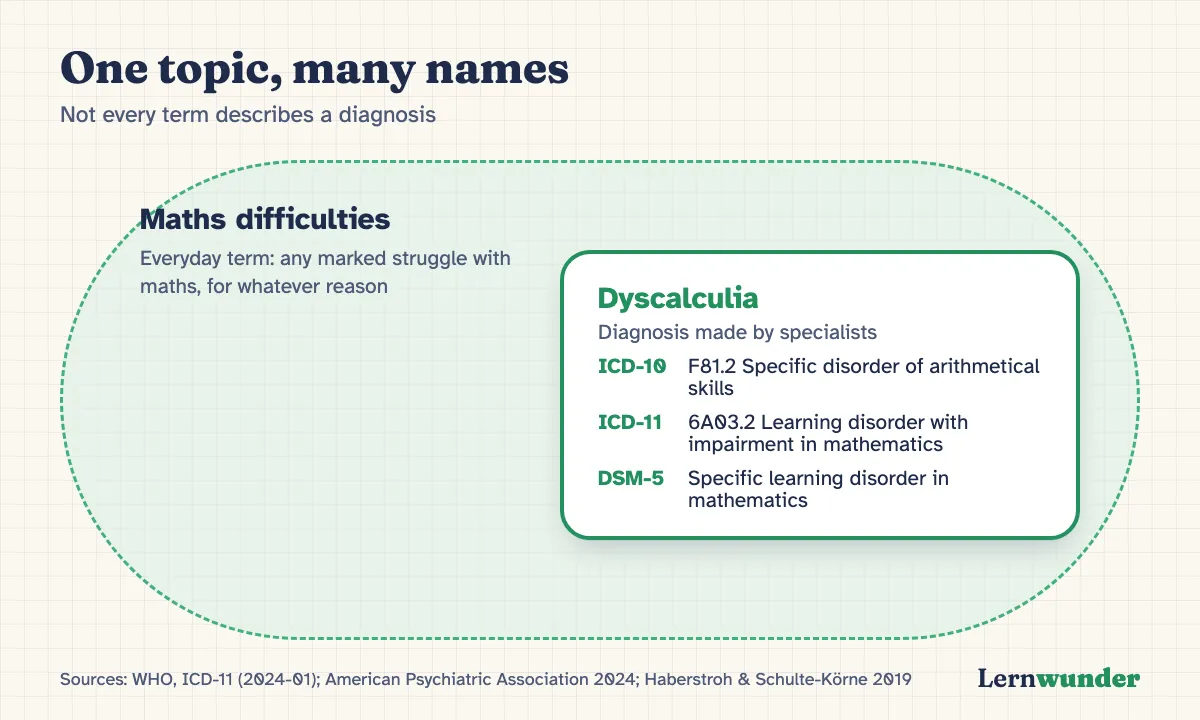
Many words are used for the same topic. Not all of them describe a diagnosis.
| Term | Where it comes from | What it means |
|---|---|---|
| Specific disorder of arithmetical skills | ICD-10, F81.2 | Diagnosis: marked, persistent problems with basic arithmetic and recalling number facts |
| Developmental learning disorder with impairment in mathematics | ICD-11, 6A03.2 | Diagnosis in the WHO’s current classification |
| Specific learning disorder with impairment in mathematics | DSM-5 (USA, 2013) | Diagnosis; reading, writing and maths are combined in one learning disorder |
| Dyscalculia | Specialist and everyday language | Usually the same as the diagnoses above |
| Maths difficulties, maths learning difficulties | School, everyday life, tutoring | Not a diagnosis; sometimes any struggle with maths, sometimes dyscalculia |
In the World Health Organization’s ICD-11, the maths learning disorder is one of the developmental learning disorders. It can affect number sense, memorising number facts, accurate and fluent calculation and mathematical reasoning (WHO, ICD-11). The American Psychiatric Association describes the same areas for the DSM-5 and names “dyscalculia” as the common term for them (American Psychiatric Association, 2024).
What has to come together for a diagnosis?
ICD-11 and DSM-5 list very similar requirements (WHO, ICD-11; American Psychiatric Association, 2024):
- Maths skills are markedly below what is expected for the child’s age, ideally measured with a standardised, normed test.
- The difficulties persist despite appropriate teaching; in DSM-5, for at least six months despite targeted help.
- They begin during the school years.
- They are not better explained by something else: an intellectual disability, vision or hearing problems, lack of schooling, limited knowledge of the language of instruction or difficult life circumstances.
- They clearly affect the child at school and in everyday life.
One sentence in ICD-11 is worth remembering: a single test score is not enough to tell a disorder apart from the normal range. Children learn at different speeds, and a slow start is not yet a finding.
How does a diagnosis work in practice?
The German S3 clinical guideline on dyscalculia, developed by 20 professional societies and associations, describes three building blocks that belong together (Haberstroh & Schulte-Körne, 2019):
- Testing: a normed maths test that mainly covers basic arithmetic and the understanding of number and quantity.
- Examination: physical and neurological, including vision and hearing, plus a standardised intelligence test.
- History and circumstances: development, family, school. Other explanations have to be ruled out, such as many cancelled lessons, frequent changes of teacher, long absences or an anxiety disorder.
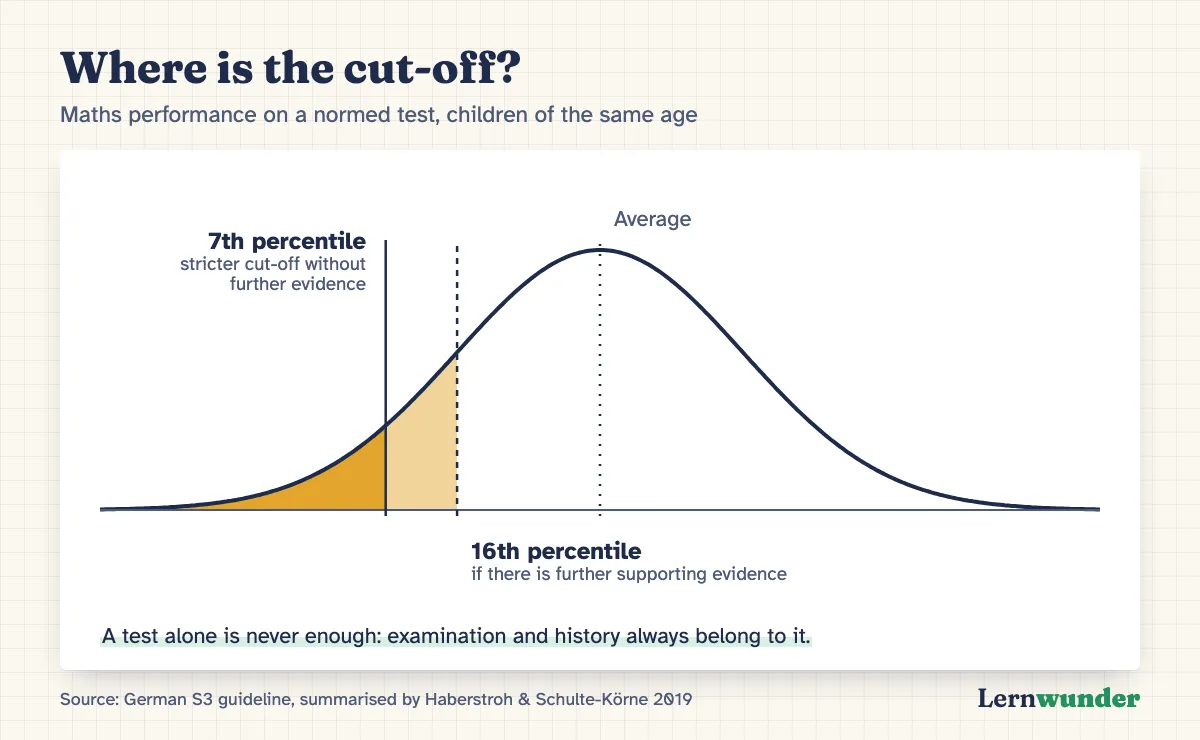
The guideline also sets thresholds. Maths performance has to be at least below average, in the bottom sixth (16th percentile or lower). If the examination and history do not add further support for dyscalculia, a stricter cut-off applies: the 7th percentile or lower. If there are further signs, for example difficulties with numbers and quantities already before school, the 16th percentile is enough (Haberstroh & Schulte-Körne, 2019).
Why do prevalence figures vary so much?
The German guideline gives 3 to 7 per cent (Haberstroh & Schulte-Körne, 2019), ICD-11 6 to 7 per cent of school-age children (WHO, ICD-11). In a British study of 2,421 primary school children, 5.7 per cent showed a profile of a maths learning disorder according to DSM-5 over the years (Morsanyi et al., 2018).
The differences have a simple cause: where you draw the line determines the result. In a study of 1,004 primary school children, both the prevalence and even whether boys or girls were more often affected depended on the criterion used (Devine et al., 2013).
Dyscalculia often does not come alone. About 30 to 40 per cent of those affected also have dyslexia, 10 to 20 per cent attention difficulties (Haberstroh & Schulte-Körne, 2019). In a Munich study of 1,633 children in Years 3 and 4, combined learning disorders were as common as single ones (Moll et al., 2014). And in the British study, about half of the children with a maths learning disorder also had language or communication difficulties (Morsanyi et al., 2018). A good assessment therefore always looks at reading, attention and feelings too.
So are “maths difficulties” less serious?
Not necessarily. The term simply does not say why a child is struggling. Sometimes dyscalculia is behind it, sometimes gaps after a bumpy start, sometimes anxiety. For support, that is secondary: what a child cannot do yet can be practised in a targeted way. For formal accommodations or funding, however, a professional diagnosis usually matters.
What help is available, and who pays?
Support works best when it targets exactly the content a child finds hard, starts early and is given by trained specialists, ideally one to one (Haberstroh & Schulte-Körne, 2019). How families get it depends heavily on the country. In Germany, for example:
- At school: extra lessons and exam accommodations are regulated by each federal state. The guideline authors criticise that children with dyscalculia are often treated less favourably than children with dyslexia (Haberstroh & Schulte-Körne, 2019).
- Specialist tutoring outside school: health insurers do not cover the costs (Haberstroh & Schulte-Körne, 2019).
- Youth welfare office: children are entitled to integration support if their mental health is likely to deviate from what is typical for their age for more than six months and their participation in society is or may become impaired. The office obtains a statement from a child psychiatrist or psychotherapist (§ 35a, German Social Code Book VIII). Whether tutoring is funded this way is decided case by case.
Outside Germany, ask your child’s school and your local education or health services which route applies where you live.
What you can do
- Write down what you notice. Which problems work, which do not, and since when? This helps in every conversation.
- Ask for reasons, not just a label. “What makes you think so?” is a good question for teachers and tutors.
- Have vision and hearing checked. It is part of any assessment anyway.
- Keep assessment and support separate. German law requires that integration support should not be provided by the same person or service that wrote the assessment (§ 35a SGB VIII). A sensible rule elsewhere, too.
- Look at reading, attention and anxiety as well. Co-occurring difficulties are common and need their own support.
- Take the pressure off at home. Short, successful maths moments help more than long practice evenings. How closely anxiety and performance are linked is explained in our article on maths anxiety.
Why this matters to us
Behind both words, maths difficulties and dyscalculia, there is a child who finds numbers hard. No app can make a diagnosis or replace specialist support, ours included. Our app Zahlzerlegung (currently in German only) practises one foundation that many difficulties depend on: number bonds instead of counting-based calculation. That can accompany support, but it cannot take its place.
Frequently asked questions
Is dyscalculia the same as maths difficulties? Not quite. Dyscalculia usually refers to a diagnosed learning disorder. “Maths difficulties” is a broad term without a fixed definition.
Does intelligence still play a role? Yes. The maths problems must not be explained by an intellectual disability, which is why an intelligence test is part of the assessment (Haberstroh & Schulte-Körne, 2019).
From what age can children be tested? In Germany, normed tests are available from the end of Year 1. Before that, the focus is on observation and early support, not on a diagnosis.
Does dyscalculia go away on its own? Usually not. ICD-11 describes that the difficulties often persist into adulthood, especially without support. That makes targeted support, which demonstrably works, all the more important (Haberstroh & Schulte-Körne, 2019).
Sources
- American Psychiatric Association (2024). What are specific learning disorders? Psychiatry.org, physician review March 2024. https://www.psychiatry.org/patients-families/specific-learning-disorder/what-is-specific-learning-disorder
- Devine, A., Soltész, F., Nobes, A., Goswami, U. & Szűcs, D. (2013). Gender differences in developmental dyscalculia depend on diagnostic criteria. Learning and Instruction, 27, 31–39. https://doi.org/10.1016/j.learninstruc.2013.02.004
- German Social Code, Book VIII (SGB VIII), § 35a Integration support for children and adolescents with (or at risk of) a mental disability. https://www.gesetze-im-internet.de/sgb_8/__35a.html
- Haberstroh, S. & Schulte-Körne, G. (2019). The diagnosis and treatment of dyscalculia. Deutsches Ärzteblatt International, 116(7), 107–114. https://doi.org/10.3238/arztebl.2019.0107
- Moll, K., Kunze, S., Neuhoff, N., Bruder, J. & Schulte-Körne, G. (2014). Specific learning disorder: Prevalence and gender differences. PLoS ONE, 9(7), e103537. https://doi.org/10.1371/journal.pone.0103537
- Morsanyi, K., van Bers, B. M. C. W., McCormack, T. & McGourty, J. (2018). The prevalence of specific learning disorder in mathematics and comorbidity with other developmental disorders in primary school-age children. British Journal of Psychology, 109(4), 917–940. https://doi.org/10.1111/bjop.12322
- World Health Organization (2024). ICD-11 for Mortality and Morbidity Statistics (Version 2024-01), 6A03.2 Developmental learning disorder with impairment in mathematics. https://icd.who.int/browse/2024-01/mms/en#2099676649
Lernwunder editorial team · Chaolan Lu