In short: A good educational app makes your child think, does not distract, connects to everyday life and leaves room for conversation. It helps after mistakes, does not push children to keep playing or to buy, shows no ads and passes no data to third parties. The label “educational” tells you little: in studies, a large share of popular “educational apps” fail these criteria.
A made-up but typical scene: one evening a father searches the app store for “Year 1 maths”. He finds dozens of apps with colourful animals, 4.7 stars and “learning game” in the name. He downloads one. After three questions a video ad plays, then a pop-up: “Unlock all levels!” His daughter taps the cross, but it is so small that she hits the buy button instead.
In our post on screen time we briefly introduced four hallmarks of good learning apps. Here we go further: what do studies that actually tested apps show? And how can you tell in ten minutes whether an app is any good?
Does the label “educational” say anything about quality?
Hardly. As early as 2015 there were around 80,000 apps in the “Education” category of Apple’s App Store, which a research team described as largely unregulated and untested (Hirsh-Pasek et al., 2015). The team derived four pillars from the science of learning: children learn when they are active, engaged rather than distracted, learning something meaningful, and socially interactive. On top of that comes a clear learning goal. An app without one is not an educational app under this definition, whatever it calls itself.
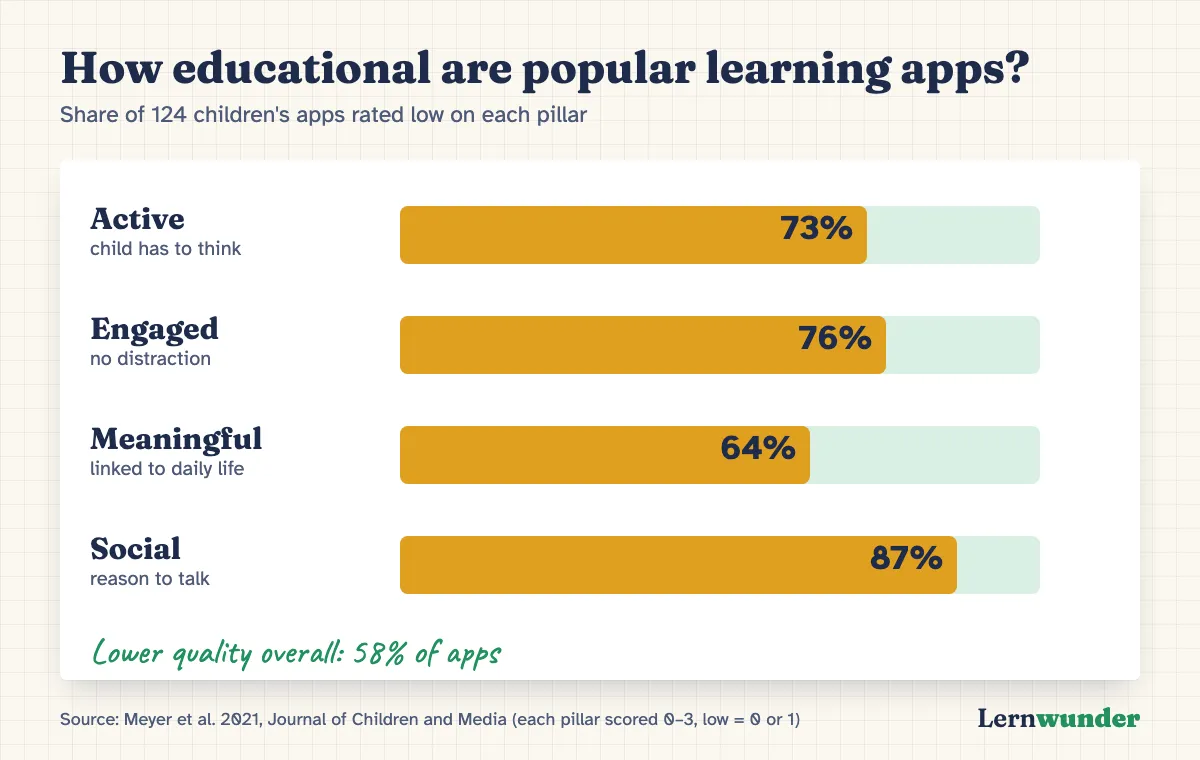
How well do real apps measure up? A team led by Marisa Meyer turned the four pillars into a coding scheme and rated 124 apps: the most downloaded children’s “education” apps from both stores, plus the apps preschoolers used most in a study. Each pillar scored 0 to 3 (Meyer et al., 2021). The result:
- 73% of the apps required little thinking. A rigid pattern in which the child just taps the one expected answer was typical.
- 76% distracted from learning, for example with ads, tappable effects or excessive reward animations.
- 64% had little connection to children’s lives.
- 87% offered little reason to interact with others.
- Overall, 58% were rated lower quality.
Free apps scored clearly lower than paid apps on engagement, because of distracting add-ons. The authors note, however, that free does not automatically mean poor: some apps are free because non-profit organisations fund them.
How can I spot pressure to keep playing or to buy?
By four recurring patterns. A team led by Jenny Radesky examined the apps that 160 children aged three to five used for the longest time, and sorted these “dark patterns” (manipulative design tricks) into four groups (Radesky et al., 2022):
- Pressure from characters: a character is sad, begs or shames the child for wanting to stop or not buy.
- Fake time pressure: countdowns at decision points, “hurry!”, offers that are about to vanish.
- Navigation constraints: the way out is hidden, the close button is pale and tiny, the buy button big and bright.
- Lures: sparkly rewards and treasure chests that pull towards the next level or a purchase.
Only 20% of the apps studied had none of these patterns. Children from families with lower parental education used apps with more manipulative design. Why rewards and streaks play such a large role here is explained in our post on rewards in learning apps.
How much advertising is in children’s apps?
A lot, including in “educational apps”. In an analysis of 135 apps for children aged five and under, 95% contained at least one type of advertising: video ads interrupting play (35%), in-app purchases (30%), prompts to rate the app (28%), banners (17%) and even ads disguised as gameplay items (7%). Apps labelled “educational” contained ads about as often as other apps (Meyer et al., 2019).
Ads are more than an annoyance. Every interruption pulls a child out of the task, and that is exactly what lowers an app’s engagement score (Meyer et al., 2021).
What happens to my child’s data?
You can hardly tell from the outside. An automated analysis of 5,855 popular free children’s apps for Android found that the majority were potentially in violation of COPPA, the US children’s privacy law, mainly because of third-party software (SDKs) for advertising and analytics. 19% of the apps collected identifiers or personal data through SDKs whose own terms of service prohibit their use in child-directed apps (Reyes et al., 2018).
The study is from the US and a few years old. But the mechanism has not changed: whoever earns money from ads needs data. An app without ads, without an account and without an internet connection has fewer reasons to collect it.
Does the app help when my child gets stuck?
This criterion is often missing from ratings. In an experiment with 240 four- and five-year-olds, children learned new words in an app better when they received a spoken hint after a mistake, especially at the start. And difficulty that increased gradually led to faster and more accurate answers than tasks in random order (Callaghan & Reich, 2021). A sound effect or a “Great job!” alone explains nothing.
The checklist: twelve questions in ten minutes
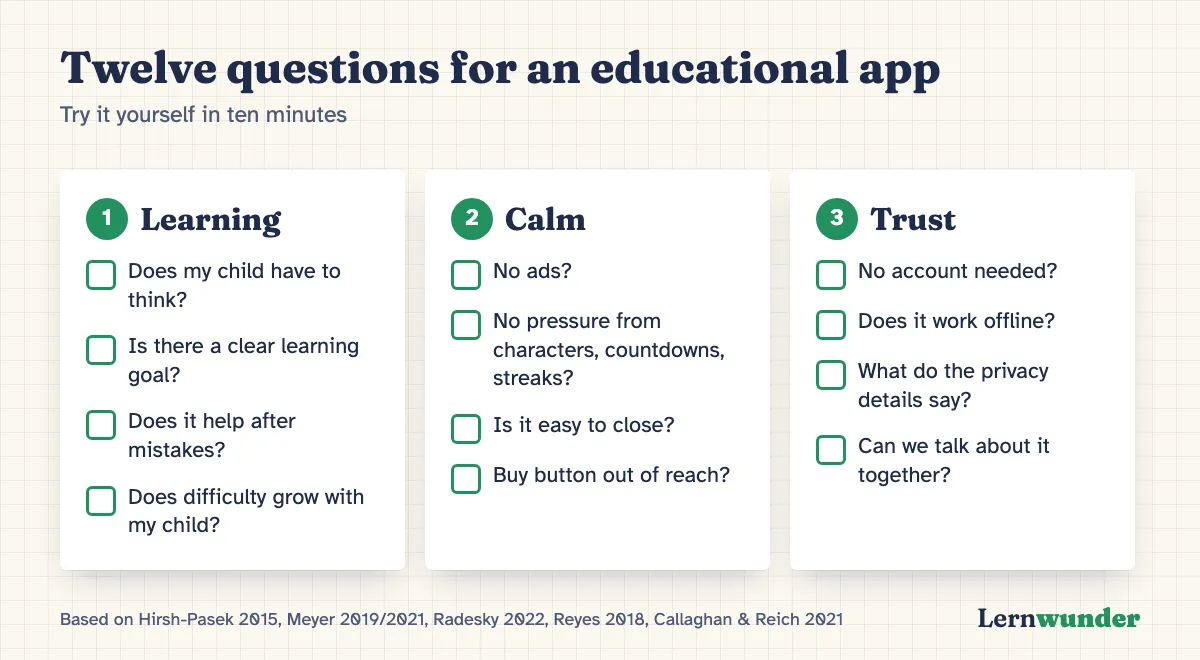
What you can do
- Play for ten minutes yourself. Make mistakes on purpose. What happens: a verdict, a hint, a lost life?
- Try to close the app. Is the way out as easy as the way in? Does a character beg?
- Switch on airplane mode. Does the app still work? Then it probably does not depend on ads loaded from the internet.
- Read the privacy details in the store. Look for “Data used to track you”.
- Check the parent area. Buy buttons, settings and rating requests belong behind a gate that children cannot open.
- Ask your child about the content. “What did you find out today?” If they cannot say, it may have been more play than learning.
How we rate our own apps
We apply the same list to our apps. They meet much of it: Zahlzerlegung (number bonds), Droptiply (times tables), Tinu Time (telling the time) and Mengenpiraten (comparing quantities) have no ads, no account and no third-party software for analytics or advertising. All of them work offline, all have a clear learning goal and adapt tasks to the child’s level.
But they do not meet everything, and we say so openly:
- Red for mistakes. Zahlzerlegung, Droptiply and Tinu Time mark wrong answers in red. Why we would build that differently today is explained in why mistakes should not be red. Mengenpiraten uses no red.
- Streaks. Droptiply and Tinu Time show how many days in a row a child has practised. By our own checklist, that is a pressure tool.
- Speed. Droptiply is a falling-block game, so pace is part of the game. The speed mode with a countdown is optional, and zen mode has no pace at all. In Zahlzerlegung a ring runs for five seconds on every question. It takes nothing away, but it is there.
- Random stickers. Zahlzerlegung occasionally shows a sticker at random after a correct answer.
- Audio. Zahlzerlegung has no voice-over; it is designed to need very little text. Tinu Time and Mengenpiraten are fully voiced.
- Rating request. Droptiply asks once, after ten games, on the progress screen, using the system dialog for a store rating.
- Social. Only Mengenpiraten has a partner mode for two children on one iPad. The other apps are played alone; the conversation has to come from you.
For everything we build from now on, the list applies from day one: no red, no streaks, no time pressure. For our existing apps, we treat it as a to-do list.
Frequently asked questions
Are free educational apps worse? On average they were more distracting in one study, mainly because of ads (Meyer et al., 2021). But there are good free apps, for example from non-profits. What matters is how the app makes its money.
Is the star rating enough? No. Stars say whether people like an app, not whether children learn with it. The most popular “educational apps” often scored poorly in studies (Meyer et al., 2021).
Are rewards in learning apps bad? Not in principle. The problem is lures that push children to keep playing or to buy (Radesky et al., 2022).
What is the single most important criterion? Whether your child is thinking while playing. If they just tap until something flashes, they learn little, however colourful the app.
Sources
- Callaghan, M. N. & Reich, S. M. (2021). Mobile app features that scaffold pre-school learning: Verbal feedback and leveling designs. British Journal of Educational Technology, 52(2), 785–806. https://doi.org/10.1111/bjet.13055
- Hirsh-Pasek, K., Zosh, J. M., Golinkoff, R. M., Gray, J. H., Robb, M. B. & Kaufman, J. (2015). Putting education in “educational” apps: Lessons from the science of learning. Psychological Science in the Public Interest, 16(1), 3–34. https://doi.org/10.1177/1529100615569721
- Meyer, M., Adkins, V., Yuan, N., Weeks, H. M., Chang, Y.-J. & Radesky, J. (2019). Advertising in young children’s apps: A content analysis. Journal of Developmental & Behavioral Pediatrics, 40(1), 32–39. https://doi.org/10.1097/DBP.0000000000000622
- Meyer, M., Zosh, J. M., McLaren, C., Robb, M., McCafferty, H., Golinkoff, R. M., Hirsh-Pasek, K. & Radesky, J. (2021). How educational are “educational” apps for young children? App store content analysis using the Four Pillars of Learning framework. Journal of Children and Media, 15(4), 526–548. https://doi.org/10.1080/17482798.2021.1882516
- Radesky, J., Hiniker, A., McLaren, C., Akgun, E., Schaller, A., Weeks, H. M., Campbell, S. & Gearhardt, A. N. (2022). Prevalence and characteristics of manipulative design in mobile applications used by children. JAMA Network Open, 5(6), e2217641. https://doi.org/10.1001/jamanetworkopen.2022.17641
- Reyes, I., Wijesekera, P., Reardon, J., Elazari Bar On, A., Razaghpanah, A., Vallina-Rodriguez, N. & Egelman, S. (2018). “Won’t somebody think of the children?” Examining COPPA compliance at scale. Proceedings on Privacy Enhancing Technologies, 2018(3), 63–83. https://doi.org/10.1515/popets-2018-0021
Lernwunder editorial team · Chaolan Lu