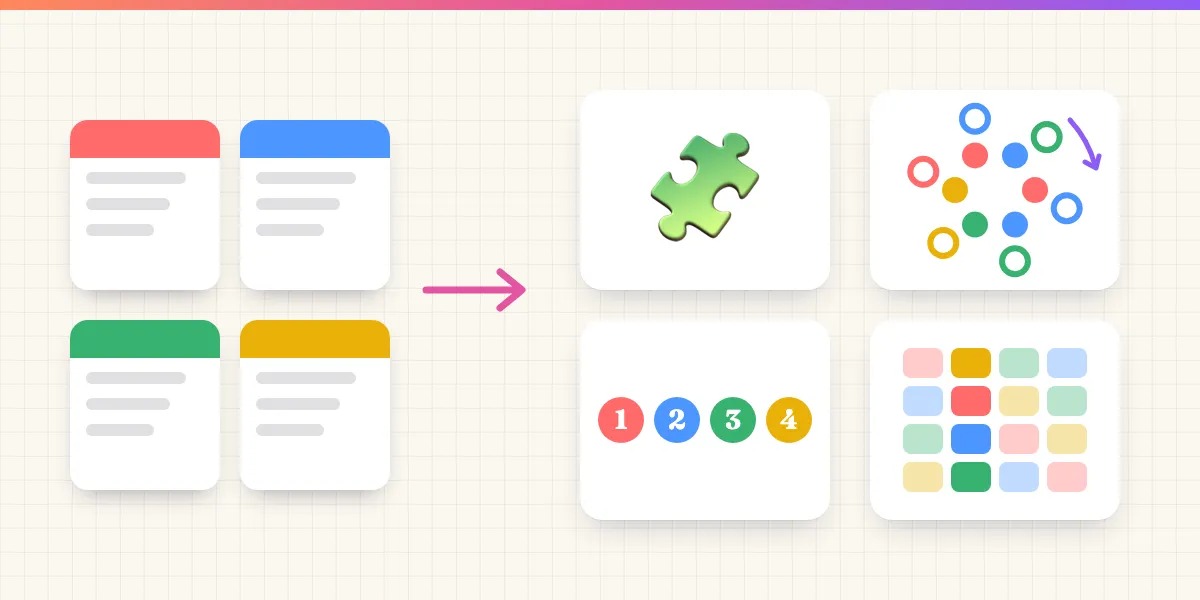
In short: Cooperative learning is one of the most thoroughly researched ways of teaching. Whether it works depends less on the name of the structure than on two ingredients: a shared group goal and each person’s accountability for the result. In studies, the jigsaw mainly strengthens relationships; for achievement, recent findings are mixed.
Tuesday, period three, a learning carousel with four teams and five stations. Before you can start, you draw a rotation plan on the board, notice that two teams will be at the same station in round three, and wipe it off again. (An invented scene, but you probably know it.)
Cooperative learning means students work in small groups in such a way that they can only reach a shared goal if everyone contributes.
What does research know about cooperative learning?
A great deal. More than 1,200 studies over eleven decades have compared cooperative, competitive and individual learning. The underlying theory, social interdependence, has given rise to procedures for the teacher’s role that are used around the world (Johnson & Johnson, 2009).
A review of studies in regular classrooms lasting at least four weeks counted 67 comparisons of achievement: 41 found significantly better results in cooperative classes, 25 found no difference and only one favoured the control class. Effects appeared from grade 2 to grade 12, in all major subjects, and equally for high, average and lower achievers (Slavin, 1991).
What makes cooperative learning work?
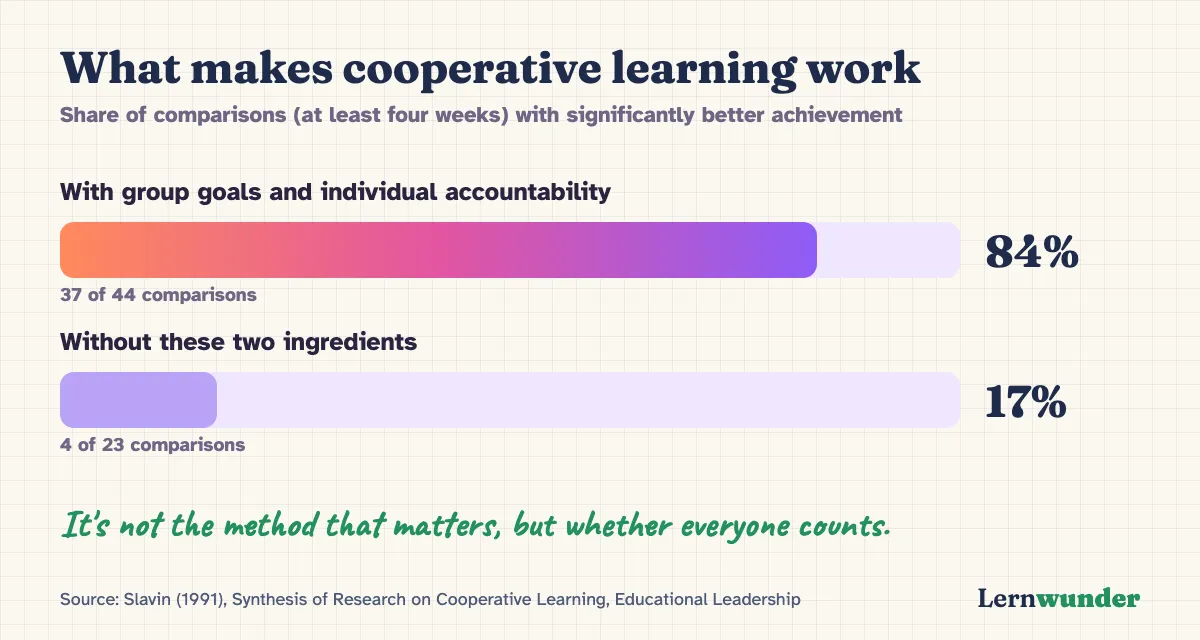
Two ingredients, according to the same review: a group goal and individual accountability. The group has something to achieve, and its success depends on every member having learned something. Methods with both ingredients showed positive effects in 37 of 44 comparisons (84 percent), methods without them in only 4 of 23 (17 percent) (Slavin, 1991).
The reason: if the group only has to hand in one worksheet, the quick students can simply supply the answers. If everyone has to learn, explaining pays off. Slavin points to observation studies showing that the students who gain most are those who give and receive elaborated explanations, while just passing on answers was negatively related to learning gains (Slavin, 1991).
Spencer Kagan calls such fixed routines “structures”: content-free sequences of steps that shape how students interact with each other and with the material. His test for every structure is positive interdependence, individual accountability, equal participation and simultaneous interaction (Kagan, 2003). The first two match Slavin’s ingredients exactly.
Jigsaw: a classic with a mixed record
In a jigsaw, each member of a home group gets one part of the material. Everyone with the same part meets in an expert group, and then each person teaches their part to their home group.
In an early field study, 304 fifth graders worked this way three times a week for six weeks. Afterwards they had higher self-esteem, liked their group members more than other classmates and liked school more (Blaney et al., 1977).
For achievement the picture is less clear. Five randomised experiments with sixth graders found no overall advantage for the jigsaw over other teaching; the pooled effect size was 0.00 (Stanczak et al., 2022). A review of 69 studies describes the effects as inconsistent and highly variable, depending on factors such as sample size, classroom diversity and content (Cochon Drouet et al., 2023).
Our take: the jigsaw is worth it when the material genuinely splits into parts and relationships matter. Check each student’s understanding at the end, otherwise the second ingredient is missing.
Numbered heads, think-pair-share, inside-outside circle
Numbered heads together. Every team member has a number, the team discusses a question, then the teacher calls a number and that person answers. Because anyone might be called, everyone has to understand the answer. Kagan traces the structure back to a teacher’s classroom he observed (Kagan, 2003). A study with a sixth-grade chemistry class describes it as an effective way to get more students responding actively; adding an incentive package raised test performance noticeably further (Maheady et al., 2006).
Think-pair-share. Think alone first, then discuss in pairs, then share with the class. Kagan credits Frank Lyman with this sequence (Kagan, 2003). We did not review effectiveness studies of it for this article. The rationale lies in the principles: everyone thinks before anyone answers.
Inside-outside circle. Two circles face each other, and after each round the outer circle moves on one place. Kagan lists it among the structures that get the whole class talking to each other (Kagan, 2003).
Which structure fits when?
| Structure | Good for | Time |
|---|---|---|
| Think-pair-share | any question, even spontaneous | 3–5 minutes |
| Numbered heads together | review, checking understanding | 5–10 minutes |
| Inside-outside circle | vocabulary, opinions, sharing knowledge | 10–15 minutes |
| Team roles | longer group tasks | a whole lesson |
| Jigsaw | material that splits into parts | 1–2 lessons |
| Stations | practice with different materials | 1–2 lessons |
The times are our editorial experience, not figures from studies.
What you can do in class
- Start small. Think-pair-share needs no preparation: ask a question, one minute of silence, one minute in pairs, then call on someone.
- Call at random. For numbered heads, roll a die before calling. Say beforehand that any number may come up.
- Rotate roles. Whoever writes today speaks next time. Two or three roles are enough to begin with.
- Time the circle. One to two minutes per round, then a signal. Five rounds are usually enough.
- Jigsaw with an expert sheet. Each expert group writes three key sentences that everyone takes back to their home group.
- Finish individually. Quiz, exit ticket or one sentence in the exercise book: the second ingredient is that each person shows what they have learned.
How we solved it in Ene Mene Miste
Ene Mene Miste has had the jigsaw since version 1.1, and since version 1.2 (October 2026) a whole method menu on the result screen. The design decision behind it: every method is just a view of the same teams. Tap back to “Teams” and exactly the teams you had are there. The fair mix is kept, and skill levels stay private.
- Jigsaw: expert groups with one person from each team; an icon next to each name shows the home group.
- Team roles: six default roles (Speaker, Writer, Timekeeper, Materials, Checker, Quiet keeper), assigned at random and reassignable. The list can be customised, including your own roles.
- Numbered heads: “Call a number” shows it big, and the matching person lights up in every team. Every number comes up once before any repeats.
- Pair work (think-pair-share): pairs within each team, with one group of three if the size is odd. Nobody is left alone.
- Inside-outside circle: everyone outside meets everyone inside exactly once. People who are “better apart” stand in the same circle, so they never meet.
- Stations: a rotation plan, also with more stations than teams and with required and optional stations.
There is also a round timer from 1 to 15 minutes that can move on to the next round automatically. Round, number and time left are shown large for the projector.

Frequently asked questions
Do I need rewards? Not necessarily. Slavin describes the group goal as rewards or recognition, so praise in front of the class counts. In the study by Maheady and colleagues an incentive package added something on top.
What if someone does nothing? Then individual accountability is missing. Numbers, roles and a short individual task at the end make visible who contributed what.
How should I form the groups? That was the topic of Grouping students at the start of the school year.
Sources
- Blaney, N. T., Stephan, C., Rosenfield, D., Aronson, E. & Sikes, J. (1977). Interdependence in the classroom: A field study. Journal of Educational Psychology, 69(2), 121–128. https://doi.org/10.1037/0022-0663.69.2.121
- Cochon Drouet, O., Lentillon-Kaestner, V. & Margas, N. (2023). Effects of the Jigsaw method on student educational outcomes: Systematic review and meta-analyses. Frontiers in Psychology, 14, 1216437. https://doi.org/10.3389/fpsyg.2023.1216437
- Johnson, D. W. & Johnson, R. T. (2009). An educational psychology success story: Social interdependence theory and cooperative learning. Educational Researcher, 38(5), 365–379. https://doi.org/10.3102/0013189X09339057
- Kagan, S. (2003). A brief history of Kagan Structures. Kagan Online Magazine, Spring 2003. https://www.kaganonline.com/free_articles/dr_spencer_kagan/256/A-Brief-History-of-Kagan-Structures
- Maheady, L., Michielli-Pendl, J., Harper, G. F. & Mallette, B. (2006). The effects of Numbered Heads Together with and without an incentive package on the science test performance of a diverse group of sixth graders. Journal of Behavioral Education, 15(1), 24–38. https://doi.org/10.1007/s10864-005-9002-6
- Slavin, R. E. (1991). Synthesis of research on cooperative learning. Educational Leadership, 48(5), 71–82. https://files.ascd.org/staticfiles/ascd/pdf/journals/ed_lead/el_199102_slavin.pdf
- Stanczak, A., Darnon, C., Robert, A., Demolliens, M., Sanrey, C., Bressoux, P., Huguet, P., Buchs, C. & Butera, F. (2022). Do jigsaw classrooms improve learning outcomes? Five experiments and an internal meta-analysis. Journal of Educational Psychology, 114(6), 1461–1476. https://doi.org/10.1037/edu0000730
Lernwunder editorial team · Chaolan Lu