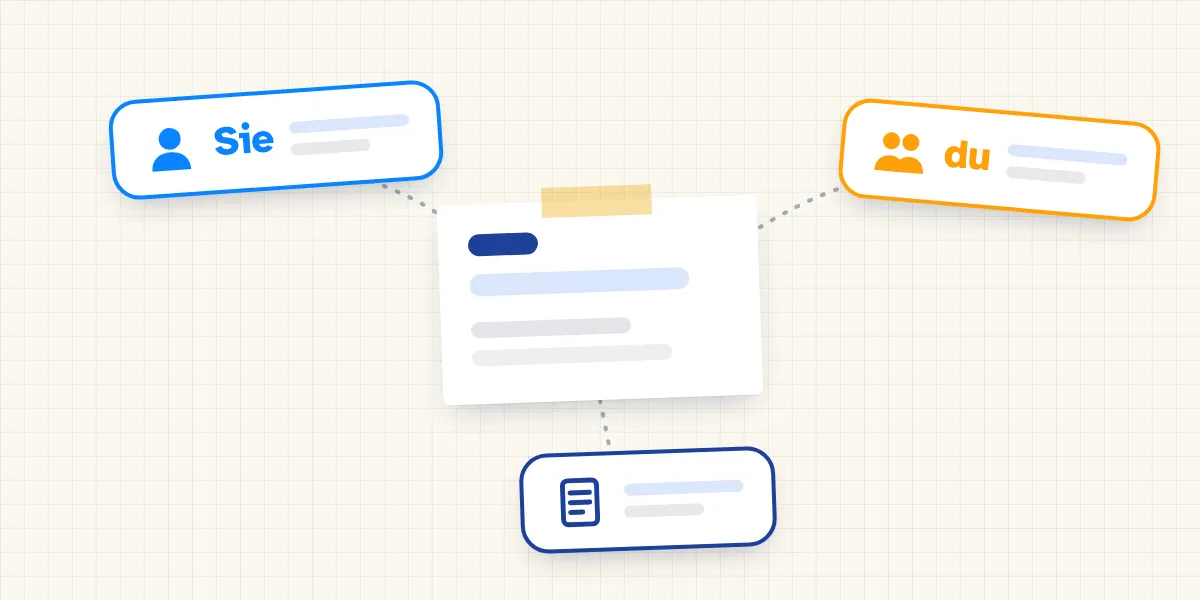
In short: Nurses working in German need at least three ways of saying the same thing: friendly and clear with the formal “Sie” to the patient, short and often with the informal “du” to a colleague, precise and structured to the doctor. Linguists call these registers. Knowing a medical term on its own is therefore not enough. It should be learned in these three sentences from the start.
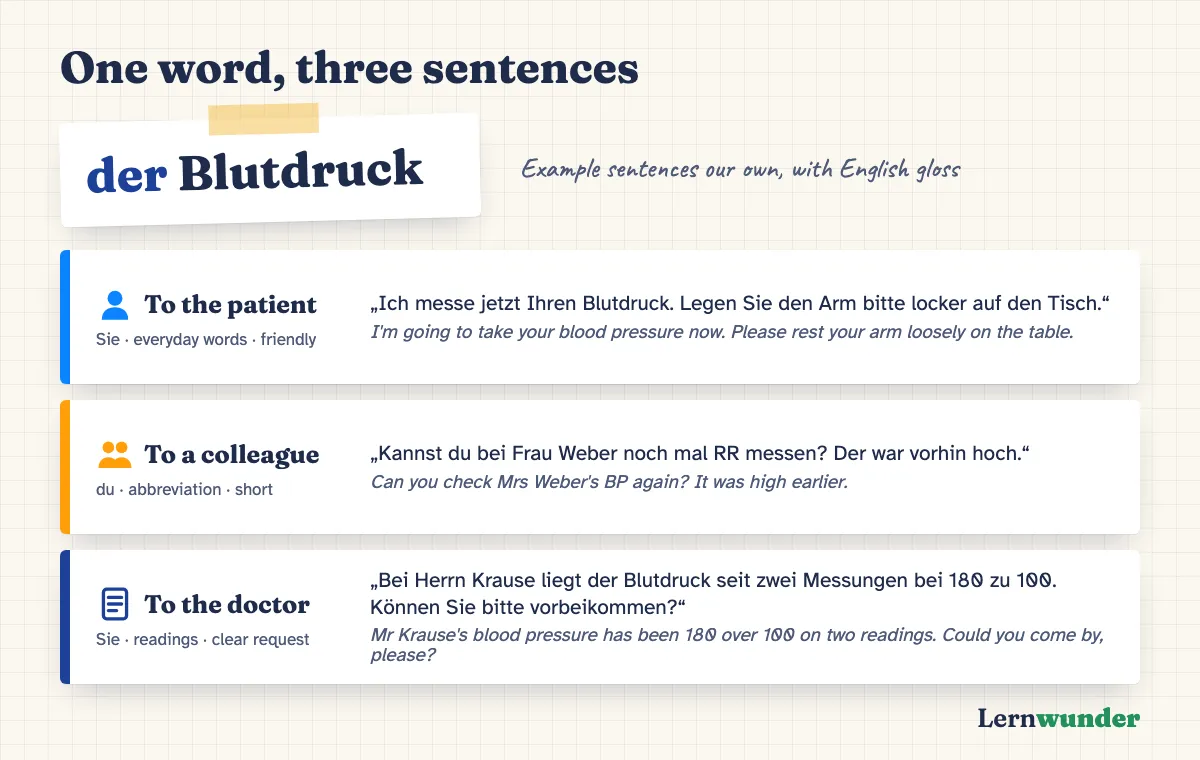
Take a single word: der Blutdruck, blood pressure. In the morning, a nurse might say these three sentences:
- To the patient: „Ich messe jetzt Ihren Blutdruck. Legen Sie den Arm bitte locker auf den Tisch.“ (I’m going to take your blood pressure now. Please rest your arm loosely on the table.)
- To a colleague: „Kannst du bei Frau Weber noch mal RR messen? Der war vorhin hoch.“ (Can you check Mrs Weber’s BP again? It was high earlier.)
- To the doctor: „Bei Herrn Krause liegt der Blutdruck seit zwei Messungen bei 180 zu 100. Können Sie bitte vorbeikommen?“ (Mr Krause’s blood pressure has been 180 over 100 on two readings. Could you come by, please?)
We made these sentences up, but this is what a German ward sounds like. The same topic, said three different ways: different form of address, different vocabulary, different length, different tone. Someone who has only learned the word “Blutdruck” is not really ready for any of the three.
Our last post explained why B2 German is not enough on the ward. Today is about an idea that follows from it.
What is a register?
A register is a way of speaking or writing that fits a particular situation: who is talking to whom, for what purpose and through which channel. Linguists describe registers by the language features that are typical of such situations (Biber & Conrad, 2019). Everyone commands several registers, usually without thinking about it. You talk to your grandmother differently than in a job interview.
In a foreign language, this does not come naturally. Language courses tend to practise a polite, middle-of-the-road standard German. On the ward you need the edges instead: very simple, warm sentences for patients and very short, technical sentences within the team.
Why does switching between registers matter so much?
A study in London hospitals observed how internationally educated nurses use language at work. Its conclusion: nurses must use appropriate registers with doctors, patients and relatives, and be able to translate between everyday and medical language. Politeness strategies are part of this too, for example to avoid making anyone lose face (Sedgwick & Garner, 2017). Very few language exams test this kind of translation work.
To the patient: clear, but never condescending
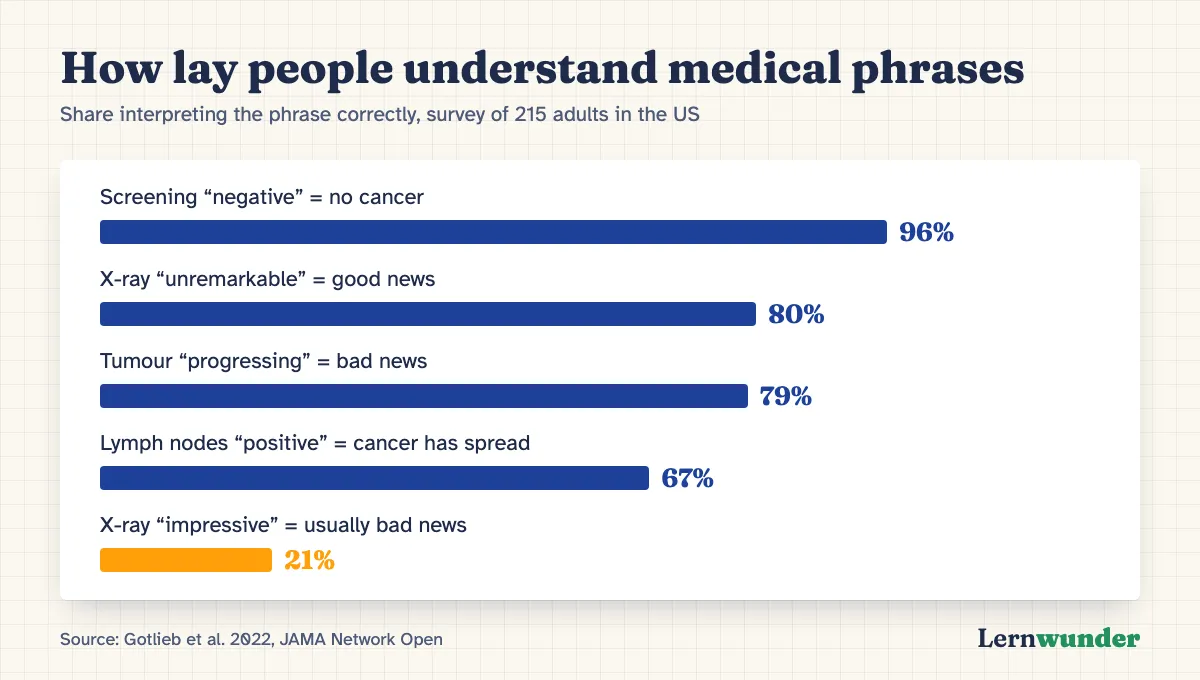
Lay people often understand medical terms differently than intended. In a US survey, 80 percent knew that an “unremarkable” chest X-ray is good news. But only 21 percent understood that an “impressive” X-ray is usually bad news in medical speak. In every pair tested, the plain-language version was understood better than the jargon (Gotlieb et al., 2022). And clinicians use a lot of jargon without noticing: in surgeons’ consultations with parents, there were on average almost 29 unexplained technical terms per visit (Links et al., 2019).
Simple does not mean childish, though. A study in nursing homes looked at how residents with dementia respond to “elderspeak”, a patronising way of talking as if to a child. After such utterances, resistance to care was clearly more likely than after normal talk (Williams et al., 2009). For the patient sentence this means: plain everyday words, a respectful “Sie”, no baby talk.
To a colleague: short, in jargon, often with “du”
Different rules apply within the team. On many German wards colleagues use the informal “du”, sentences get shorter, and abbreviations replace words. That is our own observation, not a fixed rule; some hospitals stay with “Sie”. Forms of address are never just grammar: they signal how close or distant people are (Clyne et al., 2009). Saying “du” too early or “Sie” for too long sends a message you may not have meant to send.
That this register is hard for newcomers is shown by an observational study from Australia: overseas-qualified nurses engaged in small talk and laughter mostly with colleagues from similar cultural backgrounds, and rarely with local colleagues (Philip et al., 2019).
To the doctor: precise and in a fixed order
Many hospitals use fixed formats for reporting to doctors. A well-known one is SBAR: Situation, Background, Assessment, Recommendation. A systematic review of eleven studies found moderate evidence that such structures improve patient safety, especially on the phone (Müller et al., 2018). For learners, a fixed format has an extra benefit: you know what comes next and can practise the sentences for it.
What you can do
If you are learning German for nursing:
- For every new word, write three sentences: one for the patient, one for a colleague, one for the doctor.
- In the patient sentence, use everyday words: “Blutdruck” rather than “RR”, “Zucker messen” (check your sugar) rather than “BZ”.
- Listen for short forms at handover and write down what they stand for.
- Learn the structure for reporting to doctors that your hospital uses and practise it out loud.
- When in doubt, just ask: „Duzen wir uns?“ (Shall we use “du”?) On a ward this is a perfectly normal question.
If you are onboarding new colleagues:
- Say which register you are using: “That’s how we say it among ourselves; to the patient I would say …”
- Show the template for reporting to doctors and do one report together.
What we are working on
These findings led to the idea for PflegeMate, a learning aid we are currently working on. Its core: one term, three sentences. No medical term should stand alone; each should appear in three example sentences that show how to say it to a patient, a colleague and a doctor.
There are reasons for this. A word in a sentence shows how it is used: with which verb, which article, which tone. Three sentences make it visible that the same thing sounds different depending on who you are talking to. And because the sentences come from typical ward situations, learners can use them almost word for word. We will show what this looks like when it is ready.
PflegeMate is meant to be a language learning aid only. It does not replace onboarding or professional training.
Frequently asked questions
What is the best way to learn German for nursing? With words in context rather than word lists: every medical term with its article and with sentences for the typical people you talk to on the ward. Practise out loud, ideally with feedback from colleagues.
Do nurses in Germany use “du” with each other? In many teams, yes, but not everywhere. Patients are addressed with “Sie”. When in doubt, ask.
What is SBAR? A format for short reports: Situation, Background, Assessment, Recommendation. Many hospitals use it or their own version (Müller et al., 2018).
Is plain language with patients impolite? No. Everyday words are understood better than medical jargon (Gotlieb et al., 2022). It only becomes impolite when you talk to adults as if they were children (Williams et al., 2009).
Sources
- Biber, D. & Conrad, S. (2019). Register, Genre, and Style (2nd ed.). Cambridge University Press. https://doi.org/10.1017/9781108686136
- Clyne, M., Norrby, C. & Warren, J. (2009). Language and Human Relations: Styles of Address in Contemporary Language. Cambridge University Press. https://doi.org/10.1017/CBO9780511576690
- Gotlieb, R., Praska, C., Hendrickson, M. A., Marmet, J., Charpentier, V. et al. (2022). Accuracy in patient understanding of common medical phrases. JAMA Network Open, 5(11), e2242972. https://doi.org/10.1001/jamanetworkopen.2022.42972
- Links, A. R., Callon, W., Wasserman, C., Walsh, J., Beach, M. C. & Boss, E. F. (2019). Surgeon use of medical jargon with parents in the outpatient setting. Patient Education and Counseling, 102(6), 1111–1118. https://doi.org/10.1016/j.pec.2019.02.002
- Müller, M., Jürgens, J., Redaèlli, M., Klingberg, K., Hautz, W. E. & Stock, S. (2018). Impact of the communication and patient hand-off tool SBAR on patient safety: a systematic review. BMJ Open, 8(8), e022202. https://doi.org/10.1136/bmjopen-2018-022202
- Philip, S., Woodward-Kron, R. & Manias, E. (2019). Overseas qualified nurses’ communication with other nurses and health professionals: An observational study. Journal of Clinical Nursing, 28(19–20), 3505–3521. https://doi.org/10.1111/jocn.14942
- Sedgwick, C. & Garner, M. (2017). How appropriate are the English language test requirements for non-UK-trained nurses? A qualitative study of spoken communication in UK hospitals. International Journal of Nursing Studies, 71, 50–59. https://doi.org/10.1016/j.ijnurstu.2017.03.002
- Williams, K. N., Herman, R., Gajewski, B. & Wilson, K. (2009). Elderspeak communication: impact on dementia care. American Journal of Alzheimer’s Disease & Other Dementias, 24(1), 11–20. https://doi.org/10.1177/1533317508318472
Lernwunder editorial team · Chaolan Lu