In short: Shift work often costs sleep, and lack of sleep makes learning harder – especially taking in new material. If you’re learning nursing German alongside shift work, you’ll usually do better with short sessions of ten to fifteen minutes spread across the week: learn new words when you’re rested, and recall familiar ones from memory when you’re tired.
A made-up but typical week: two early shifts, two late shifts, two nights, then days off. The Tuesday evening German class clashes with the late shift, and the textbook has been lying under the uniforms for days. The plan is to catch up on the free Sunday – and after an hour your head is full and little has stuck.
Many internationally educated nurses learn German alongside work, in the middle of their first weeks on a German ward and often while preparing for an exam. This post sums up what research says about sleep, memory and study breaks, and what that means for study time on shift work. It isn’t health advice. Questions about sleep and shift patterns belong with your occupational health service, your GP or your staff representatives.
What does shift work do to learning?
A large overview of meta-analyses and systematic reviews concludes that shift work mainly shortens sleep around night and early-morning shifts. Laboratory studies also show that both shift work and sleep loss impair cognitive performance (Kecklund & Axelsson, 2016).
That matters for learning because sleep plays an active role in remembering. A meta-analysis pooled studies of at least one full night without sleep. Sleep deprivation before learning had a clear negative effect on how well new material was taken in. Sleep deprivation after learning also harmed memory, but less strongly (Newbury et al., 2021). The research team points out, though, that many of the included studies were small, so the exact effect sizes are uncertain.
Put cautiously for everyday life: learning new vocabulary after a long night means working against yourself. Tired moments are better suited to review.
Why are short, spaced sessions better?
That spaced learning sticks better than cramming is one of the most robust findings in learning research. In a study with more than 1,350 participants, the gap between first learning and review was varied systematically. The best gap depended on how long you want to remember something. If you want to remember something for a week, the best time to review is after roughly one to three days (Cepeda et al., 2008).
Two more findings fit shift work well:
- Sleep between two study sessions. In one experiment, 40 participants learned foreign-language vocabulary and relearned it twelve hours later. Those who had slept in between needed only about half as much practice when relearning, and retained the words much better in the long run (tested after one week and after six months) than the group who relearned on the same day (Mazza et al., 2016).
- Recall rather than reread. Pulling something out of memory makes it last longer than reading it again – even though rereading feels more reassuring (Roediger & Karpicke, 2006).
And microlearning? A scoping review of short learning units in the health professions found that most studies used units under 15 minutes and reported positive effects on knowledge and confidence. But the studies almost only measured satisfaction and knowledge gains, hardly any changes in practice (De Gagne et al., 2019). Short sessions aren’t a miracle cure, but they fit a life in which long study blocks are rare.
What does that look like in a shift week?
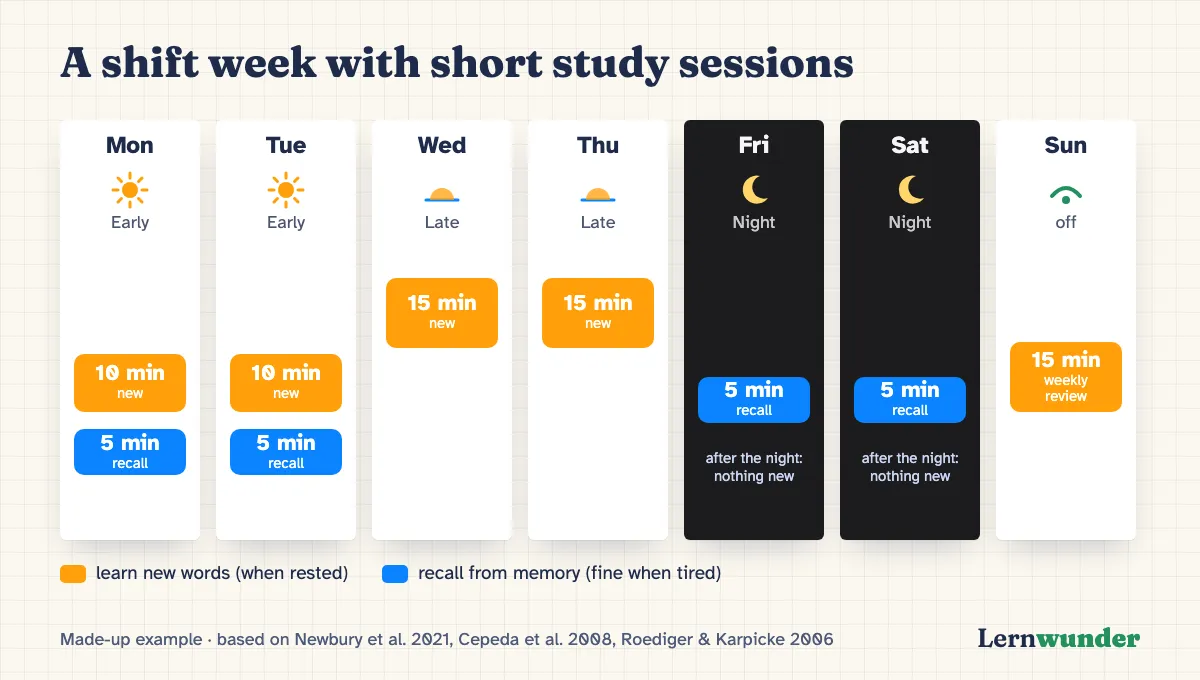
The chart shows one possible plan, not a fixed one. Three rules are built into it:
- New words when you’re rested. In the afternoon after an early shift, in the morning before a late shift. Not on the morning after a night.
- Recall when you’re tired. Five minutes is enough: cover the word, say the article and the sentence from memory, then check.
- One night in between. What you learn today, recall again tomorrow or the day after.
What you can do
- Small portions. Five to eight new terms per session, not thirty. Better one category over several days than everything on Sunday.
- Fixed anchors instead of fixed times. On shift work there’s no fixed study time. Link learning to something that always happens: getting home, leaving for work, the train ride.
- Cover and say. Cover the word or sentence and say it from memory before checking. It’s harder than reading – and that’s exactly why it works (Roediger & Karpicke, 2006).
- Let the ward do the review. When you hear or use a word you’ve learned during your shift – at handover, for instance – that’s the best review there is. In the evening, jot down which words came up.
- Don’t overload your days off. Better two 15-minute sessions on a free day than three hours in one go.
- Be honest with yourself. After a hard night, sleep matters more than vocabulary. A skipped session is not a step back.
How PflegeMate can help
PflegeMate is built for short sessions. Terms are grouped into categories, so you can take on a small portion – say five words from “Mobilisation & Lagerung” (mobility and positioning). The app works offline, including on a break in the staff room. Since the March update you can listen to every term and example sentence, and the speaking speed is adjustable. You can mark difficult words as favourites to review them on purpose.
What the app doesn’t do: it doesn’t quiz you or schedule reviews. Covering and recalling is up to you. PflegeMate is purely a language learning aid and doesn’t replace a language course. More on the PflegeMate page.
Frequently asked questions
When is the best time to study on shift work? New material when you’re rested; review also works in more tired moments. Short, regular sessions matter more than the time of day.
Can I still study after a night shift? A short review is fine. Taking in new material is measurably harder after sleep loss (Newbury et al., 2021). Sleep comes first.
How many words should I learn per day? Research doesn’t give a fixed number. Five to eight new terms per session, recalled again the next day or the day after, is a good start.
Does microlearning really work? Short units show positive effects on knowledge in the health professions, but evidence on long-term effects is still thin (De Gagne et al., 2019).
Sources
- Cepeda, N. J., Vul, E., Rohrer, D., Wixted, J. T. & Pashler, H. (2008). Spacing effects in learning: A temporal ridgeline of optimal retention. Psychological Science, 19(11), 1095–1102. https://doi.org/10.1111/j.1467-9280.2008.02209.x
- De Gagne, J. C., Park, H. K., Hall, K., Woodward, A., Yamane, S. & Kim, S. S. (2019). Microlearning in health professions education: Scoping review. JMIR Medical Education, 5(2), e13997. https://doi.org/10.2196/13997
- Kecklund, G. & Axelsson, J. (2016). Health consequences of shift work and insufficient sleep. BMJ, 355, i5210. https://doi.org/10.1136/bmj.i5210
- Mazza, S., Gerbier, E., Gustin, M.-P., Kasikci, Z., Koenig, O., Toppino, T. C. & Magnin, M. (2016). Relearn faster and retain longer: Along with practice, sleep makes perfect. Psychological Science, 27(10), 1321–1330. https://doi.org/10.1177/0956797616659930
- Newbury, C. R., Crowley, R., Rastle, K. & Tamminen, J. (2021). Sleep deprivation and memory: Meta-analytic reviews of studies on sleep deprivation before and after learning. Psychological Bulletin, 147(11), 1215–1240. https://doi.org/10.1037/bul0000348
- Roediger, H. L. & Karpicke, J. D. (2006). Test-enhanced learning: Taking memory tests improves long-term retention. Psychological Science, 17(3), 249–255. https://doi.org/10.1111/j.1467-9280.2006.01693.x
Lernwunder editorial team · Chaolan Lu