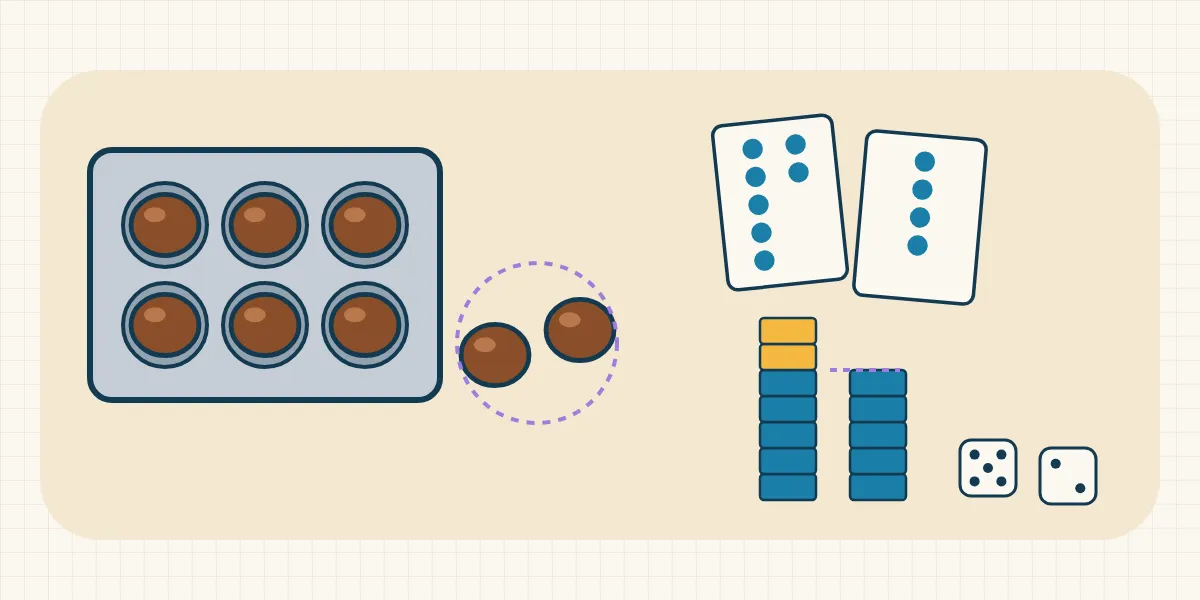
In short: Preschoolers learn to compare quantities best with things they can touch and with sentences they hear and say themselves: “There are more here than there.” Six games with everyday materials cover the three building blocks: one-to-one correspondence, talking about real sets, and experiencing numbers as distances. Each takes a few minutes and needs no screen.
A made-up scene: a five-year-old is putting conkers into a muffin tin, one per hole. At the end he still has two in his hand: “They don’t fit any more!” Without counting, he knows there are more conkers than holes, and even how many more.
Why comparing comes before calculating is the subject of our article More, less or the same?. This one is about practice: six games for children aged about four to six, using things you will find in almost any home or nursery.
What should the games practise?
Three things that support each other: one-to-one correspondence (what is left over shows where there are more), the language of comparison (“more than”, “fewer than”, “the same as”) and a sense of how big numbers are, which grows when numbers are tied to paths and sets.
A note on English: strictly, “fewer” is for things you count and “less” for amounts, but young children mostly hear “less” for both. Either is fine at home. What matters is that the child hears the opposite of “more” as often as “more” itself.
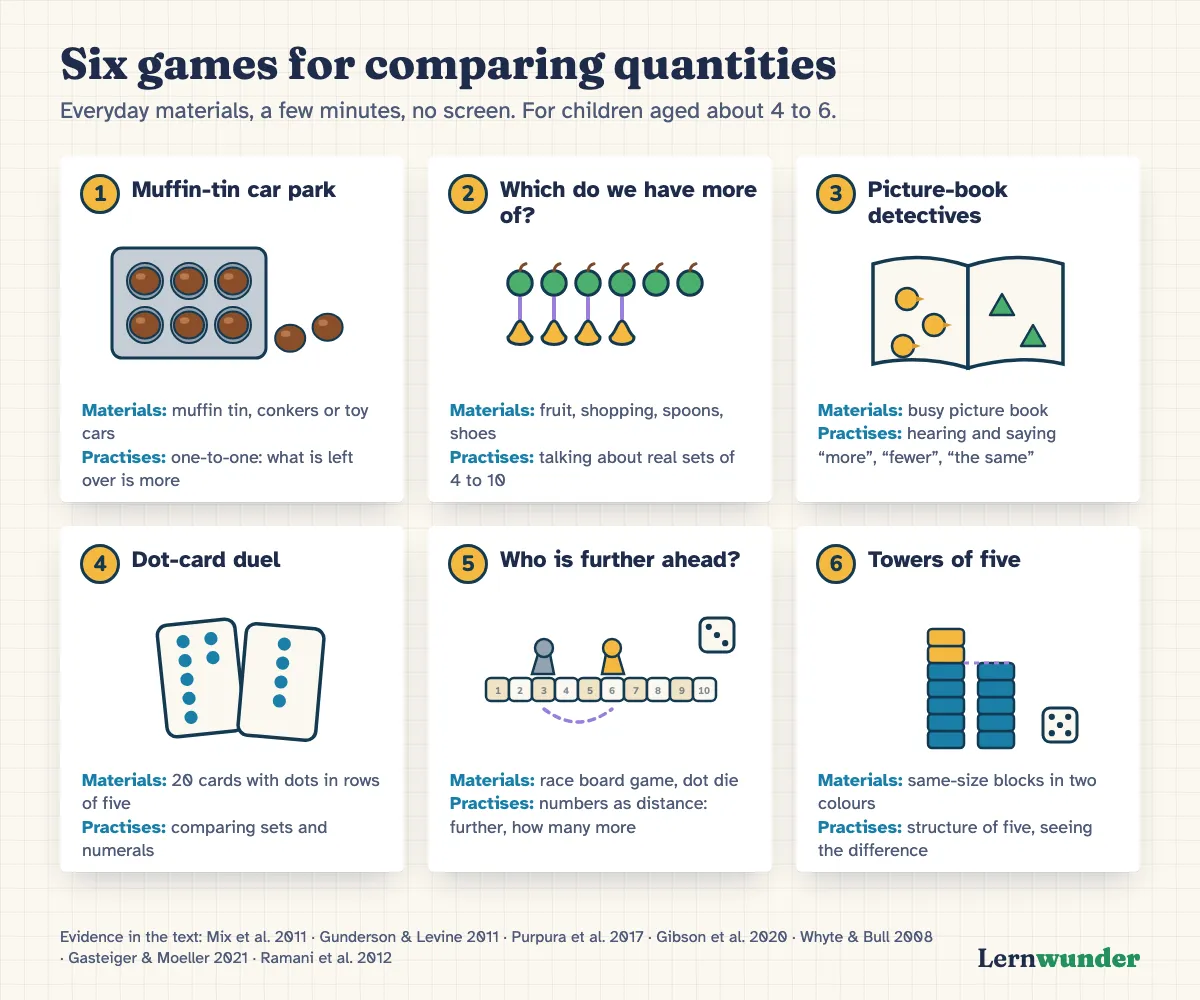
1. The muffin-tin car park
Materials: a muffin tin or egg box, plus conkers, nuts, toy cars or buttons.
How to play: Each hole is a parking space, and each car needs exactly one. Give your child a handful and ask first: “Are there enough spaces?” Then they park. Cars left over mean too few spaces. Empty holes mean fewer cars than spaces.
Language: “There are more cars than spaces. Two cars have nowhere to park.”
Easier / harder: Start with six holes. Later use two different containers, for example five conkers in the tin and five blocks in a row: “Are these the same number, even though they are different things?”
Why it works: In one study, three-year-olds were given toys to take home. One group also got a container that invites one-to-one matching, such as balls and a muffin tin. The other group got the same number of loose objects. Afterwards, the children with containers did much better on a difficult number-matching task, while the others stayed at chance (Mix, Moore & Holcomb, 2011). The container does most of the pairing for them.
2. Which do we have more of?
Materials: whatever is around: shopping being unpacked, fruit in the bowl, spoons in the drawer, shoes in the hall.
How to play: More a habit than a game. While unpacking, put six apples and four pears side by side: “Which do we have more of? How many more?” Your child can count, pair them up or estimate.
Language: Count and label what is in front of you: “One, two, three, four, five, six. Six apples. And four pears. Six is more than four.”
Easier / harder: Start with small sets. For confident children, choose sets between four and ten and ask about the difference.
Why it works: In a longitudinal study, not all parent number talk was related to children’s later number knowledge. What mattered most was counting and labelling sets of objects that were present and visible. Talk about sets of four to ten, too many to keep track of at a glance, was the strongest predictor, even after accounting for family background (Gunderson & Levine, 2011).
3. Picture-book detectives
Materials: a busy picture book, or any picture book with lots of characters.
How to play: While reading, ask comparison questions now and then: “Are there more ducks or more frogs here?” Let your child point and answer, then ask: “How can you tell?”
Language: Use “fewer” and “the same” on purpose, not just “more”. Many children understand “less” and “fewer” later than “more”, as described in More, less or the same?.
Easier / harder: Start with sets up to three. Confident children get bigger sets and the question: “How many more frogs would need to come so there are the same number?”
Why it works: In a study with 47 children in Head Start preschool classes, half received eight weeks of dialogic reading with a deliberate focus on quantity and spatial words. Afterwards they knew more of those words and also did better on a general maths assessment than the comparison group (Purpura et al., 2017). In another experiment, parents read number books with their children every day for four weeks. Books with small sets of one to three were especially effective for two- to four-year-olds, while children who were further along also benefited from sets of four to six (Gibson, Gunderson & Levine, 2020).
4. Dot-card duel
Materials: 20 cardboard cards, two each with 1 to 10 dots. Draw the dots in rows of five, like a ten frame. Later, write the numeral on the back.
How to play: Deal the cards. Both players turn one over at the same time. Whoever has more dots says the whole sentence (“I have more than you”) and takes both cards. If they match, everyone calls “The same!” and the next cards decide.
Language: The other player says their sentence too: “I have fewer than you.”
Easier / harder: Use only cards up to five. Later, play numeral side up and turn the cards over if there is a dispute: the dots decide.
Why it works: In a study with children around four years old, card games that involved comparing sets and linking dot patterns to numerals improved some basic number skills. They did not, however, help children judge where a number belongs on a line. Only a board game with numbers in a row did that (Whyte & Bull, 2008). That is why game 5 belongs with the cards.
5. Who is further ahead?
Materials: any classic race board game with a track and a dot die. Or draw your own: ten squares in a row, numbered 1 to 10.
How to play: Play as usual, but after each move ask: “Who is further ahead? How many squares until you catch me up?” Count on aloud from your own square when you move.
Language: “You are three squares further than me.” “I haven’t got as far.”
Easier / harder: A short track of ten squares and a die that only goes to three (cover the 4, 5 and 6). Later, two dice and the question of who gets further with their roll.
Why it works: A study with four- to six-year-olds shows that you do not even need a special game. Children who played conventional board games with ordinary dot dice for seven 30-minute sessions improved more than children using colour or symbol dice, in counting and in recognising and using structures. The advantage for structures was still measurable a year later (Gasteiger & Moeller, 2021). It works in nursery groups too: after playing a number board game in small groups, preschoolers compared numbers better (Ramani, Siegler & Hitti, 2012).
6. Towers of five
Materials: building blocks of the same size in two colours, such as stacking bricks or wooden blocks.
How to play: Each child builds a tower with as many blocks as the die shows. The rule: after five blocks, the colour changes. Then stand the towers side by side: “Which is taller? How many blocks more?”
Language: “My tower is five and two, so seven. Yours is five. Mine has two more.”
Easier / harder: One die at first, later two and towers up to ten. Extra: lay the same blocks out once as a tower and once spread far apart. Are there more now? The length of a loose row can fool you, the height of same-size blocks cannot.
Why it works: With same-size blocks, height and number match, and the colour change at five makes amounts readable at a glance. Why this structure helps is explained in our article on the power of five. The board-game study with dot dice also shows that children learn to use such structures through play (Gasteiger & Moeller, 2021).
How often and for how long?
Little and often. The studies above used sessions of 25 to 30 minutes over a few weeks; in everyday life, a few minutes is enough. What matters more is the talk: “How can you tell?” If your child gets it wrong, lay the sets side by side together. The pairs show the answer.
And the app?
Number Pirates (Mengenpiraten in German) works on the same three building blocks. On the first island, lines join the pairs of coins so children can see which have no partner. The three comparison sentences are read aloud, and the Word chest plays them at any time. On Misty Island the coins disappear after three seconds, and children compare from memory. The app does not replace the games here; it adds to them. How it began is told in A pirate island for comparing quantities.
Frequently asked questions
What age are these games for? The muffin tin and picture-book questions from about three; the studies on them worked with two- to four-year-olds. Dot cards, board games and towers suit children from about four or five.
My child always counts everything instead of pairing. Is that wrong? No. Counting is a good strategy. Show pairing as well, so your child sees that both lead to the same answer.
What if my child keeps mixing up “fewer” and “more”? That is common in the preschool years. Use “fewer” and “less” often and in whole sentences, including for the player with fewer dots in the card duel. The games support the basics; they do not replace an assessment or specialist support.
Sources
- Gasteiger, H. & Moeller, K. (2021). Fostering early numerical competencies by playing conventional board games. Journal of Experimental Child Psychology, 204, 105060. https://doi.org/10.1016/j.jecp.2020.105060
- Gibson, D. J., Gunderson, E. A. & Levine, S. C. (2020). Causal effects of parent number talk on preschoolers’ number knowledge. Child Development, 91(6), e1162–e1177. https://doi.org/10.1111/cdev.13423
- Gunderson, E. A. & Levine, S. C. (2011). Some types of parent number talk count more than others: Relations between parents’ input and children’s cardinal-number knowledge. Developmental Science, 14(5), 1021–1032. https://doi.org/10.1111/j.1467-7687.2011.01050.x
- Mix, K. S., Moore, J. A. & Holcomb, E. (2011). One-to-one play promotes numerical equivalence concepts. Journal of Cognition and Development, 12(4), 463–480. https://doi.org/10.1080/15248372.2011.554928
- Purpura, D. J., Napoli, A. R., Wehrspann, E. A. & Gold, Z. S. (2017). Causal connections between mathematical language and mathematical knowledge: A dialogic reading intervention. Journal of Research on Educational Effectiveness, 10(1), 116–137. https://doi.org/10.1080/19345747.2016.1204639
- Ramani, G. B., Siegler, R. S. & Hitti, A. (2012). Taking it to the classroom: Number board games as a small group learning activity. Journal of Educational Psychology, 104(3), 661–672. https://doi.org/10.1037/a0028995
- Whyte, J. C. & Bull, R. (2008). Number games, magnitude representation, and basic number skills in preschoolers. Developmental Psychology, 44(2), 588–596. https://doi.org/10.1037/0012-1649.44.2.588
Lernwunder editorial team · Chaolan Lu