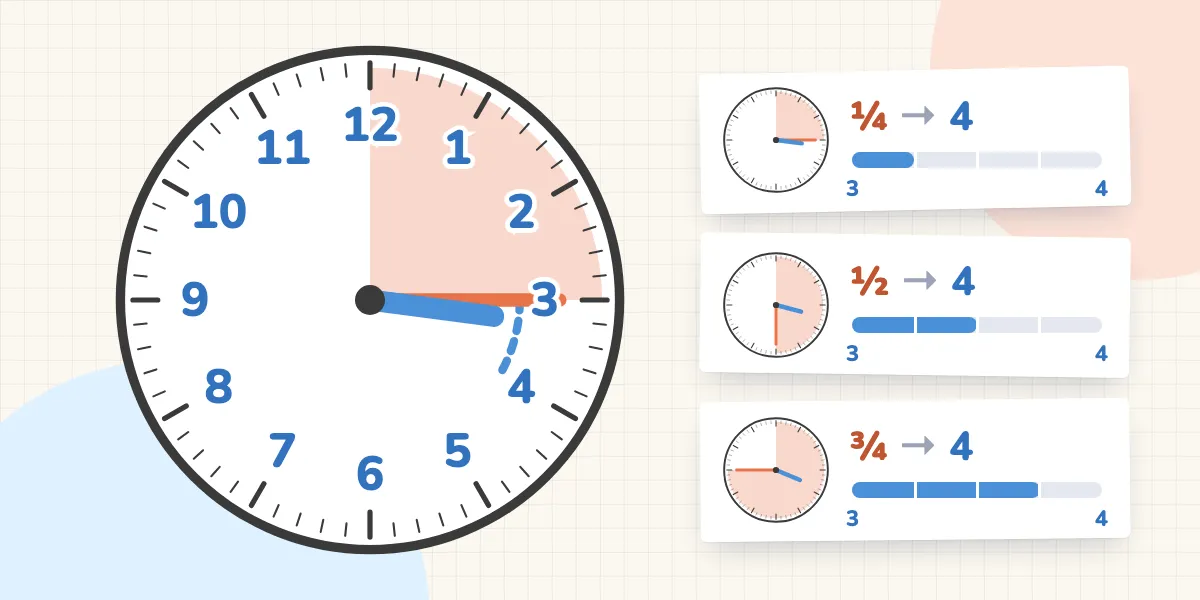
Short answer: English names the quarter hours from the hour that has started: “quarter past three”, then “quarter to four”. Many German speakers do the same (“Viertel nach drei”), but in eastern Germany, parts of the south and Austria people count towards the next hour: 3:15 is “Viertel vier”, literally “quarter four”, and 3:45 is “dreiviertel vier”, “three-quarter four”. For children, the safest route is to learn one form first and hear early on that the other means the same.
A made-up but typical scene: a family moves from Manchester to Dresden. The father learnt German at school and says “Viertel nach drei” for 3:15. At the nursery, the staff say “Viertel vier”. Their daughter, five years old, comes home convinced that pick-up is at four.
In our article on half past three and “halb vier” we touched on regional forms only briefly. Here we look at them properly: how English names the quarters, which German forms exist, where you hear them and what families can do with that.
How does English name the quarter hours?
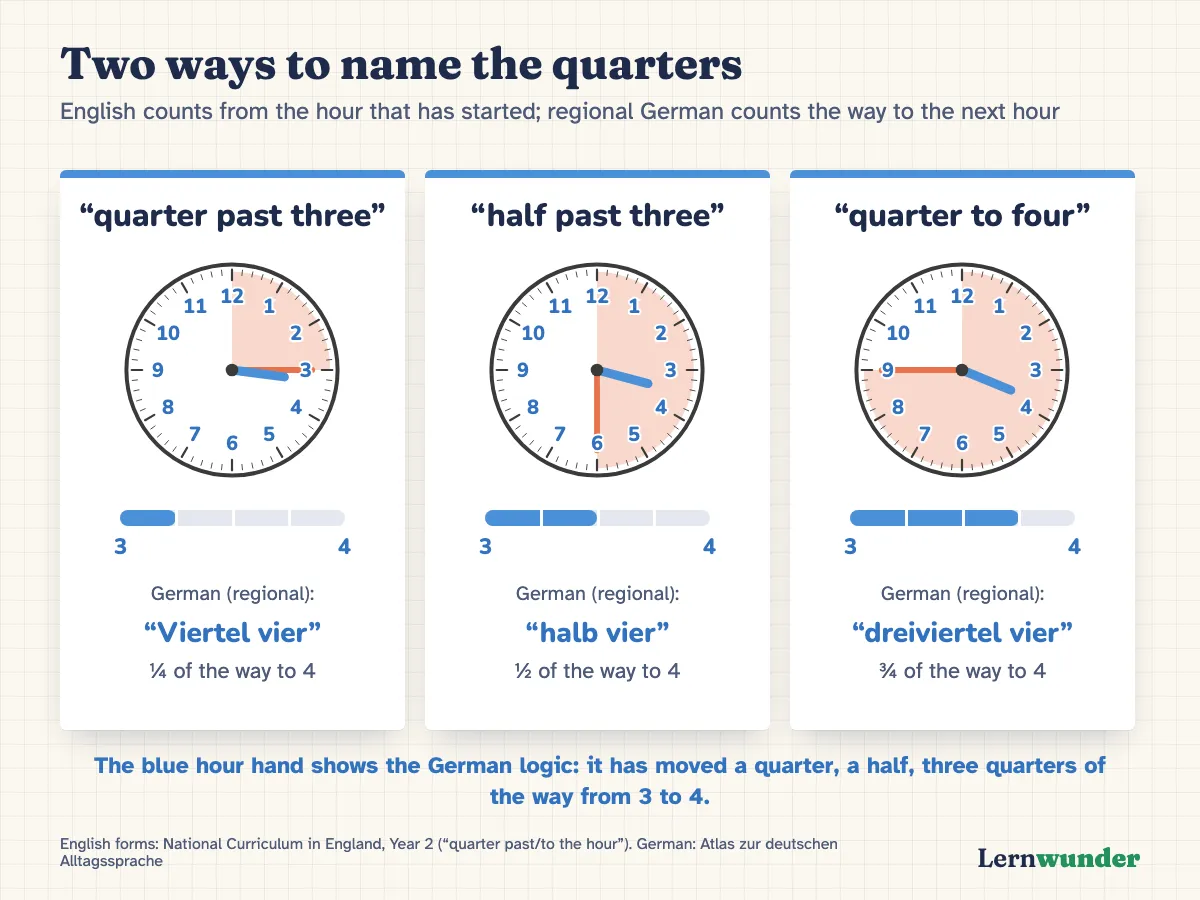
English counts from the hour that has started until the half hour, then towards the next one: “quarter past three” (3:15), “half past three” (3:30), “quarter to four” (3:45). The minutes follow the same pattern, “twenty past three” and then “twenty to four”.
In England this language is written into the curriculum. In Year 1, children learn to tell the time “to the hour and half past the hour”, first using o’clock and then half past. In Year 2 they tell the time to five minutes, “including quarter past/to the hour” (Department for Education, 2013).
The US Common Core standards do not prescribe these words at all. In Grade 2, children should “tell and write time from analog and digital clocks to the nearest five minutes, using a.m. and p.m.” (National Governors Association Center for Best Practices & Council of Chief State School Officers, 2010). Which words families use alongside, “quarter past” or “quarter after”, is left open.
What does “Viertel vier” mean?
“Viertel vier” means a quarter of the way to four has gone: it is 3:15. The logic is the same as in “halb vier” (3:30, half of the way to four), and “dreiviertel vier” continues it: three quarters of the way, 3:45.
This system is consistent in its own way. All three names give the coming hour and say how much of the way there is done. You can see it on the clock by watching the short hand: at 3:15 it has moved a quarter of the way from 3 to 4, at 3:30 half, at 3:45 three quarters.
Where do German speakers say what?
The best source is the Atlas zur deutschen Alltagssprache, an online survey that maps how people say everyday things in their area.
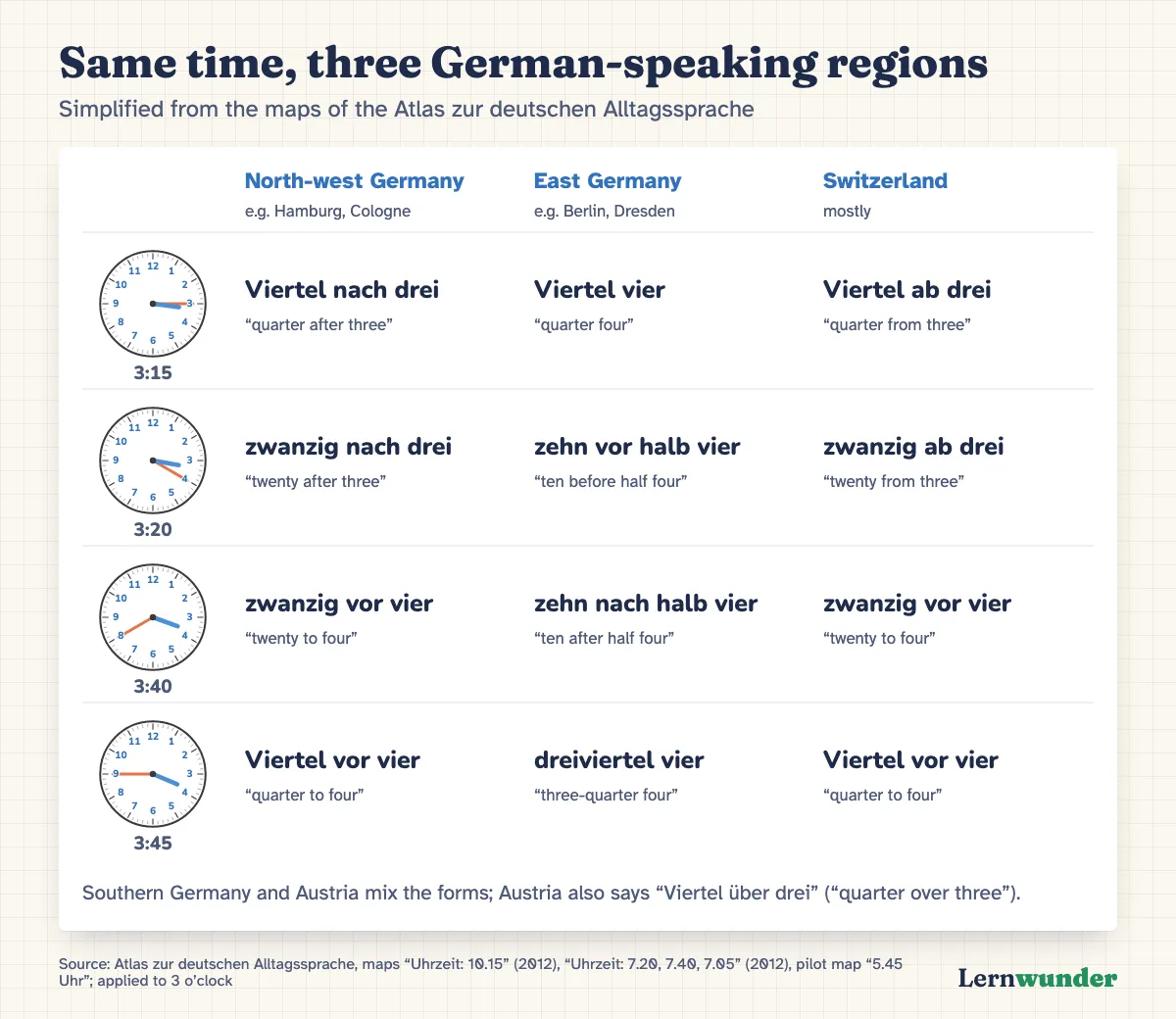
3:15. On the map for 10:15, “Viertel nach zehn” (quarter after ten) dominates in north-west and south-east Germany, for example in Hamburg, Cologne and Munich. “Viertel elf” (quarter eleven) is used in a broad belt in between, including Berlin, Dresden, Erfurt, Nuremberg and Stuttgart, and in eastern Austria and Carinthia. Austria also has “Viertel über zehn” (quarter over ten). Switzerland mostly says “Viertel ab zehn” (quarter from ten), while the canton of Bern keeps “Viertel nach” (Atlas zur deutschen Alltagssprache, map “Uhrzeit: 10.15”).
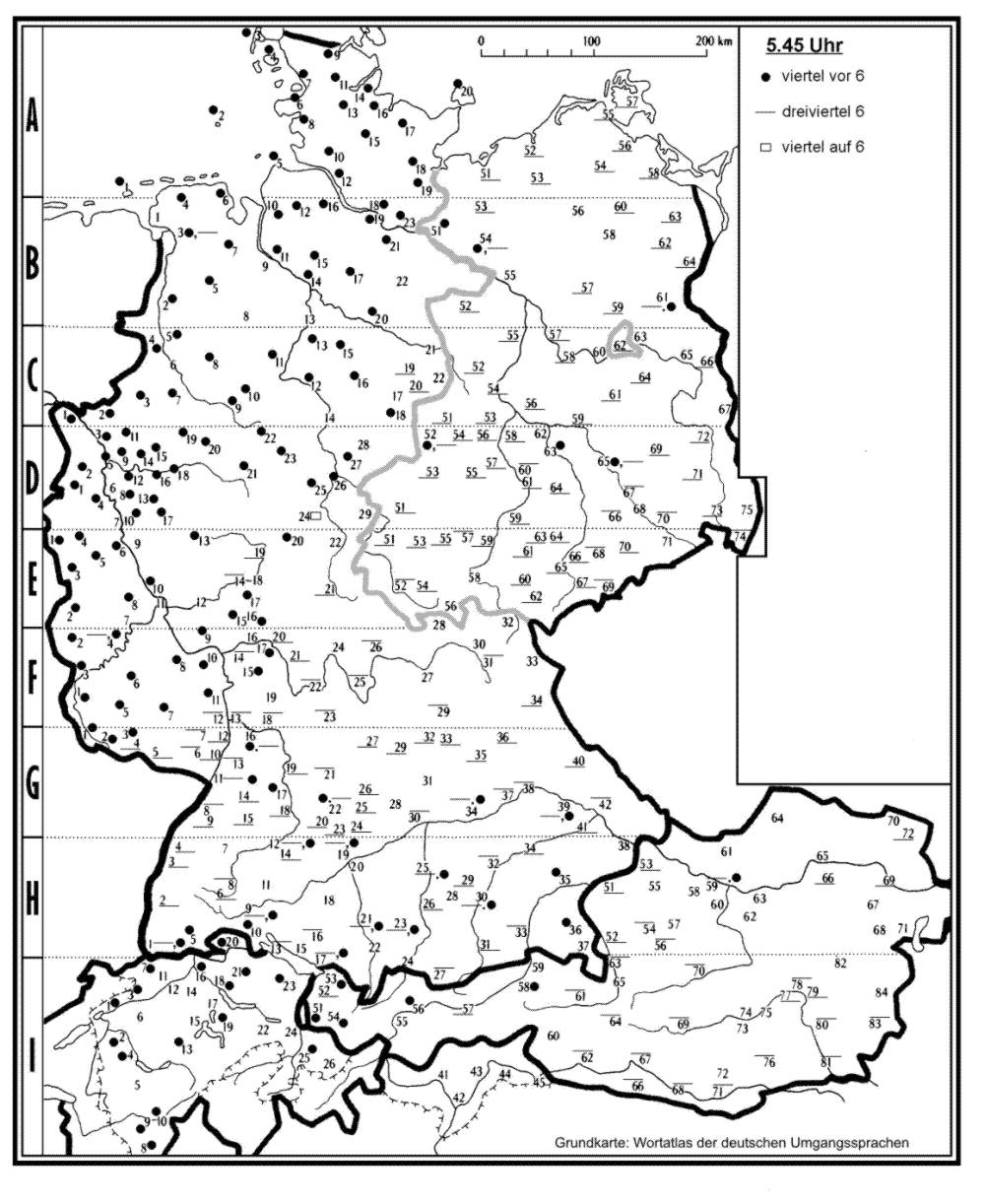
3:45. A pilot map for 5:45 shows a similar picture: “dreiviertel sechs” dominates in eastern Germany, much of the south and Austria, “Viertel vor sechs” (quarter to six) in the north and west (Atlas zur deutschen Alltagssprache, map “5.45 Uhr”).
3:20 and 3:40. Where people say “zehn vor halb acht” (ten before half eight) for 7:20, they mostly say “zehn nach halb acht” (ten after half eight) for 7:40. Where they say “zwanzig nach sieben”, they continue with “zwanzig vor acht”, just like English. The atlas concludes that the difference is not simply about counting forwards: what matters is whether the half hour serves as a reference point (Atlas zur deutschen Alltagssprache, map “Uhrzeit: 7.20, 7.40, 7.05”).
The atlas also compared its 10:15 map with a survey from the 1970s. The regional pattern has stayed broadly the same, but “Viertel elf” has become less common overall (Atlas zur deutschen Alltagssprache, map “Uhrzeit: 10.15”).
What does this mean for children?
Children use time words long before they know exactly what they mean. In one study of words such as minute, hour and day, even preschoolers knew that an hour is longer than a minute, but many only learnt how long it actually lasts years later, often once they had been taught a definition. The authors suggest that children first work out the meaning of these words from how they are used in conversation (Tillman & Barner, 2015).
For telling the time, we think this means: the form a child learns first depends on what it hears at home and at school. We have not found a study that compares how children learn the clock with “Viertel vier” versus “Viertel nach drei”, or with “quarter past” versus “quarter after”. We expect two stumbling blocks, though:
- Two names for one time. If home says one thing and school another, a child needs to hear that both mean the same. Otherwise one of them sounds like a mistake.
- The wrong hour. For bilingual English-German families, “Viertel vier” names the four while the short hand is still close to the three. It is the same trap as “halb vier” versus “half past three”, a quarter of an hour earlier.
What you can do
- One form first. Start with the form your child hears most. Add the second once the first is secure.
- Say early that both exist. “Grandma says quarter after, your teacher says quarter past. Both mean 3:15.” Then neither form becomes a mistake.
- Ask at school. Find out which words are used in class and use them at home as well.
- Show the quarters. Divide the face of a home-made learning clock into four quarters with two lines. Shade one quarter for quarter past, three for quarter to.
- Watch the short hand. At quarter past three it sits just after the 3. Ask: “Where is it on its way to?”
- For bilingual families: name the trap. “Viertel vier” is 3:15, not 4:15, just as “halb vier” is 3:30. Say it out loud once, then practise with the clock.
How we solved it in Tinu Time
In Tinu Time, families choose when they set up a child’s profile how the app names the quarter hours. In English the choice is “quarter past” or “quarter after”, in German “Viertel nach drei” or “Viertel vier”. In English, “quarter past” is preselected. The choice can be changed for each profile at any time in the settings.
With “quarter after”, the tasks say “quarter after three” and “twenty-five after three”. “Half past” and “quarter to” stay the same in both settings. At launch, the choice applied to the lesson tasks. Since version 1.2 it also applies to the mastery test, the daily challenge and the placement test, and the voice speaks the chosen form: we recorded the differing times specially for this.
Two limits, honestly stated. The explanations at the quarter-hour stage introduce “quarter past” and “quarter to”, so a child who practises with “quarter after” hears the explanation in the standard form. And the app does not offer forms such as “half three” or “quarter of”; for the casual British “half three”, see our half past article.
Why hours are blue and minutes orange in the app is explained in Blue for hours, orange for minutes. Tinu Time does not replace a diagnostic assessment or learning therapy.
Frequently asked questions
Is “quarter after” wrong? No. It means the same time as “quarter past”; some families say one, some the other. What matters is that your child understands both.
What does “Viertel vier” mean? It is a regional German form for 3:15: a quarter of the way to four. “Dreiviertel vier” is 3:45.
Which form should my child learn first? The one it hears every day. Later it should understand the others too.
Does Tinu Time offer the Swiss or Austrian forms? No. In German, the app offers “Viertel nach drei” and “Viertel vier”.
More about the app on the Tinu Time page.
Sources
- Atlas zur deutschen Alltagssprache (AdA). Map “Uhrzeit: 10.15” (round 7, post of 24 January 2012). https://www.atlas-alltagssprache.de/runde-7/f11e/
- Atlas zur deutschen Alltagssprache (AdA). Map “5.45 Uhr” (pilot map, embedded in the 10.15 post, May 2012). https://www.atlas-alltagssprache.de/wp-content/uploads/2012/05/17_45.jpg
- Atlas zur deutschen Alltagssprache (AdA). Map “Uhrzeit: 7.20, 7.40, 7.05” (post of 20 December 2012). https://www.atlas-alltagssprache.de/uhrzeit/
- Department for Education (2013, updated 2021). National curriculum in England: mathematics programmes of study. https://www.gov.uk/government/publications/national-curriculum-in-england-mathematics-programmes-of-study
- National Governors Association Center for Best Practices & Council of Chief State School Officers (2010). Common Core State Standards for Mathematics, Grade 2, Measurement and Data (2.MD.C.7). https://www.thecorestandards.org/Math/Content/2/MD/
- Tillman, K. A. & Barner, D. (2015). Learning the language of time: Children’s acquisition of duration words. Cognitive Psychology, 78, 57–77. https://doi.org/10.1016/j.cogpsych.2015.03.001
Lernwunder editorial team · Chaolan Lu