In short: For internationally educated nurses, the preceptor is often their most important language teacher, even if nobody calls it that. Studies show that new colleagues often say “yes” when they have not fully understood, ask others to check their written notes, and find phone calls and speaking up hard. Fixed routines help: check understanding with a teach-back instead of “Got it?”, agree on one person who reads notes over, and practise phone calls, questions and speaking up on purpose.
A scene many preceptors will recognise (it is made up): your new colleague from Manila has been shadowing you for three days. Clinically she is confident; she worked on a surgical ward for years. You explain that Mrs K. should be mobilised after lunch, but only with two people and only after her pain medication. You ask: “All clear?” She nods and says “Yes”. An hour later she is alone with Mrs K. at the edge of the bed.
What happened? Probably not carelessness but a language problem that is easy to miss during orientation. We described the first weeks as a whole, and what helps teams in general, in Arriving on the ward. This article is about the role that passes on the most language: the preceptor.
Why do new colleagues say “yes” when they are unsure?
An interview study from Norway asked 14 nurses, seven with Norwegian as their first language and seven with Norwegian as a second language. Both groups described the same pattern: people who are not yet confident in the language often agree even when they have not quite understood, because they worry about admitting it. Misunderstandings were common, for example about which kind of medication packaging was meant. Participants saw them as a risk to patient safety and wanted clear communication routines (Moi et al., 2026).
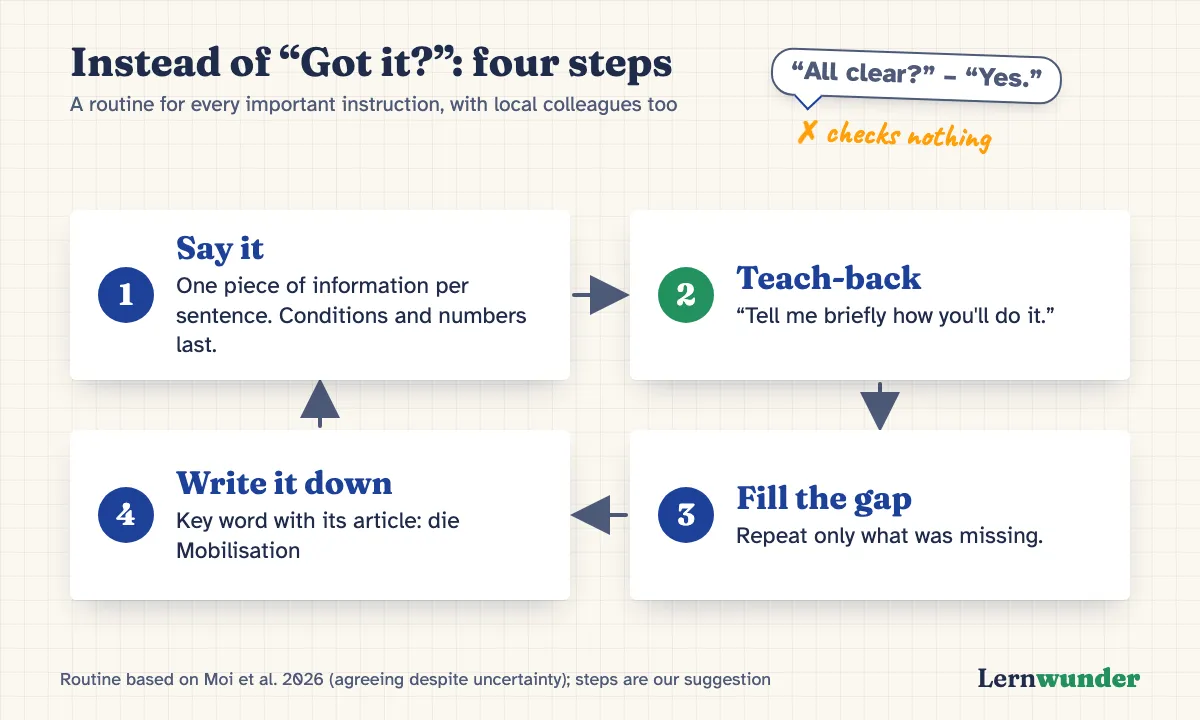
So the problem is not only understanding but showing that you have not understood. A question like “Got it?” invites a polite “yes”. It checks nothing.
Where does language get in the way most?
The same study points to two places preceptors should watch:
- Writing. Nurses with Norwegian as a second language often asked a colleague to read over their documentation, usually whoever happened to be sitting next to them. Reading long reports took longer and details were missed more easily (Moi et al., 2026).
- The phone. Without faces and gestures, cues are missing. Nuances got lost on the phone especially easily; one participant preferred to pass on important information in person (Moi et al., 2026).
An observational study in an Australian hospital followed 13 internationally educated nurses for twelve weeks. Conversations with doctors and colleagues were hampered mainly by hesitancy, a lack of assertiveness and few strategies for handling unclear or rude responses. Relaxed small talk with laughter happened with colleagues from the same background, but rarely with local colleagues (Philip et al., 2019). Educators in bridging programmes had earlier described nurses keeping the hierarchies between professions they knew from home, and finding rapport-building talk with patients difficult (Philip et al., 2015).
For precepting, this means vocabulary is only part of it. Asking, speaking up, phoning and small talk matter at least as much, and none of that is in a dictionary.
What does research say about good support?
A systematic review published this year looked at 20 studies on how employers support internationally educated nurses from non-English-speaking backgrounds. It identified nine approaches, including support from peers on the ward, a buddy or mentor system with one day-to-day contact person, orientation tailored to international nurses, and targeted support for language and communication (Connolly et al., 2026).
The authors are candid: none of the studies tested individual strategies experimentally. What we know comes from interviews and surveys (Connolly et al., 2026). A review of quantitative studies paints a similar picture: social and organisational support go along with successful integration, discrimination works against it (Joensuu et al., 2024). The tips below are therefore reasoned practice, not tested programmes.
What you can do
- Teach-back instead of “Got it?”. After every important instruction, ask: “Tell me briefly how you’ll do it.” Only add what is missing. Say why you do it: it is routine, not mistrust.
- One piece of information per sentence. Three short sentences beat one with “but only if … and not before …”. Put conditions and numbers at the end, where they get stressed. Speak slowly, but in normal language, not baby talk.
- One fixed person for reading notes over. Agree who checks documentation during the first weeks, so your new colleague does not have to ask someone different every day. Go through recurring phrases once, properly.
- Prepare phone calls. Rehearse the three most common calls on your ward (lab, doctor, relatives) once in the staff room. A small prompt card by the phone helps: who is calling, about whom, what is happening, what do I need?
- Practise speaking up. Give explicit phrases: “I’m not sure, can you come with me?”, “Stop, I need to check this first.”, “Doctor, may I ask something?”. Make clear that this is welcome on your ward.
- Small talk is work. Invite your colleague into conversations during breaks and explain the idioms everyone laughs at. That builds the contact with local colleagues that Philip et al. (2019) rarely observed.
- Put language goals in the orientation plan. Next to clinical goals, add one language goal per week, for example “Week 2: report vital signs by phone”. A suggestion is shown below.
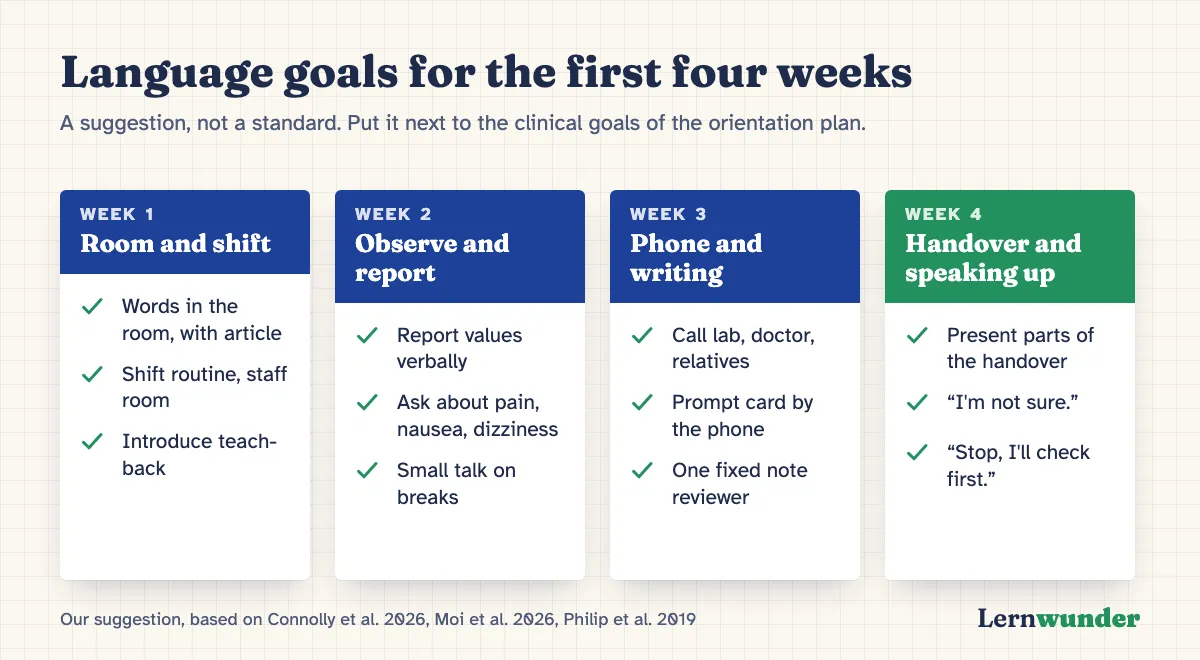
The four-week plan is our suggestion, not a research standard. Adapt it to your ward and your colleague. Anyone who phones confidently after one week can skip that step.
How PflegeMate can help
PflegeMate is a language learning aid for the German words and sentences of everyday ward work. Two things are useful for precepting: every term comes in three sentences, one for the patient, one for a colleague and one for the doctor, which matches the idea in One word, three sentences. And since version 2.1 in August, the app speaks every word with its article and spells out abbreviations the way they are said on the ward.
You could use it for the words of the week: you point out what is in the patient room, your colleague listens to the words again in the evening. The app does not replace your support. PflegeMate does not prepare for exams and gives no clinical instructions. More on the PflegeMate page.
Frequently asked questions
Isn’t it rude to ask someone to repeat back what I said? Not if it applies to everyone and you explain it. In the Norwegian study, both groups wanted clear routines precisely because misunderstandings were common (Moi et al., 2026). You can use teach-back with local colleagues too, so it never feels like a test.
Should I speak more slowly or more simply? More slowly and in clearer chunks, yes. Dropping words or using broken grammar (“you patient wash”) is not a good idea, because then your colleague does not hear the language she needs on the ward. That is our view, not a research finding.
What if my new colleague knows more clinically than I do? That happens. Language support does not mean re-teaching nursing. Ask about her experience and let her explain procedures in German. That practises the language and makes her expertise visible.
How long until ward language feels natural? It varies a lot with prior knowledge, the ward and the support available. We have not found reliable figures. More important than a date is that the language goals keep growing.
Sources
- Connolly, C., Mcdonald, J., Unger, L., Williams, D., Cains, G. & Laver, K. (2026). Strategies to support Internationally Educated Nurses from non-English speaking backgrounds transition into the Western healthcare workforce: a systematic review. BMC Nursing, 25, 591. https://doi.org/10.1186/s12912-026-04654-4
- Joensuu, R., Suleiman, K., Koskenranta, M., Kuivila, H., Oikarainen, A., Juntunen, J., Goh, Y. S., Liaw, S. Y. & Mikkonen, K. (2024). Factors associated with the integration of culturally and linguistically diverse nurses into healthcare organisations: A systematic review of quantitative studies. Journal of Nursing Management, 2024, 5887450. https://doi.org/10.1155/2024/5887450
- Moi, E. B., Skisland, A. V., Johannessen, B., Haraldstad, K., Rohde, G. & Flateland, S. (2026). Communication and interaction between native-speaker Norwegian nurses and nurses with Norwegian as a second language in home-based care settings: a qualitative exploratory interpretive study. BMC Nursing, 25, 677. https://doi.org/10.1186/s12912-026-04834-2
- Philip, S., Manias, E. & Woodward-Kron, R. (2015). Nursing educator perspectives of overseas qualified nurses’ intercultural clinical communication: barriers, enablers and engagement strategies. Journal of Clinical Nursing, 24(17–18), 2628–2637. https://doi.org/10.1111/jocn.12879
- Philip, S., Woodward-Kron, R. & Manias, E. (2019). Overseas qualified nurses’ communication with other nurses and health professionals: An observational study. Journal of Clinical Nursing, 28(19–20), 3505–3521. https://doi.org/10.1111/jocn.14942
Lernwunder editorial team · Chaolan Lu