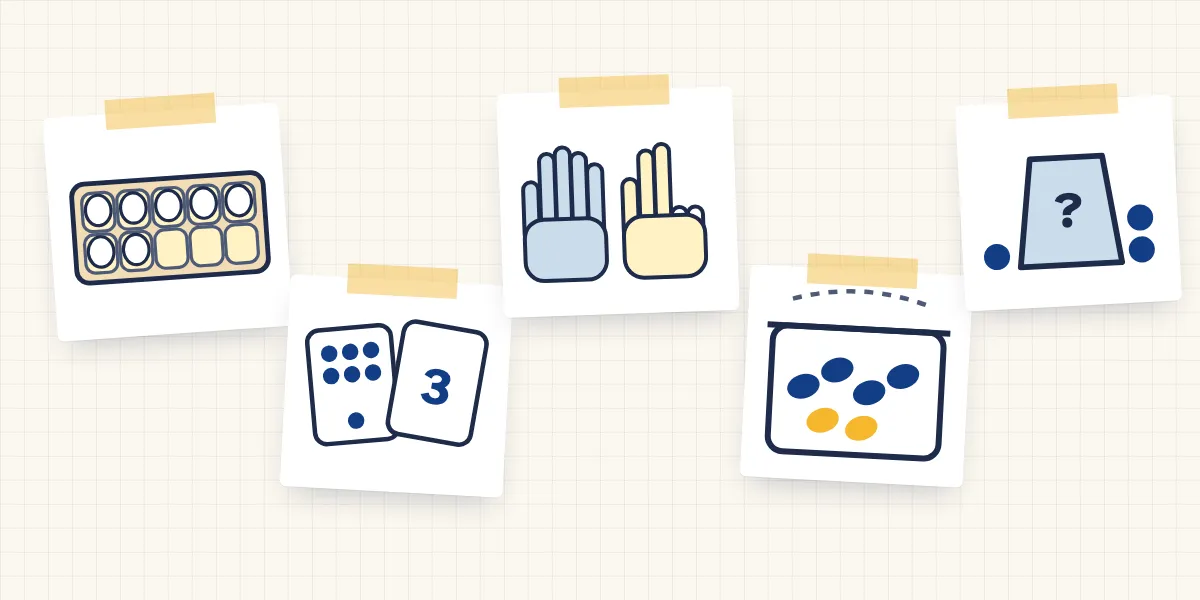
In short: Number bonds mean seeing that a number is made of two parts, such as 7 from 5 and 2. They are easy to practise at home with everyday things: beans, a cup, fingers, an egg box, cards, a home-made board and the dinner table are all you need. Short, frequent rounds work best, where children see quantities, find parts and talk about how they got there.
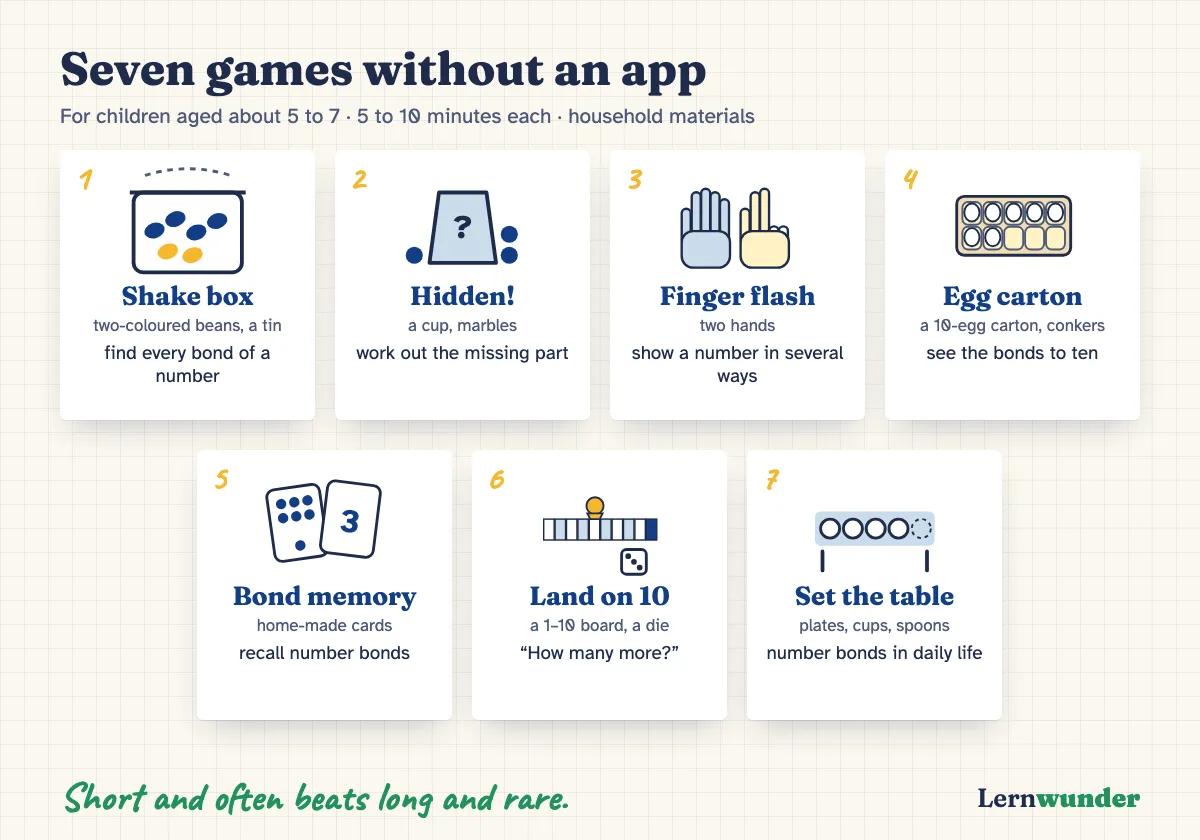
December is a time for games. Maybe you’re wondering: how can I help my child learn to calculate without it feeling like homework? Good news: number bonds don’t need a worksheet. Here are seven games we recommend for children aged about five to seven, each with a short explanation from research.
Why number bonds matter so much is covered in our main article on number decomposition. This post is about practice.
Why play instead of drill?
Play isn’t a trick to disguise practice. In a study of 183 families, informal number play at home, such as games with numbers, was linked a year later to children’s arithmetic with quantities. Formal practice such as working on sums was more closely linked to knowledge of digits and the number system. Parents’ own enjoyment of numbers mattered too (Skwarchuk, Sowinski & LeFevre, 2014). Both have their place, and your attitude counts.
1. The shake box
You need: a tin with a lid and seven beans painted on one side (or buttons in two colours).
How to play: Shake hard, tip out, look: “Five coloured and two plain. Seven is five and two.” Every round gives a new number bond. Write down what you find as a list or as little number houses. After a few rounds ask: “Have we found them all?”
Why it works: Children discover all the bonds of a number and notice that the whole stays the same however the parts fall. In an experiment with five- and six-year-olds, success at adding by decomposing was linked to exactly this knowledge of part-part-whole relations for numbers up to 10 (Cheng, 2012).
2. Hidden!
You need: a cup and seven marbles or nuts.
How to play: Count the seven marbles together. Your child closes their eyes while you hide some under the cup. “Three are outside. How many are hidden?” Then check. Later, swap roles.
Why it works: The child has to work out the missing part instead of counting everything. This kind of calculating with parts rather than counting can be fostered even before school (Cheng, 2012).
3. Finger flash
You need: two hands.
How to play: You call out a number; your child shows it on their fingers as fast as possible. Then: “Can you show seven another way?” Five and two, four and three … Or the other way round: you flash some fingers briefly and your child names the number without counting.
Why it works: In a training study with 328 kindergarteners, finger counting training clearly improved addition (Poletti et al., 2025). Another study with six- and seven-year-olds found the biggest benefit when finger exercises were combined with games that show numbers in different ways (Jay & Betenson, 2017). The aim is a full hand as “five”, not counting each finger.
4. The egg box ten frame
You need: a box for ten eggs, plus conkers, walnuts or ping-pong balls.
How to play: Put in, say, seven conkers, filling the top row first. “How many cups are empty?” Your child sees: five on top, two below, three free. Seven and three make ten.
Why it works: From first grade, children take in grouped quantities faster than unstructured ones, and this advantage is linked to arithmetic fluency (Starkey & McCandliss, 2014). The egg box delivers the structure of five for free. More in our post on the power of five.
5. Bond memory
You need: 18 home-made cards: nine with the numbers 1 to 9, nine with the matching partner to 10 as a dot picture.
How to play: Like pairs, except a pair makes ten together: the 7 and the card with three dots. Whoever finds a pair says the sentence: “Seven and three make ten.” For younger children, play with the bonds of a smaller number, such as 6.
Why it works: This game is about recall, and memorising is allowed: in a large study of 877 second graders, memory-focused practice with number pairs brought greater gains than purely conceptual practice in almost every achievement group (Östergren et al., 2023). The dot picture keeps the quantity in view.
6. Land on 10
You need: a home-made board with squares 1 to 10 in a row, a die, a counter for each player.
How to play: Take turns to roll and move. The winner is whoever lands exactly on 10. Before each roll, ask: “How many more do you need to get to 10?” Roll too much and you stay put. If needed, stick the numbers 1 to 3 on the die.
Why it works: Board games with a numbered row measurably improve number sense. In one study with preschoolers from low-income families, about an hour of play led to gains in counting, comparing numbers, number line estimation and recognising numerals that were still there nine weeks later. Children who played the same game with coloured instead of numbered squares did not improve (Ramani & Siegler, 2008). The question “How many more to 10?” is our own addition: it turns a counting game into a number bond game.
7. Set the table
You need: whatever is going on the table anyway.
How to play: “There are six of us. Four plates are out, how many are missing?” Or while tidying up: “Eight spoons, five are in the drawer, where are the others?”
Why it works: Numbers in everyday life are part of the home learning environment that is linked to number skills (Skwarchuk et al., 2014). And they show your child, in passing, that number bonds are genuinely useful.
How often should we play?
Short and often. Spaced practice has been shown in classrooms with third graders too, with an advantage after one week that was no longer reliably detectable after six weeks in that age group (Barzagar Nazari & Ebersbach, 2019). Five to ten minutes on several days beats one long session at the weekend. Stop while it’s still fun.
And if your child gets it wrong: ask how they got there and let them lay out the answer themselves. Why we never treat mistakes as a flaw is explained in our post Why mistakes in our apps are never red.
And the app?
If your child wants to practise alone now and then, our app Zahlzerlegung (German only) can help. It doesn’t replace the games above, though. Touching, hiding and talking about parts together is something no screen can do.
Frequently asked questions
What age are these games for? From about five. For younger children, start with small numbers up to 5; for school children, go up to 10.
My child counts everything in every game. Is that wrong? No, counting is a normal step along the way. Help with structure: “Can you see the full row? That’s five.” More in our post on counting-based calculation.
Which game is best to start with? The shake box: it needs hardly any materials, every result is correct, and it shows all the bonds of a number.
How long until my child knows their number bonds by heart? That varies a lot. How deriving and practice work together is covered in our post Number bonds to 10.
Sources
- Barzagar Nazari, K. & Ebersbach, M. (2019). Distributing mathematical practice of third and seventh graders: Applicability of the spacing effect in the classroom. Applied Cognitive Psychology, 33(2), 288–298. https://doi.org/10.1002/acp.3485
- Cheng, Z.-J. (2012). Teaching young children decomposition strategies to solve addition problems: An experimental study. The Journal of Mathematical Behavior, 31(1), 29–47. https://doi.org/10.1016/j.jmathb.2011.09.002
- Jay, T. & Betenson, J. (2017). Mathematics at your fingertips: Testing a finger training intervention to improve quantitative skills. Frontiers in Education, 2, 22. https://doi.org/10.3389/feduc.2017.00022
- Östergren, R., Träff, U., Elofsson, J., Hesser, H. & Samuelsson, J. (2023). Memorization versus conceptual practice with number combinations: Their effects on second graders with different types of mathematical learning difficulties. Scandinavian Journal of Educational Research, 68(6), 1155–1170. https://doi.org/10.1080/00313831.2023.2211983
- Poletti, C., Krenger, M., Létang, M., Hennequin, B. & Thevenot, C. (2025). Finger counting training enhances addition performance in kindergarteners. Child Development, 96(1), 251–268. https://doi.org/10.1111/cdev.14146
- Ramani, G. B. & Siegler, R. S. (2008). Promoting broad and stable improvements in low-income children’s numerical knowledge through playing number board games. Child Development, 79(2), 375–394. https://doi.org/10.1111/j.1467-8624.2007.01131.x
- Skwarchuk, S.-L., Sowinski, C. & LeFevre, J.-A. (2014). Formal and informal home learning activities in relation to children’s early numeracy and literacy skills: The development of a home numeracy model. Journal of Experimental Child Psychology, 121, 63–84. https://doi.org/10.1016/j.jecp.2013.11.006
- Starkey, G. S. & McCandliss, B. D. (2014). The emergence of “groupitizing” in children’s numerical cognition. Journal of Experimental Child Psychology, 126, 120–137. https://doi.org/10.1016/j.jecp.2014.03.006
Lernwunder editorial team · Chaolan Lu