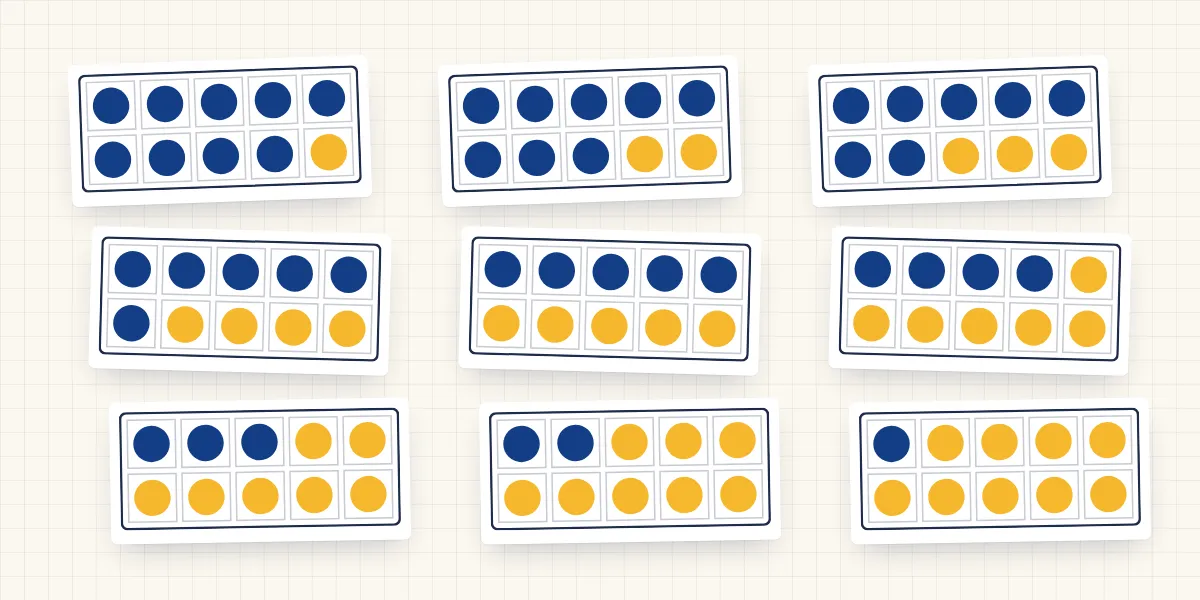
In short: Number bonds are pairs of numbers that make a given total, such as 7 and 3 for 10. By the end of primary school, children should know them by heart. But research shows that children who derive number bonds from facts they already know are later more likely to recall them directly. Understanding and practice work best together, spread over many short sessions.
In many Year 1 classrooms they are called “friends of ten” or “rainbow facts”: 1 and 9, 2 and 8, 3 and 7, and so on. Some children can soon recite the list like a poem. And yet the same child starts counting on their fingers when asked “6 and how many make 10?”. How does that fit together?
What are number bonds, and why do they matter so much?
Number bonds (sometimes called part-whole facts) describe how a number can be split into two parts: 7 is 5 and 2, 4 and 3, 6 and 1. The bonds to 10 are especially important because they carry calculation across ten later on: a child who knows that 8 and 2 make ten can work out 8 + 5 as 8 + 2 + 3. Why splitting numbers is so fundamental is explained in our main article on number decomposition.
The German national education standards are clear: children should know the basic mental facts, explicitly including number bonds, “by heart” and derive their inverses reliably (KMK, 2022). So the goal really is instant recall. The question is how to get there.
Is it enough to memorise number bonds?
A study from California gives a sobering answer. There, first graders were expected to memorise basic addition and subtraction facts especially early. Even in the highest-performing schools, fewer than 11 percent of children progressed at the pace the standard required. Several teaching practices were actually negatively related to recall, including heavy reliance on the textbook (Henry & Brown, 2008).
That does not mean memorising is bad. A large Swedish study of 877 second graders compared two kinds of practice: one focused on memory and speed, one focused on understanding. Memorisation practice produced greater gains in almost every group, explicitly including children with maths difficulties. Only the highest achievers did not benefit more from it (Östergren et al., 2023).
Taken together, the picture is clear: practising until facts stick makes sense. But setting a target and relying on rote drill alone leaves many children short of it.
What does deriving number bonds achieve?
Deriving means working out an unknown fact from a known one: “5 + 5 is 10. For 6 + 4, one moves from one side to the other, so that’s 10 too.”
Michael Gaidoschik followed 139 first graders in Austria through a school year. One key finding: children who derived a fact in the middle of the year were significantly more likely to recall that very fact from memory by the end of the year than children who were still counting it at mid-year. Remarkably, the classes studied did not teach deriving systematically at all (Gaidoschik, 2012).

Deriving can also be taught deliberately. In an experiment with five- and six-year-olds, children were taught to use decomposition as a strategy and relied less on counting as a result. How well that worked was linked to their knowledge of the part-part-whole relations of the numbers 1 to 10 (Cheng, 2012). Understanding is not the opponent of recall; it is its foundation.
How often and how long should children practise?
One of the best-established findings in learning research is that spaced practice beats massed practice. A meta-analysis of 317 experiments shows that material is retained longer when practice sessions are spread out over time. Most of these studies used memory tasks (Cepeda et al., 2006).
For primary maths the evidence is thinner. In a classroom study, third graders practised either three times in one day or once a day on three days. Spacing gave an advantage after one week; after six weeks it was no longer clearly detectable. In seventh graders it lasted longer (Barzagar Nazari & Ebersbach, 2019). So the direction holds for young children too, but the effect is more modest.
What you can do
- See first, then know. Show number bonds in a ten frame, for example an egg box with ten cups: seven conkers in, how many cups are empty?
- Make deriving audible. “You know 5 + 5. So what’s 6 + 4?” Praise the route, not just the answer.
- Use turnaround facts. 3 + 7 and 7 + 3 are the same bond. That halves the work.
- Short and often. Five minutes on four days beats twenty minutes on one.
- Flashcards in three piles. Known cards move on a pile and come up less often; shaky ones stay at the front. That way you practise what isn’t secure yet.
- Check recall playfully. “I say 4, you say …?” If your child still counts, go back to the picture, not to pressure.
And in Zahlzerlegung?
Our app Zahlzerlegung (German only) practises the number bonds of 4 to 10 on the same principle as the three piles, with four learning levels. A bond placed quickly and correctly moves up a level. After a mistake it starts again at the bottom. Bonds on the lower levels come up more often in every round; mastered ones only now and then as a check. What “quickly” means here, and why the app doesn’t rush children, is described in our post Recall, not counting.
The app doesn’t handle understanding on its own. Every number appears with a quantity picture so that the parts stay visible. Talking about deriving, though, remains a job for adults.
Frequently asked questions
Should my child memorise number bonds at all? Yes; in the end they should be instantly available (KMK, 2022). The route there works better when the child understands what they are learning and can derive it.
My child still counts to find the bonds to 10. Is that a problem? No, getting there is a process. The standards describe what should be secure by the end of primary school (KMK, 2022). If a child is still counting in the first school year, it’s worth showing them ways to derive facts: derived facts were later recalled more often (Gaidoschik, 2012).
Does speed practice help? Yes, once understanding is in place. Memory and speed practice led to good gains in a large study, including for children who struggle (Östergren et al., 2023). It should never create pressure or fear.
How much practice in one go makes sense? A few minutes, more often. Spaced practice is well supported (Cepeda et al., 2006), though the effect is smaller in younger children than in older ones.
Sources
- Barzagar Nazari, K. & Ebersbach, M. (2019). Distributing mathematical practice of third and seventh graders: Applicability of the spacing effect in the classroom. Applied Cognitive Psychology, 33(2), 288–298. https://doi.org/10.1002/acp.3485
- Cepeda, N. J., Pashler, H., Vul, E., Wixted, J. T. & Rohrer, D. (2006). Distributed practice in verbal recall tasks: A review and quantitative synthesis. Psychological Bulletin, 132(3), 354–380. https://doi.org/10.1037/0033-2909.132.3.354
- Cheng, Z.-J. (2012). Teaching young children decomposition strategies to solve addition problems: An experimental study. The Journal of Mathematical Behavior, 31(1), 29–47. https://doi.org/10.1016/j.jmathb.2011.09.002
- Gaidoschik, M. (2012). First-graders’ development of calculation strategies: How deriving facts helps automatize facts. Journal für Mathematik-Didaktik, 33(2), 287–315. https://doi.org/10.1007/s13138-012-0038-6
- Henry, V. J. & Brown, R. S. (2008). First-grade basic facts: An investigation into teaching and learning of an accelerated, high-demand memorization standard. Journal for Research in Mathematics Education, 39(2), 153–183. https://www.jstor.org/stable/30034895
- Kultusministerkonferenz (2022). Bildungsstandards für das Fach Mathematik Primarbereich [National education standards for primary mathematics] (resolution of 15 Oct 2004, as amended 23 Jun 2022). https://www.kmk.org/fileadmin/Dateien/veroeffentlichungen_beschluesse/2022/2022_06_23-Bista-Primarbereich-Mathe.pdf
- Östergren, R., Träff, U., Elofsson, J., Hesser, H. & Samuelsson, J. (2023). Memorization versus conceptual practice with number combinations: Their effects on second graders with different types of mathematical learning difficulties. Scandinavian Journal of Educational Research, 68(6), 1155–1170. https://doi.org/10.1080/00313831.2023.2211983
Lernwunder editorial team · Chaolan Lu