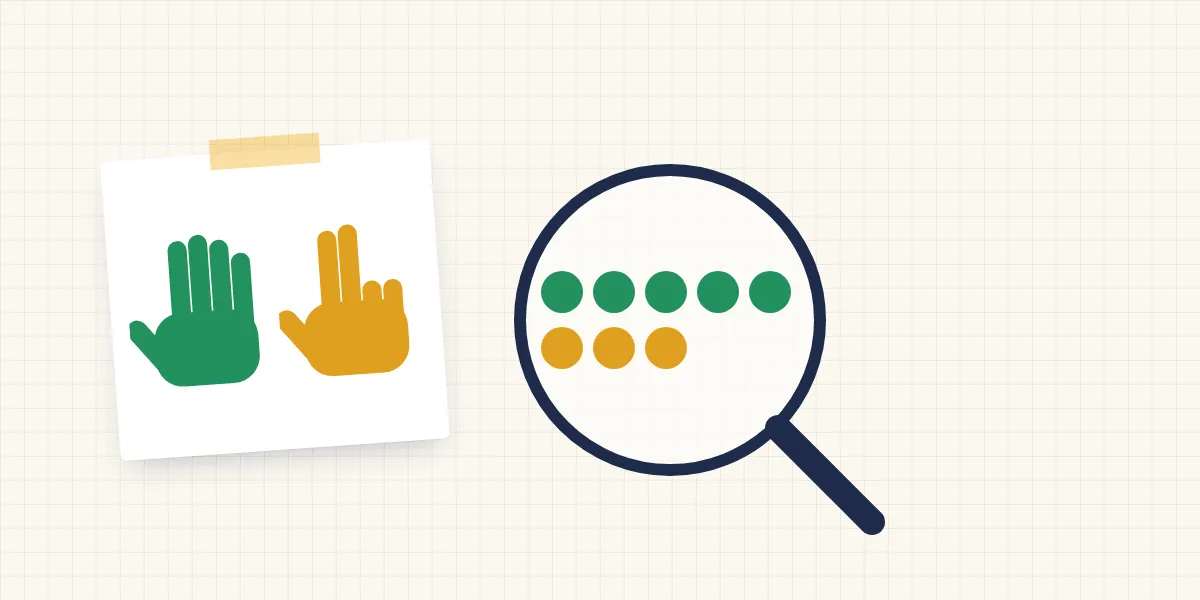
In short: In the first two years of school, maths difficulties show less in single mistakes than in patterns that last for months: a child keeps counting out simple, well-practised sums on their fingers, struggles to link numbers with quantities, or cannot take in small amounts at a glance. Dyscalculia affects roughly 3 to 7 percent of children and can only be diagnosed by specialists. Looking early pays off: targeted support works.
A scene we made up, but one many parents will recognise: the end of first grade. For 7 + 2, Ben holds up seven fingers, then two more, and counts all nine one by one. For 9 − 1 the same, only backwards. His mother wonders: is this still normal, or should we do something?
This article helps you put things in perspective. It does not replace a diagnosis. If you are worried, your child’s teacher is the first person to talk to.
Maths difficulties, dyscalculia: what is what?
Maths difficulties is a broad term. It means that a child finds learning to calculate much harder than others do, for whatever reason: missed lessons, too little practice, anxiety, language, or a genuine learning disorder.
Dyscalculia (in German Rechenstörung) is narrower. It means marked, persistent problems with basic arithmetic and with recalling number facts that cannot be explained by low intelligence or inadequate teaching. It affects about 3 to 7 percent of children (Haberstroh & Schulte-Körne, 2019); an earlier review puts it at around 5 percent of primary school children (Kaufmann & von Aster, 2012). It is diagnosed with a standardised test, the child’s history, a clinical examination and a look at the child’s wider situation, not from a single test at school (Haberstroh & Schulte-Körne, 2019). We will look at the terms in more detail in a later article.
What are the signs in first and second grade?
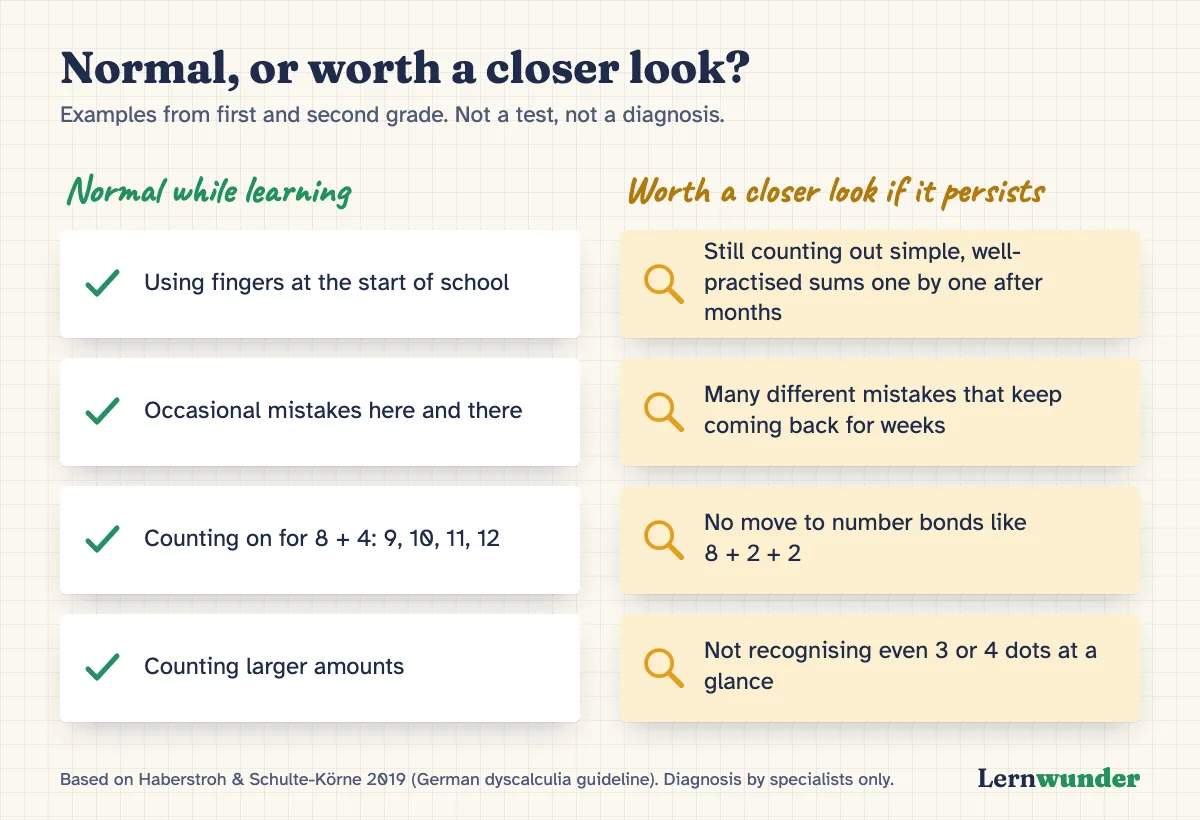
The German clinical guideline on dyscalculia, summarised by Haberstroh and Schulte-Körne (2019), lists typical features. For the first two years of school they translate like this:
- Numbers and quantities don’t connect. The digit 6 and six apples are two different things to the child. That two apples and one apple are the same as 2 + 1 remains unclear.
- Small amounts are always counted. Even three or four dots are not recognised at a glance (subitizing).
- Comparing is hard. Which is bigger, 7 or 9? Where does 8 go on a number line?
- Counting-based calculation persists. 8 + 4 is solved as “9, 10, 11, 12”, not as “8 + 2 + 2”. The move to strategies that don’t rely on counting doesn’t happen.
- Reading and writing numbers (number word, digit, quantity) is shaky, later also tens and ones.
Two points from the guideline summary matter to us most. First: finger counting in itself is not a sign of dyscalculia; it is a normal aid to learning. What stands out is persistent finger counting for easy, frequently practised sums. Second: it is not the fact that a child makes mistakes that matters, but how varied, persistent and frequent they are (Haberstroh & Schulte-Körne, 2019).
Are there signs before school starts?
Yes, but read them with care. A review lists features in kindergarten that can point to later difficulties: comparing numbers (which digit is bigger), how advanced counting strategies are, recognising numbers fluently and working memory. Almost all children with maths difficulties later struggle to recall simple facts like 6 + 3 quickly and accurately. At the same time, the review stresses: for many children, early difficulties are not stable over time (Gersten et al., 2005).
What makes the difference is persistence. In a large US study, children whose difficulties were present in both autumn and spring of kindergarten grew most slowly over the next five years. Children who had overcome their difficulties by spring grew faster than they did, though still a little more slowly than children with no difficulties at all (Morgan et al., 2009). One weak result is no reason to worry; lasting patterns are.
What really helps?
The good news first: support works. Across all studies analysed for the guideline, the average effect was d = 0.52, a medium effect. Support that targeted the specific maths content a child struggled with worked best (Haberstroh & Schulte-Körne, 2019). The guideline also recommends:
- starting early, in the first years of primary school,
- with trained specialists, ideally one-to-one,
- addressing related problems too, such as reading and spelling difficulties, attention problems or anxiety.
This matters because dyscalculia usually does not go away on its own without targeted help, and it often comes with anxiety and falling self-esteem (Kaufmann & von Aster, 2012). We described how closely anxiety and achievement are linked in our article on maths anxiety in children.
Who can I turn to?
- Your child’s class teacher. They see your child alongside the class and can judge whether the difficulties are unusual.
- Your paediatrician. Paediatricians play an important part in early recognition and can advise on next steps (Kaufmann & von Aster, 2012).
- Specialist assessment services, such as child and adolescent psychiatry or psychotherapy, or educational psychology services, depending on where you live. Standardised tests are available from the end of first grade (Haberstroh & Schulte-Körne, 2019).
What you can do
- Observe rather than test. Note over a few weeks how your child calculates: do they count everything, count on, or already use number bonds like 8 + 4 = 8 + 2 + 2?
- Ask how they thought about it. “How did you work that out?” reveals more than the answer.
- Practise seeing amounts. Show dice patterns, finger patterns and rows of dots briefly: “How many, without counting?”
- Break numbers apart. Why number bonds like 8 = 5 + 3 matter so much is explained in our article on number bonds.
- Protect self-esteem. Avoid labels like “hopeless at maths” and name progress, however small.
- Don’t wait if patterns persist. Talk to the school if little has changed after half a year.
Why this matters to us
Maths difficulties are often recognised late, and by then a child has collected many experiences of failure. We cannot replace a diagnosis or therapy. What interests us are the foundations that almost all the signs depend on: seeing amounts, breaking numbers apart, moving from counting to calculating. That is what we are working on.
Frequently asked questions
Does my child have dyscalculia if they still use their fingers? Not necessarily. Finger counting is a normal aid at first. It is worth a closer look if a child is still counting out simple, well-practised sums step by step after months (Haberstroh & Schulte-Körne, 2019).
When can dyscalculia be diagnosed? Standardised tests are available from the end of first grade. Specialists make the diagnosis using a test, the child’s history and an examination (Haberstroh & Schulte-Körne, 2019).
Will my child grow out of it? For many children, early difficulties are not lasting (Gersten et al., 2005). Genuine dyscalculia, however, usually does not improve without targeted support (Kaufmann & von Aster, 2012).
Can a learning app help with dyscalculia? An app can support practice, but it replaces neither assessment nor support from specialists. The guideline recommends targeted support from trained professionals.
Sources
- Gersten, R., Jordan, N. C. & Flojo, J. R. (2005). Early identification and interventions for students with mathematics difficulties. Journal of Learning Disabilities, 38(4), 293–304. https://doi.org/10.1177/00222194050380040301
- Haberstroh, S. & Schulte-Körne, G. (2019). The diagnosis and treatment of dyscalculia. Deutsches Ärzteblatt International, 116(7), 107–114. https://doi.org/10.3238/arztebl.2019.0107
- Kaufmann, L. & von Aster, M. (2012). The diagnosis and management of dyscalculia. Deutsches Ärzteblatt International, 109(45), 767–778. https://doi.org/10.3238/arztebl.2012.0767
- Morgan, P. L., Farkas, G. & Wu, Q. (2009). Five-year growth trajectories of kindergarten children with learning difficulties in mathematics. Journal of Learning Disabilities, 42(4), 306–321. https://doi.org/10.1177/0022219408331037
Lernwunder editorial team · Chaolan Lu