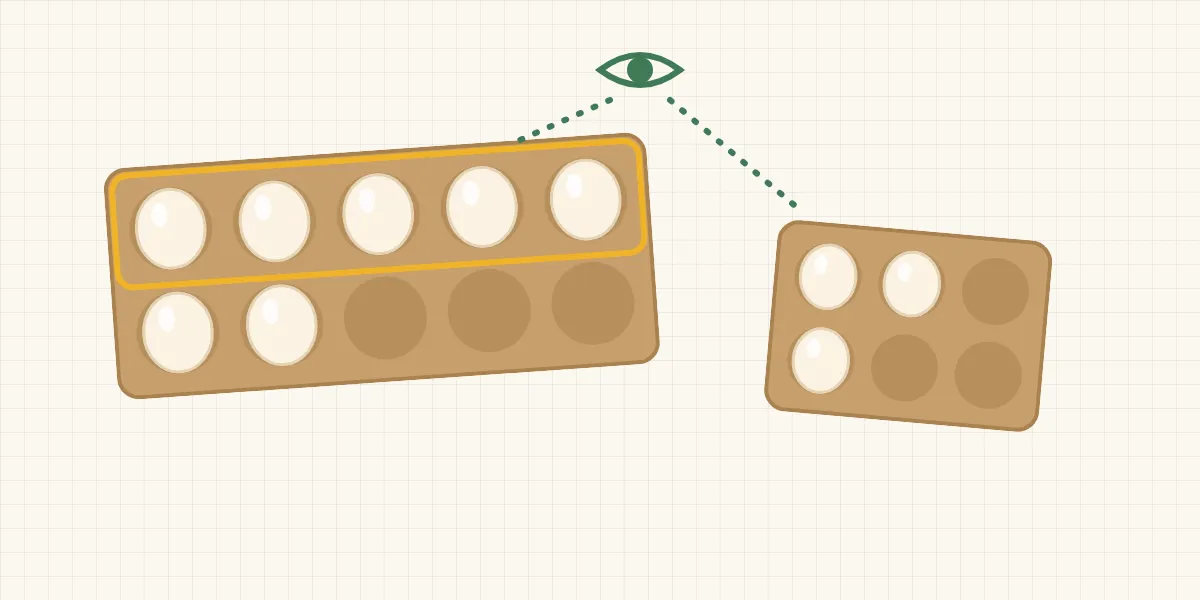
In short: Children recognise small amounts at a glance, without counting. This is called subitizing. In two-year-olds it usually reaches three; over the preschool years it grows to adult level. How quickly and reliably children take in small amounts is linked to their later arithmetic skills. Everyday materials such as an egg carton are a great way to practise.
A breakfast scene (made up, but typical): a four-year-old looks at the bread basket and says “three” straight away. With the strawberries on her plate, though, she touches each one: “one, two, three, four, five, six, seven.” Between those two moments lies an ability that matters surprisingly much for learning to calculate.
In our article on the power of five we described how adults and schoolchildren see larger amounts through fives and tens. Here we take a step back: how does the eye for small amounts develop in the first place, what does it reveal, and what can you do before and at the start of school?
What is subitizing?
Subitizing means recognising a small number of things at a glance, without counting. The word comes from the Latin for “suddenly”. Nobody counts the three dots on a dice; you simply see them.
Maths educators distinguish this from conceptual subitizing: a larger amount is split into small parts that are each recognised at a glance and then put together, such as six seen as two threes. That is already a little bit of arithmetic, and it builds on the first step.
When can children do it?
Earlier than many people think. In three experiments, Starkey and Cooper (1995) showed children aged two to five small sets for just 200 milliseconds, too short to count. The children still named the number reliably, whatever the arrangement. The ability was there before the children could count confidently.
What changes is the range. In the youngest children, subitizing reached three; in the older ones, five, which the researchers give as the adult range (Starkey & Cooper, 1995). Depending on the study and the task, the adult limit is sometimes put at four. In everyday terms: at three, three things are usually “obvious”, four or five not necessarily.

What does a quick glance say about later maths?
More than you would expect from such a simple skill.
- Before school. In a study of 78 children aged three and a half to almost five, efficiency at enumerating dots predicted how well they solved simple non-verbal addition and subtraction problems, even after accounting for working memory and impulse control. The group with the smallest subitizing range also showed weak addition skills (Gray & Reeve, 2014).
- Similar over the years. 159 children were tested seven times over six years. Three typical dot enumeration profiles emerged. The scores themselves changed considerably with age, but 69 percent of children stayed in the same group (Reeve et al., 2012).
Two caveats. First, these studies show associations, not causes: a child who takes in small amounts slowly will not necessarily struggle with maths. Second, “stable” here means that children’s positions relative to each other changed little, not that nobody improves. A slow glance is a reason to look more closely, not a diagnosis.
Does structure really help, or do children not even see it?
Teachers use structured materials from day one, such as the twenty frame: two rows of ten spaces, each row split into two fives. The assumption is that children use this structure instead of counting one by one.
Obersteiner and colleagues (2014) tested this with first graders. The children named amounts from 1 to 20 on a screen, once randomly scattered and once in a twenty frame. With scattered dots, the more dots there were, the longer children took and the more mistakes they made. In the twenty frame, this increase was barely visible: the children were using the structure. And those who were quick and accurate with the twenty frame also did better on an arithmetic test, even when other abilities were taken into account.
In our view this is good news with one condition: structure helps when the child sees it. That is why it is worth talking about the structure instead of just putting the material on the table.
Does it need practice, or does it come naturally?
Some of it comes naturally, but not equally for all children. Some children notice numbers in everyday life on their own; others pay more attention to colours or shapes. In a large study of 1,868 preschoolers in Germany, this spontaneous focusing on numerosity increased markedly between the ages of five and six. It was linked to early number skills, which in turn predicted arithmetic in second grade (Poltz et al., 2022). So the link with later arithmetic ran through number understanding, not directly.
For home, that means it is worth making amounts a casual topic in everyday life. Not as a quiz, but as an invitation to look.
What you can do at home or in class
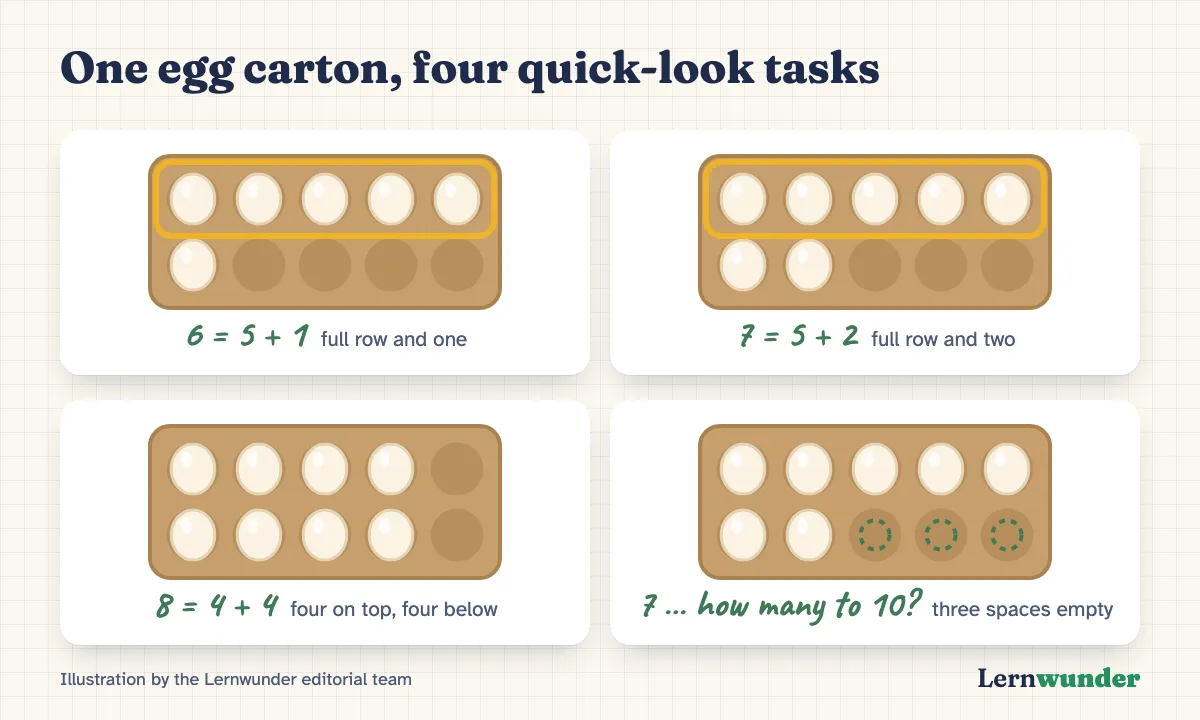
- Egg carton flash. Put marbles, pasta or cotton balls into a ten-egg carton (two rows of five), uncover it, say “and gone” and cover it again. For younger children, a six-egg carton with up to three balls is enough.
- “How did you see it?” After the answer, always ask for the way. “Five on top and two below” is a great answer, even if the number is occasionally wrong.
- Let them pack. The child places a number in the carton so that you can recognise it really quickly. Then swap roles. Structure becomes something the child makes.
- How many to ten? With seven balls in the ten-egg carton: “How many spaces are still empty?” This prepares number bonds to ten.
- Dice and fingers. Dice patterns up to three should be recognised without counting, later up to six. Finger patterns (“show me four without counting”) practise the same thing with their own hands.
- Numbers on the go. “How many ducks are sitting there?” “How many apples are left in the bowl?” Small amounts up to three or four, without pressure.
- Counting is allowed. If a child counts, that is not a mistake. Show the same amount again in an ordered way and let them notice the difference. Why children shouldn’t rely on counting forever is explained in our article on counting-based calculation.
A few minutes are enough, and it is best to stop while it is still fun.
Why this matters to us
We are working on a new app that is all about this kind of seeing: seeing amounts instead of counting them. More when it is ready. Until then, all you need is an empty egg carton and a handful of pasta.
Whether a child can already compare amounts, telling where there is more and where there is less, is the topic of another article: More, less, the same.
Frequently asked questions
How many things should my child recognise at a glance? In studies, two-year-olds usually recognise up to three things without counting. By the end of the preschool years, the range grows to four or five (Starkey & Cooper, 1995). Some children get there earlier, some later, and that is normal.
Is subitizing the same as the power of five? No. Subitizing is the foundation: seeing small amounts instantly. The power of five builds on it by organising larger amounts so that each part can again be seen at a glance.
My child still counts everything one by one. Should I be worried? At preschool age that is common. Offer structured amounts and ask how your child sees them. If a child in second grade still counts even small amounts one by one, it is worth talking to the teacher. No app or game replaces a proper assessment.
From what age can we play with the egg carton? With a six-egg carton and a few balls from about three. The ten-egg carton suits the last year of preschool and the start of school.
Sources
- Gray, S. A. & Reeve, R. A. (2014). Preschoolers’ dot enumeration abilities are markers of their arithmetic competence. PLoS ONE, 9(4), e94428. https://doi.org/10.1371/journal.pone.0094428
- Obersteiner, A., Reiss, K., Ufer, S., Luwel, K. & Verschaffel, L. (2014). Do first graders make efficient use of external number representations? The case of the twenty-frame. Cognition and Instruction, 32(4), 353–373. https://doi.org/10.1080/07370008.2014.948681
- Poltz, N., Quandte, S., Kohn, J., Kucian, K., Wyschkon, A., von Aster, M. & Esser, G. (2022). Does it count? Pre-school children’s spontaneous focusing on numerosity and their development of arithmetical skills at school. Brain Sciences, 12(3), 313. https://doi.org/10.3390/brainsci12030313
- Reeve, R., Reynolds, F., Humberstone, J. & Butterworth, B. (2012). Stability and change in markers of core numerical competencies. Journal of Experimental Psychology: General, 141(4), 649–666. https://doi.org/10.1037/a0027520
- Starkey, P. & Cooper, R. (1995). The development of subitizing in young children. British Journal of Developmental Psychology, 13(4), 399–420. https://doi.org/10.1111/j.2044-835X.1995.tb00688.x
Lernwunder editorial team · Chaolan Lu