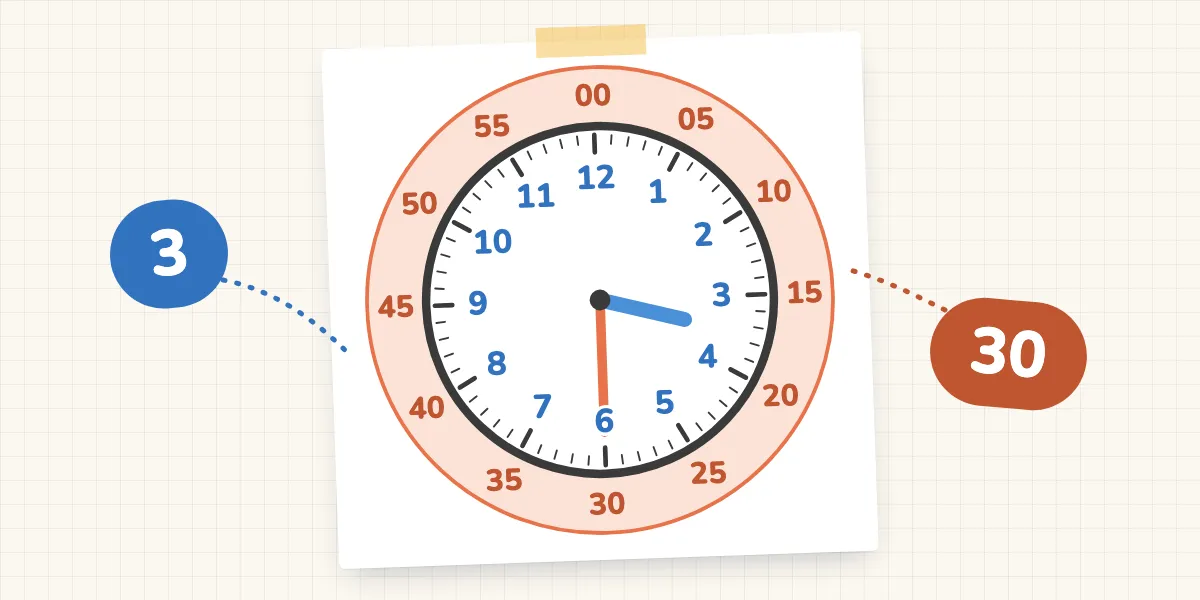
In short: The analogue clock is one of the densest symbol systems children meet in primary school. Two hands use the same twelve numbers with different meanings, minutes count to 60 instead of 100, the hour hand often sits between two numbers, and the language (“quarter to”, “half past”) has rules of its own. Studies show that children struggle at exactly these points, not because they are not trying hard enough.
An invented but typical scene: it is just before four. “What time is it?” a parent asks. The child studies the kitchen clock for a long time and then says firmly: “Four nine.” The child has seen everything that is on the clock: the short hand almost at the four, the long hand at the nine. Only the meaning is still missing. Quarter to four.
For adults, glancing at a clock is so automatic that it is easy to forget how much is packed into it. This post takes the analogue clock apart: which sub-skills does a child need, and where do children trip up most often?
What do children need to be able to do to tell the time?
Telling the time is not a single skill but a bundle. Friedman and Laycock (1989) name, among others, three building blocks: reading the display, transforming times (for example adding half an hour), and understanding what a time stands for in everyday life. In their study of 240 children from first to fifth grade, these building blocks developed at different speeds. A review therefore calls clock reading a key skill of primary school that mirrors how complex the concept of time is overall (Burny et al., 2009).
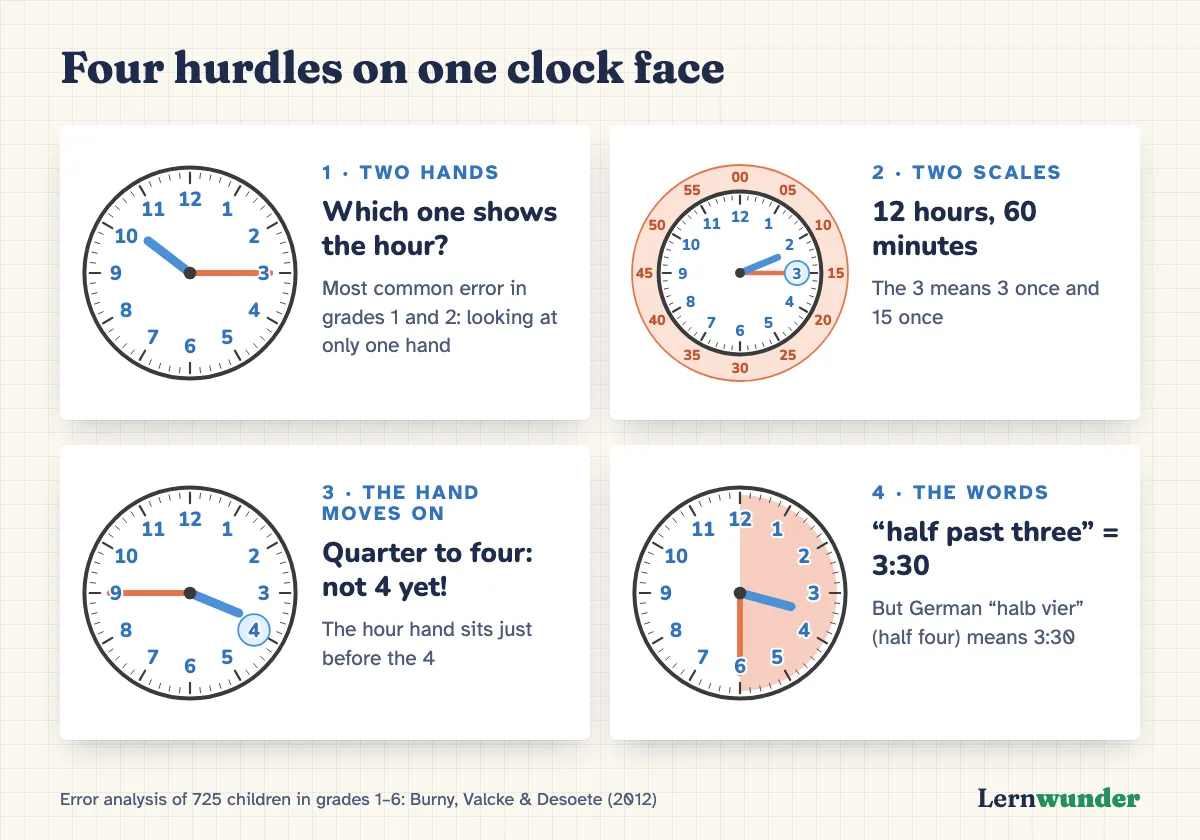
In practice, a child has to combine at least the following on an analogue clock:
- Telling the hands apart: short for the hour, long for the minutes.
- Reading two scales: hours from 1 to 12, minutes from 0 to 59, on the same clock face.
- Counting in fives: the number 4 means 20 for the minute hand.
- Understanding the movement: the hour hand creeps forward throughout the hour.
- Knowing the words: “quarter past”, “quarter to”, “half past”.
Why does one number on the clock have two meanings?
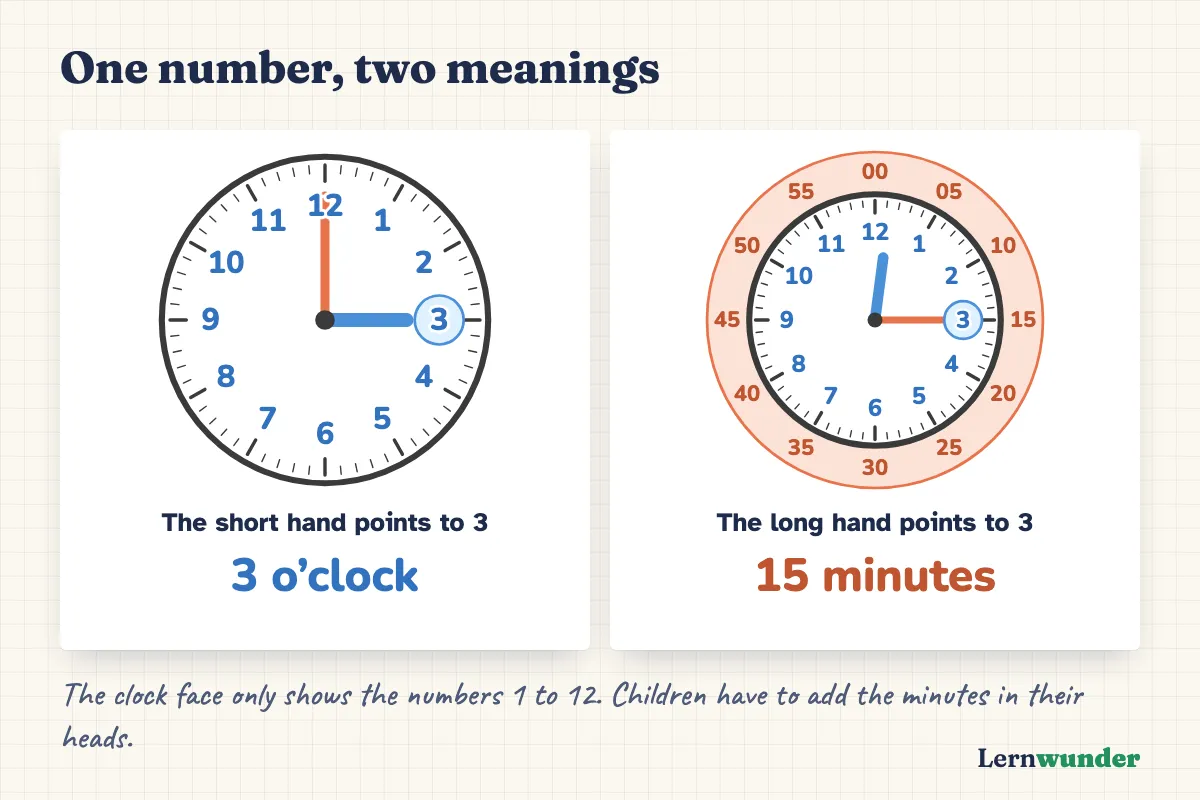
This may be the biggest hurdle. The clock face only shows the numbers 1 to 12. When the short hand points to 3, it is three o’clock. When the long hand points to 3, it is 15 minutes past. On most clocks the minute numbers are not printed at all, so children have to add them in their heads.
Burny, Valcke and Desoete (2012) give three reasons why numbers on a clock are so hard to interpret: the clock does not follow the base-ten system, the meaning of a number depends on which hand points at it, and reading it requires an understanding of clockwise movement.
What are the most common clock-reading mistakes?
The most detailed answer comes from a Flemish study of 725 children in grades 1 to 6 (Burny et al., 2012). The researchers did not just count correct answers; they classified every error by type:
- Looking at only one hand. In grade 1 this was the most common error (around 38 to 45 per cent of all errors), and it was still very frequent in grade 2. Children then say just “ten” instead of “quarter past ten”, or take both the hour and the minutes from the same hand.
- Misreading the numbers. Instead of “quarter past ten”, children write “three and ten”: they see the numbers but not what they mean. In first graders without maths difficulties this made up about a third of errors; after that it almost disappeared.
- The wrong reference point. For precise times, children count from “quarter to” rather than from the full hour. This error was common in grades 3 to 6.
- Miscounting. The more precise the time, the more often a minute or an hour is miscounted.
- Mixing up the hands, or “to” and “past”. Rarer on their own, more often combined with other errors.
Another finding: children with maths difficulties struggled more with the clock in almost every grade, especially with times to five minutes or one minute. That fits what clock reading demands: a mixture of recall (“the 4 means 20”) and procedures (counting on in fives).
Why is “quarter to four” harder than “four o’clock”?
Because the hour hand does not jump, it glides. At quarter to four it is already close to the 4. A child who has learned “the short hand shows the hour” will logically say “four”. That is exactly the kitchen scene.
Williams (2012) observed lessons on clock reading and describes how children need different mental pictures for full hours (“three o’clock”), relative times (“quarter past three”) and absolute times (“three fifteen”). According to his analysis, the order in which these pictures are learned explains the most common error in reading the hour, and also why children who seemed confident suddenly get it wrong again.
Why do the words make it harder?
English “half past three” names the hour that has already begun. Yet in parts of the UK people say “half four” for 4:30, while in German “halb vier” (literally “half four”) means 3:30, half of the way to four. Children who grow up between languages, or who hear several ways of speaking, have to sort this out. Add “quarter to” and “quarter past”, and children also need to know which half of the clock face counts forwards and which counts back.
We have not found a study on these ways of speaking that we could cite reliably. That language plays a role is shown, however, by the error type “mixing up to and past” mentioned above (Burny et al., 2012).
What you can do
- Start with one hand. Begin with a clock that only has the hour hand. “It’s about three” is a good start.
- Colour the hands. Put one coloured dot on the short hand of a toy clock and another on the long hand, and call them the “hour hand” and the “minute hand”.
- Make the minutes visible. Write the minutes 0, 5, 10 … 55 as a ring around the outside of the clock face. What a child can see, it does not have to keep in its head.
- Count in fives. Run a finger round the edge: “five, ten, fifteen …” This trains the step from 3 to 15.
- Watch the hour hand. Turn the minute hand once all the way round and look together at where the hour hand has moved.
- Explain “half past”, don’t just drill it. “Half past three means half of the hour after three is done.”
And importantly: expect setbacks. Children who had mastered one step often stumble again as soon as a new one is added (Williams, 2012).
Why this matters to us
We are currently thinking about what an app would need to look like to take children through these hurdles one at a time: first one hand, then the second, then the language. Before building such an app, we wanted to understand why telling the time is so hard in the first place. This post is the result. Many of the ideas match what we have already learned for our maths apps: make structure visible and replace counting-based calculation with understanding.
Frequently asked questions
Is it normal if my child still can’t tell the time in Year 2 or second grade? Yes. In the study by Burny et al. (2012), even quarter hours were not yet secure for most children in grade 1; times to the minute come later.
Should children start with a digital clock? Children read digital displays reliably earlier (Friedman & Laycock, 1989). But the analogue clock shows how hours and minutes relate. Both have their place.
Are clock problems linked to maths difficulties? There is a link: children with maths difficulties had more trouble with the clock (Burny et al., 2012). But difficulties with the clock alone are not a diagnosis. More in our post on recognising maths difficulties.
Sources
- Burny, E., Valcke, M. & Desoete, A. (2009). Towards an agenda for studying learning and instruction focusing on time-related competences in children. Educational Studies, 35(5), 481–492. https://doi.org/10.1080/03055690902879093
- Burny, E., Valcke, M. & Desoete, A. (2012). Clock reading: An underestimated topic in children with mathematics difficulties. Journal of Learning Disabilities, 45(4), 351–360. https://doi.org/10.1177/0022219411407773
- Friedman, W. J. & Laycock, F. (1989). Children’s analog and digital clock knowledge. Child Development, 60(2), 357–371. https://doi.org/10.2307/1130982
- Williams, R. F. (2012). Image schemas in clock-reading: Latent errors and emerging expertise. Journal of the Learning Sciences, 21(2), 216–246. https://doi.org/10.1080/10508406.2011.553259
Lernwunder editorial team · Chaolan Lu