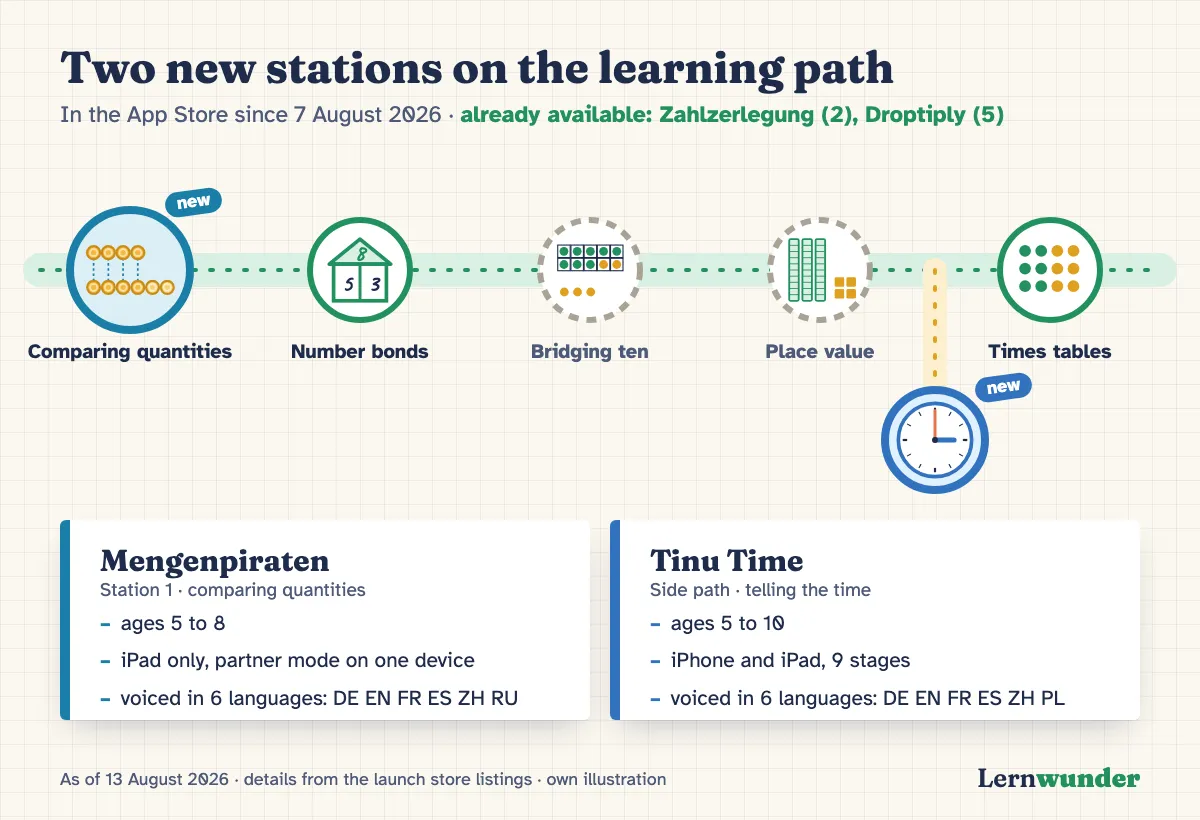
In short: Since 7 August 2026 there are two new Lernwunder apps in the App Store. Mengenpiraten (Number Pirates in the English App Store) helps children aged 5 to 8 compare quantities, the first station of our learning path. Tinu Time helps children aged 5 to 10 learn to tell the time, an application that builds on several stations. Both apps have no ads, no in-app purchases and work offline.
In June we described how our apps build on each other: comparing and recognising quantities, number bonds, bridging ten, place value, times tables, plus the clock as an application. Back then there were two apps on this path. Since last week there are four. Here is a short overview of the two new ones. What each app does in detail is covered in the launch articles for Mengenpiraten and Tinu Time.
Where does Mengenpiraten sit on the learning path?
Right at the start. Before children learn number bonds, they need to judge where there is more, where there is less and when amounts are the same. A meta-analysis with 17,201 participants found a reliable link between comparing quantities or digits and maths achievement, slightly stronger for digits (r = .30) than for dot sets (r = .24) (Schneider et al., 2017). A moderate link, but one that shows up across all age groups.
In a developmental model of early number sense, exact comparison (“24 is more than 23”) is the second level. At the third level, children understand relations between numbers: that 5 is exactly two more than 3 and that 8 can be split into 5 and 3 (Ennemoser et al., 2024). That is where Zahlzerlegung, our number bonds app, takes over.
Mengenpiraten leads across six islands: from comparing the dots on dice to larger amounts with two dice, then digits, and finally the greater than, less than and equals signs. It is designed for children aged 5 to 8 and runs on iPad only. In partner mode, two children play against each other on one device. Every instruction is spoken, in six languages: German, English, French, Spanish, Chinese and Russian. Why comparing comes before calculating is explained in detail in More, less or the same?.
Where does Tinu Time sit on the learning path?
On a side path. The clock is not a station of its own but an application: it combines counting in fives, halves and quarters, and calculating across the full hour. That is why children learn it over several years.
A study with 240 children from year 1 to year 5 (first to fifth grade) shows how differently this develops. Even first graders read digital times well. On analogue clocks, only o’clock times were as easy; some other times remained hard even for the oldest children (Friedman & Laycock, 1989). In another study, children with maths difficulties struggled especially with five-minute and one-minute times, and their errors pointed to immature counting strategies (Burny et al., 2012).
Tinu Time therefore builds the route in nine stages, from the clock face to o’clock, half past and quarter times, then minutes, the 24-hour clock and time spans. How we arrived at this order is explained in Analogue before digital. The app is designed for children aged 5 to 10, runs on iPhone and iPad and is fully voiced in six languages: German, English, French, Spanish, Chinese and Polish.
Which app suits which child?
| Mengenpiraten | Tinu Time | |
|---|---|---|
| Topic | comparing amounts: more, less, the same | telling the time, from o’clock to time spans |
| Age | 5 to 8 | 5 to 10 |
| Device | iPad only | iPhone and iPad |
| Voiced languages | DE, EN, FR, ES, ZH, RU | DE, EN, FR, ES, ZH, PL |
| Reading needed? | no, every instruction is spoken | no, all explanations are read aloud |
The ages are guidelines. A child in the last year before school who loves rolling dice and counting things is a good fit for Mengenpiraten. A child in year 1 who keeps asking what time it is can start with Tinu Time. Tinu Time has a placement test, so children who already know some times do not have to start from scratch.
What the apps do not do
Each app practises one station. Neither replaces teaching or a diagnosis. If a child keeps struggling a lot with comparing amounts or with the clock, talk to the teacher. Our article Recognising maths difficulties can help you put things in context.
And not everything works everywhere: Mengenpiraten is iPad only, and at launch both apps are available in the App Store only.
What you can do
- Make pairs instead of counting. Plates and spoons, socks, chairs: is anything left over? Where is more?
- Ask “how many more?” After comparing comes the difference: “You have 6, I have 4. How many more do you have?”
- O’clock first. Name full hours in everyday life: “Dinner is at seven.” Minutes come later.
- A clock in the bedroom. An analogue clock with a clear face makes time visible. Instructions for making one are in Make a learning clock.
Frequently asked questions
Since when are Mengenpiraten and Tinu Time available? Both apps have been in the App Store since 7 August 2026.
Does my child need internet access or an account? No. Both work completely offline, without ads and without in-app purchases. Data stays on the device.
Which app should we start with? The one that suits your child. On the learning path, comparing comes before number bonds. The clock runs alongside and can start as soon as a child is curious about times.
Are the apps available for Android? At launch, both are available in the App Store only.
Sources
- Burny, E., Valcke, M. & Desoete, A. (2012). Clock reading: An underestimated topic in children with mathematics difficulties. Journal of Learning Disabilities, 45(4), 351–360. https://doi.org/10.1177/0022219411407773
- Ennemoser, M., Sinner, D., Nguyen, L. & Krajewski, K. (2024). From developmental theory to effective training: Long-term and transfer effects of promoting the quantity–to–number word linkage in first-graders at risk for mathematical difficulties. Frontiers in Psychology, 15. https://doi.org/10.3389/fpsyg.2024.1380036
- Friedman, W. J. & Laycock, F. (1989). Children’s analog and digital clock knowledge. Child Development, 60(2), 357–371. https://doi.org/10.2307/1130982
- Schneider, M., Beeres, K., Coban, L., Merz, S., Schmidt, S. S., Stricker, J. & De Smedt, B. (2017). Associations of non-symbolic and symbolic numerical magnitude processing with mathematical competence: A meta-analysis. Developmental Science, 20(3), e12372. https://doi.org/10.1111/desc.12372
Lernwunder editorial team · Chaolan Lu