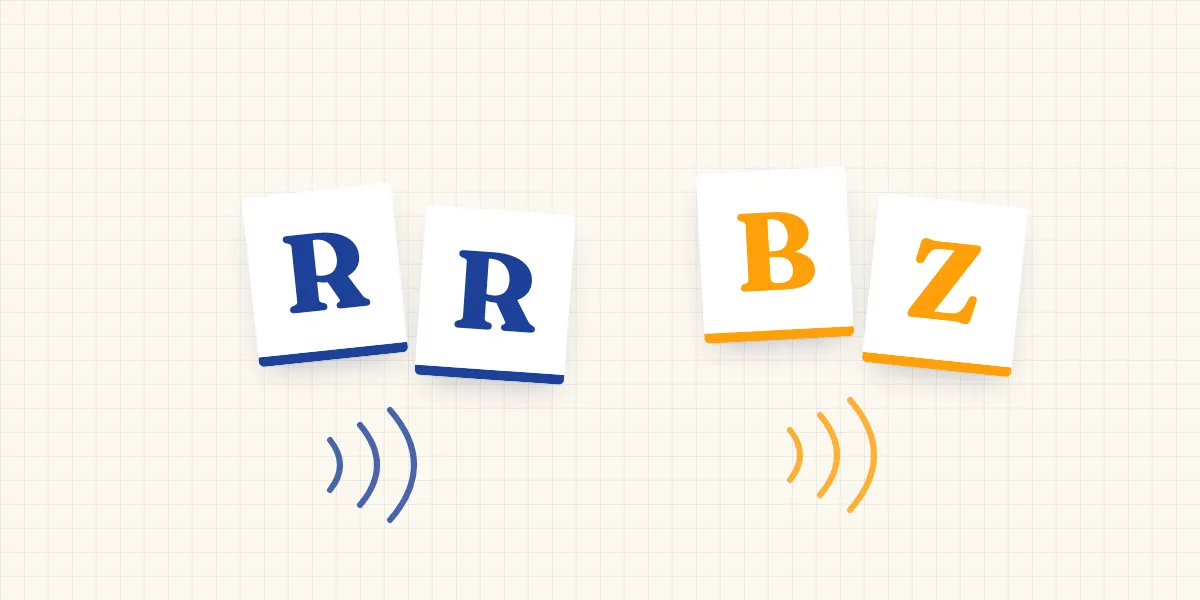
In short: Charts, handovers and records are full of abbreviations, and in studies even experienced professionals interpret fewer than half of them correctly. Nurses learning German as a second language face a second hurdle: abbreviations are spoken, usually letter by letter with German letter names, sometimes as a word, sometimes in full. So learn three things together for every abbreviation: what it looks like, how it is said, and what it means.
Early shift, handover. „Zimmer drei: RR war nachts hoch, BZ um zehn, der Zugang i.v. liegt seit gestern.“ (Room three: BP was high overnight, blood sugar at ten, the IV line has been in since yesterday.) The new colleague knows the word “Blutdruck”, blood pressure. She knows “Blutzucker”, blood sugar. But what does “Er-Er” have to do with it? And why does nobody say “ar-ar”, the way she learned the letters in her English class? The scene is made up. The problem behind it is not.
Our post on articles on the ward looked at the smallest part of a word. Today is about words that have already shrunk.
How many abbreviations are used in hospitals?
A great many. A British audit on a paediatric unit counted 2,286 abbreviations on just 25 handover sheets, 221 of them different. In 168 sets of medical notes there were 3,668, of which 479 were different. Two common reference dictionaries recognised only 14 to 20 percent of them (Sheppard et al., 2008).
German-speaking hospitals are no different. In 100 discharge letters from a university hospital in Graz, Austria, researchers found 750 different abbreviations that were not explained. One of them, “HA”, could mean Hausarzt (family doctor), hepatitis A, human albumin, haemagglutinin or hyaluronan (Schwarz et al., 2021). A database of American medical abbreviations lists 104,057 short forms with 170,426 meanings (Grossman Liu et al., 2021). Many abbreviations have more than one meaning.
Do professionals understand them?
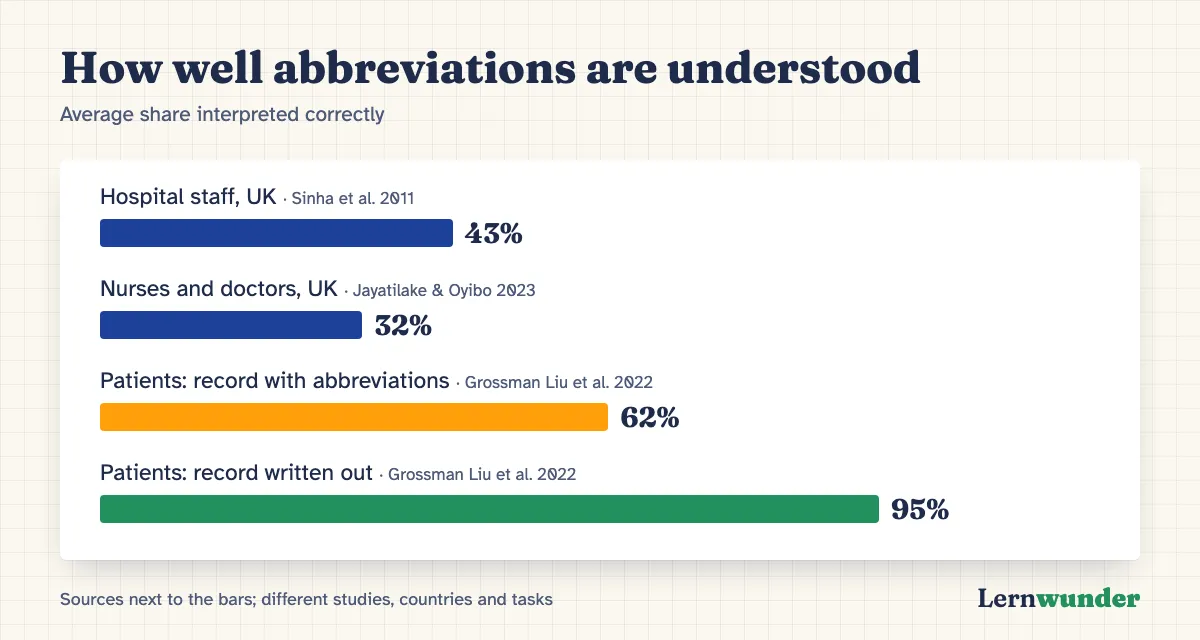
Often not. In a British survey, hospital staff from different professions correctly explained only 43 percent of abbreviations on average. One finding stands out: an abbreviation used mainly by nurses was understood by 75 percent of nurses but only 11 percent of junior doctors. For other abbreviations it was the other way round (Sinha et al., 2011). Every professional group has its own abbreviation dialect.
In another British study, 46 nurses and doctors scored an average of 32 percent on 20 abbreviations from real patient records (Jayatilake & Oyibo, 2023). And a survey of nurses in Zagreb shows where this knowledge comes from: nurses learn abbreviations mainly from more experienced colleagues, on the ward, not in a course (Režić & Hanžek, 2023).
What about patients?
For patients, abbreviations are even harder. In a randomised trial, 60 patients read excerpts from their records: half with abbreviations, half with the terms written out. With abbreviations they understood 62 percent on average, with full terms 95 percent. Simple ones like “BP” were still understood by 83 percent, “HTN” (hypertension) by only 23 percent (Grossman Liu et al., 2022). For bedside conversation this means: abbreviations belong in the chart and in handover, not in what you say to the patient.
How are abbreviations pronounced?
This is the hurdle hardly any textbook mentions. Linguists distinguish two ways of saying short words made from initials: they are either spelled out letter by letter (EKG, the German for ECG) or said as a word (TÜV, the German vehicle inspection agency). In German, spelled-out short words are far more common (Sotnikova & Khomkova, 2016).
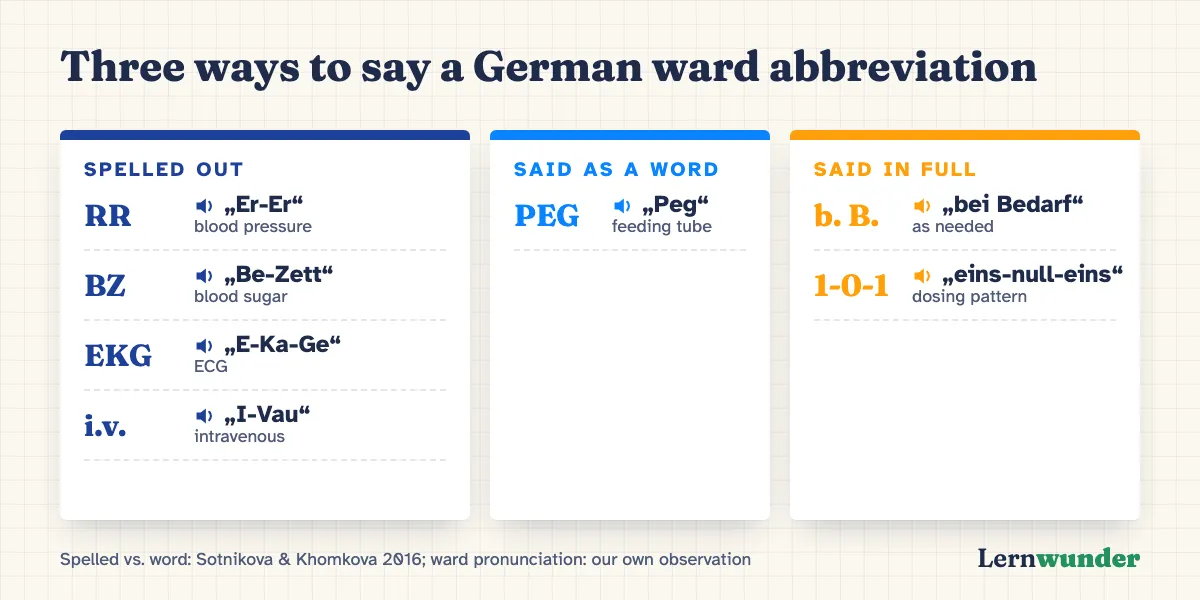
In our observation, wards add a third variant: some abbreviations are simply said in full. That gives three types:
- Spelled out: RR (“Er-Er”, blood pressure), BZ (“Be-Zett”, blood sugar), EKG (“E-Ka-Ge”, ECG), i.v. (“I-Vau”, intravenous)
- Said as a word: PEG (“Peg”, a feeding tube)
- Said in full: b. B. (“bei Bedarf”, as needed), 1-0-1 (“eins-null-eins”, or “morning one, midday none, evening one”)
For learners, spelling out is a trap in itself. German letter names sound different from English ones: R is “Er” (not “ar”), Z is “Zett” (not “zee” or “zed”), V is “Vau” (not “vee”). If you spell RR the English way, colleagues may not understand you, and if you have never heard the German pronunciation, you won’t recognise the abbreviation in a fast handover.
What you can do
- Practise the German alphabet out loud, especially letters that sound different from English: E, I, R, V, Z.
- Keep your own abbreviation list with three columns: abbreviation, how it is said, what it means. For example: RR · Er-Er · Blutdruck.
- Ask how it is used in your hospital. Many abbreviations are local, and some have several meanings.
- Use the full word with patients: „Ich messe Ihren Blutdruck“, not „Ich messe Ihren RR“.
- Use your hospital’s list when writing. Each institution decides which abbreviations are allowed in its documentation.
For preceptors: in the first weeks, say the full word once alongside the abbreviation. “RR, also der Blutdruck” takes two seconds.
What we are working on
PflegeMate, the learning aid for nursing German that we are working on, is meant to have its own category for abbreviations. We have made a decision for it: every abbreviation is spoken the way it is said on the ward, followed straight away by its meaning. So you don’t hear a slurred “Rrr” but “Er-Er, Blutdruck”, and for the emergency department “Zett-Enn-A, Zentrale Notaufnahme”.
The exceptions follow ward usage: “b. B.” is spoken as “bei Bedarf”, “1-0-1” as a sequence of numbers, and PEG stays a word. In the example sentences addressed to patients, the full word is used in most cases, because, as the studies show, an abbreviation rarely belongs there.
PflegeMate is a language learning aid only. It explains words, not treatments, and it does not replace onboarding or your hospital’s list of abbreviations.
Frequently asked questions
How do you pronounce RR in German? Spelled out with German letter names: “Er-Er”. It stands for blood pressure.
Is there an official list of nursing abbreviations in Germany? Not a single nationwide one for everyone. Many institutions have their own lists. Ask for your hospital’s list.
Why do even German colleagues not understand some abbreviations? Because every profession and every ward uses its own abbreviations, and many have several meanings (Sinha et al., 2011; Schwarz et al., 2021).
Should I avoid abbreviations when talking to patients? Yes, as a rule. Patients understand much more when terms are written out (Grossman Liu et al., 2022).
Sources
- Grossman Liu, L., Grossman, R. H., Mitchell, E. G., Weng, C., Natarajan, K., Hripcsak, G. & Vawdrey, D. K. (2021). A deep database of medical abbreviations and acronyms for natural language processing. Scientific Data, 8(1), 149. https://doi.org/10.1038/s41597-021-00929-4
- Grossman Liu, L., Russell, D., Reading Turchioe, M., Myers, A. C., Vawdrey, D. K., Masterson Creber, R. M. et al. (2022). Effect of expansion of abbreviations and acronyms on patient comprehension of their health records: A randomized clinical trial. JAMA Network Open, 5(5), e2212320. https://doi.org/10.1001/jamanetworkopen.2022.12320
- Jayatilake, D. C. & Oyibo, S. O. (2023). Interpretation and misinterpretation of medical abbreviations found in patient medical records: A cross-sectional survey. Cureus, 15(9), e44735. https://doi.org/10.7759/cureus.44735
- Režić, S. & Hanžek, K. (2023). Abbreviation use habits in nurses’ work. Croatian Nursing Journal, 7(1), 51–61. https://doi.org/10.24141/2/7/1/4
- Schwarz, C. M., Hoffmann, M., Smolle, C., Eiber, M., Stoiser, B., Pregartner, G., Kamolz, L. P. & Sendlhofer, G. (2021). Structure, content, unsafe abbreviations, and completeness of discharge summaries: A retrospective analysis in a University Hospital in Austria. Journal of Evaluation in Clinical Practice, 27(6), 1243–1251. https://doi.org/10.1111/jep.13533
- Sheppard, J. E., Weidner, L. C., Zakai, S., Fountain-Polley, S. & Williams, J. (2008). Ambiguous abbreviations: an audit of abbreviations in paediatric note keeping. Archives of Disease in Childhood, 93(3), 204–206. https://doi.org/10.1136/adc.2007.128132
- Sinha, S., McDermott, F., Srinivas, G. & Houghton, P. W. (2011). Use of abbreviations by healthcare professionals: what is the way forward? Postgraduate Medical Journal, 87(1029), 450–452. https://doi.org/10.1136/pgmj.2010.097394
- Sotnikova, E. & Khomkova, L. (2016). Entwicklungstendenzen der Kurzwörter in der deutschen Gegenwartssprache [Trends in German short words]. University of Augsburg (OPUS). https://opus.bibliothek.uni-augsburg.de/opus4/3411
Lernwunder editorial team · Chaolan Lu