In short: Most foreign nurses in Germany come from Poland, Bosnia and Herzegovina, Turkey, Romania and Croatia. The fastest growth, however, is among nurses from outside the EU, for example from the Philippines, India, Tunisia or Vietnam. They come mainly for pay, career prospects and working conditions, and they often start below their qualification level until their degree is recognised.
On a hospital ward in a large German city, five or six countries of origin can easily come together in one team: the colleague from Kraków who has been here for fifteen years, the nurse from Sarajevo, two newcomers from Manila, a trainee from Hanoi. That is not a made-up exception; it is the picture the statistics paint.
Our first post looked at what internationally educated nurses experience in their first weeks on the ward. It quoted one figure: 18 percent of people working in nursing in Germany hold a foreign nationality, and 27,000 were added between June 2023 and June 2024 alone. Today we take a closer look: who are these nurses, where do they come from, and why?
How has the number of foreign nurses in Germany changed?
Sharply. In 2014, 6 percent of employees in nursing occupations held a foreign nationality; by June 2024 it was 18 percent. That is 222,000 more people, 307,000 in total (Bundesagentur für Arbeit, 2025).
The Institute for Employment Research (IAB) analysed the ten years up to 2023 in more detail. In hospital nursing, the foreign share rose from 4.9 to 14.5 percent. And more foreign nurses now come from outside the EU (177,000) than from within it (94,000) (Carstensen et al., 2024).
One caveat applies to all of these figures: they count nationalities, not life stories. A person with a foreign passport may have been recruited, may have come to Germany as a child, or may have fled. The statistics do not show why someone is here (Carstensen et al., 2024).
Which countries do nurses in Germany come from?
The five largest groups have not changed in ten years: nurses from Poland, Bosnia and Herzegovina, Turkey, Romania and Croatia. The strongest growth was among nurses from Bosnia and Herzegovina, followed by Romania and the Philippines. In June 2014, fewer than 1,000 Filipino nurses worked in Germany; most recently it was 14,000 (Bundesagentur für Arbeit, 2025).
The IAB figures for hospital nursing in June 2023 show how varied the picture is:
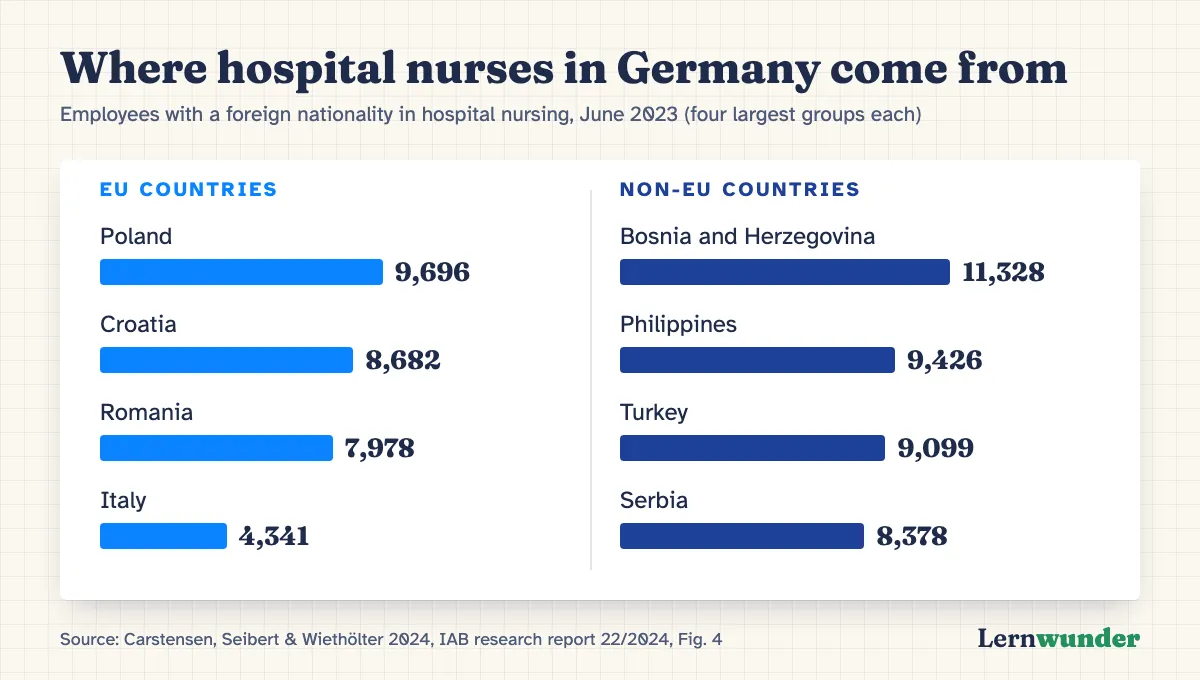
They are followed by Albania, India, Syria, Ukraine, Tunisia and Vietnam. In elder care the order differs: Poland, Romania, Turkey and Bosnia and Herzegovina lead, and Vietnam, with around 4,200 employees, is the third largest non-EU group (Carstensen et al., 2024).
Which routes lead into German nursing?
The countries of origin mirror the routes Germany has opened:
- Free movement in the EU. The number of nurses from EU countries grew by 51,000 to 97,000 in ten years.
- The Western Balkans regulation. Barriers were lowered for Albania, Bosnia and Herzegovina, Kosovo, North Macedonia, Montenegro and Serbia. Nurses from these countries have almost quintupled since 2015, to 51,000.
- Targeted recruitment. The “Triple Win” programme run by the Federal Employment Agency and GIZ places nurses from countries including the Philippines, Tunisia, Indonesia, India (Kerala) and Jordan. Employees with these nationalities grew from just under 5,000 to just under 52,000.
- Refuge. 27,000 people from the eight main asylum countries work in nursing, compared with fewer than 2,000 before 2015. From Ukraine, it was just under 5,000 before the war and 12,000 in September 2024.
(All figures: Bundesagentur für Arbeit, 2025.)
Recognition statistics point the same way. In 2023, Germany recognised 65,300 foreign vocational qualifications, 27,300 of them in nursing, or 42 percent of all recognitions. Across all professions, most recognised qualifications came from Turkey, Bosnia and Herzegovina, the Philippines and Tunisia (Statistisches Bundesamt, 2024).
Why do nurses choose to move to Germany?
There are hardly any large studies for Germany specifically. But a systematic review of 107 studies covering five decades, more than half of them about nurses, shows very stable reasons why health workers leave low- and middle-income countries (Toyin-Thomas et al., 2023):
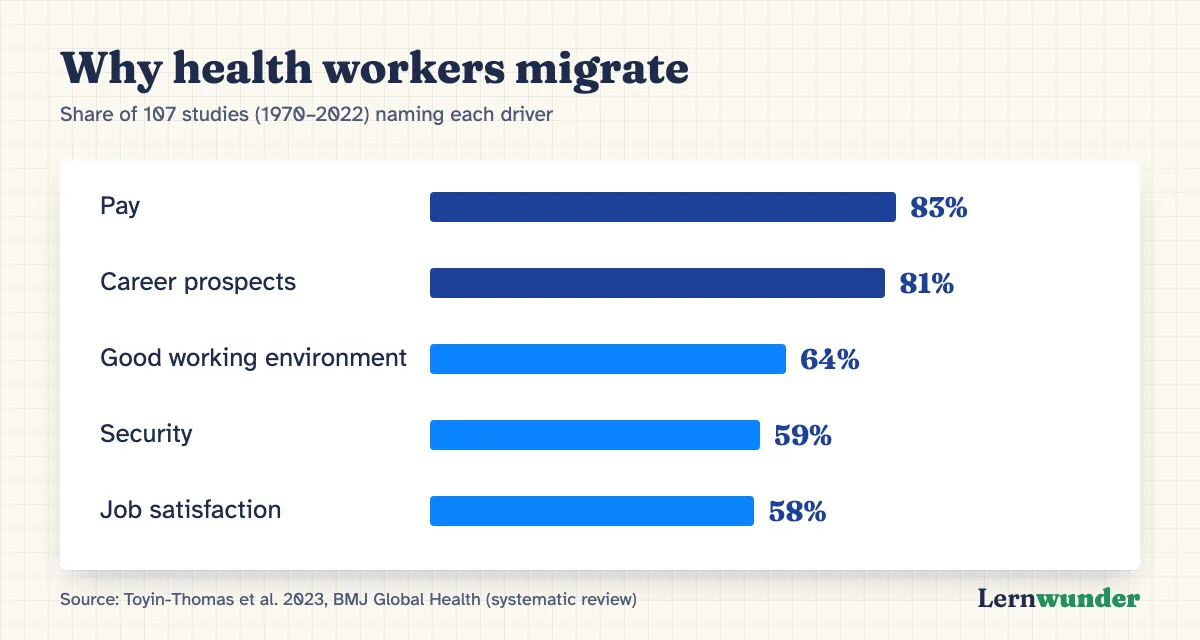
One thing to keep in mind: the percentages show how many studies mention a reason, not how many nurses give it. According to the authors, the drivers have stayed remarkably constant across decades and regions.
The global context matters too: one in seven nurses worldwide is foreign-born, and in high-income countries it is 23 percent (World Health Organization, 2025). Germany is recruiting in a market where many wealthy countries are looking for the same professionals.
What awaits internationally educated nurses in Germany?
Often a start below their qualification level. Among German employees in nursing, almost two thirds work as registered nurses; among foreign employees, just over half do. For nurses from the Triple Win countries it is six in ten, for those from asylum countries about four in ten (Bundesagentur für Arbeit, 2025). Until their qualification is fully recognised, many work as nursing assistants (Carstensen et al., 2024). We described this route in our post on recognition, language level and specialist language.
A review of nurse migration to Australia, Germany and the UK sums up the situation: discrimination is frequently reported, language and communication are central, and structured integration programmes are valued by nurses and employers alike (Smith et al., 2022).
What this feels like is shown by a small interview study with university- educated nurses from the Philippines. In Germany they experience a loss of competence and feel like strangers in their own nursing role. Many respond by taking further training or moving into technology-intensive areas of care (Zwergel et al., 2024). The study has only eight participants, but it fits what larger reviews describe.
What you can do
If you are onboarding international colleagues:
- Don’t just ask “Where are you from?” but “How was nursing organised there?”. Someone who studied nursing in the Philippines or worked for ten years in Bosnia brings a different idea of the profession.
- Expect different starting points in the same team: a recruited registered nurse, a refugee in assistant training and a colleague from the EU do not need the same support.
- Talk openly about the time until recognition and which tasks are possible during that period.
If you are thinking about moving to Germany as a nurse:
- Ask your future employer specifically how onboarding and support until recognition will work.
- Get in touch with people from your country who already work here. They know what no brochure tells you.
- Start early with the words of everyday ward life, not only with the exam.
Why this topic matters to us
Behind every number in this post there is a first language: Polish, Bosnian, Turkish, Romanian, Tagalog, Malayalam, Arabic, Vietnamese, Ukrainian. Anyone thinking about how to help nurses learn German has to keep this diversity in mind. An explanation that only works in German misses many people exactly when they need it most. That is one of the thoughts on our minds right now. Our next post asks why a B2 certificate is often not enough on the ward.
Frequently asked questions
Which countries do most foreign nurses in Germany come from? Counted by nationality: Poland, Bosnia and Herzegovina, Turkey, Romania and Croatia. Fast-growing groups include the Philippines, India, Tunisia and Vietnam (Bundesagentur für Arbeit, 2025; Carstensen et al., 2024).
How many foreign nurses work in Germany? In June 2024, 307,000 employees in nursing occupations held a foreign nationality, or 18 percent (Bundesagentur für Arbeit, 2025).
Why do nurses move to Germany? Research mainly names pay, career prospects, a good working environment, security and job satisfaction (Toyin-Thomas et al., 2023). For Germany specifically, the evidence so far comes mostly from small interview studies.
Do foreign nurses work as registered nurses straight away? Often not. Until recognition, many work as nursing assistants (Carstensen et al., 2024). For an individual case, the responsible recognition authority has the final word.
Sources
- Bundesagentur für Arbeit, Statistik (2025). Berichte: Blickpunkt Arbeitsmarkt – Arbeitsmarktsituation im Pflegebereich [Labour market situation in nursing]. Nuremberg, May 2025. Available e.g. at https://pflege.sachsen-anhalt.de/fileadmin/Bibliothek/Politik_und_Verwaltung/MS/MS/2_Pflege/Arbeitsmarktsituation_im_Pflegebereich_05-2025.pdf
- Carstensen, J., Seibert, H. & Wiethölter, D. (2024). Internationalisierung der Pflege [Internationalisation of nursing]. IAB-Forschungsbericht 22/2024. https://doi.org/10.48720/IAB.FB.2422
- Smith, J. B., Herinek, D., Woodward-Kron, R. & Ewers, M. (2022). Nurse migration in Australia, Germany, and the UK: A rapid evidence assessment of empirical research involving migrant nurses. Policy, Politics, & Nursing Practice, 23(3), 175–194. https://doi.org/10.1177/15271544221102964
- Statistisches Bundesamt (2024). 25 % mehr Anerkennungen ausländischer Berufsabschlüsse im Jahr 2023 [25% more recognitions of foreign qualifications in 2023]. Press release no. 346, 12 September 2024. https://www.destatis.de/DE/Presse/Pressemitteilungen/2024/09/PD24_346_212.html
- Toyin-Thomas, P., Ikhurionan, P., Omoyibo, E. E. et al. (2023). Drivers of health workers’ migration, intention to migrate and non-migration from low/middle-income countries, 1970–2022: a systematic review. BMJ Global Health, 8(5), e012338. https://doi.org/10.1136/bmjgh-2023-012338
- World Health Organization (2025). Nursing workforce grows, but inequities threaten global health goals. News release, 12 May 2025. https://www.who.int/news/item/11-05-2025-nursing-workforce-grows--but-inequities-threaten-global-health-goals
- Zwergel, M., Schmidt, P. F. & Hämel, K. (2024). Akademisch qualifizierte Pflegefachpersonen aus Drittstaaten [Academically qualified nurses from third countries]. Zeitschrift für Evidenz, Fortbildung und Qualität im Gesundheitswesen, 187, 88–94. https://doi.org/10.1016/j.zefq.2024.04.005
Lernwunder editorial team · Chaolan Lu