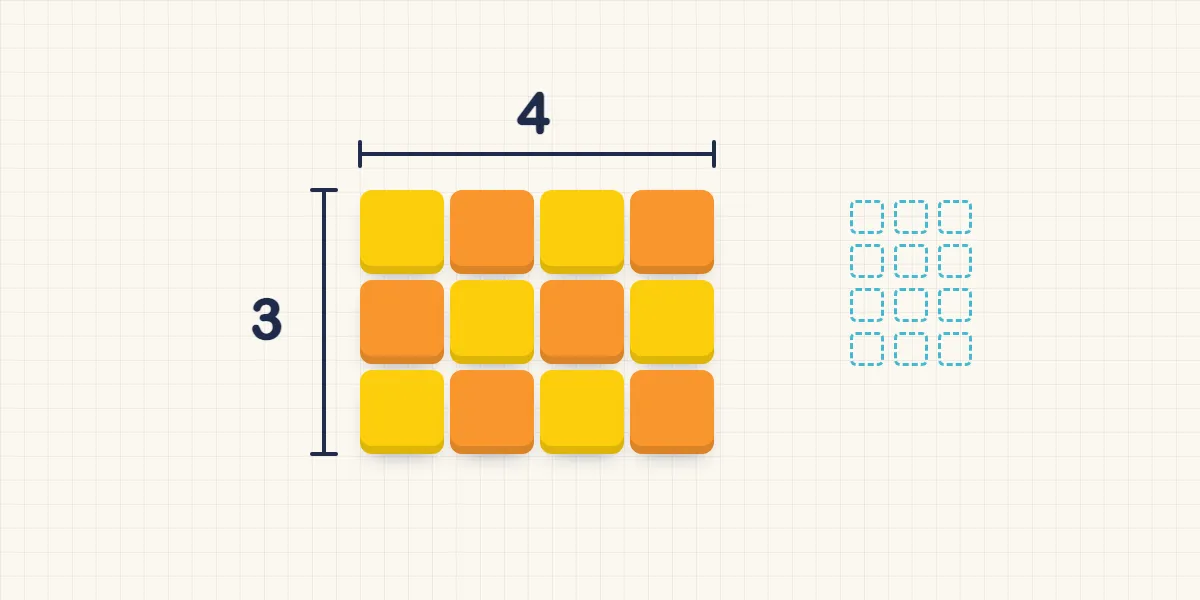
In short: Yes, children should eventually know their times tables by heart. But children who understand multiplication as a rectangle (an array) and can derive facts from a few anchor facts like 2 × 8 and 5 × 8 get there more reliably and can use what they know more flexibly. Understanding and practice are not opposites. The order makes the difference.
A scene from many living rooms (made up, but you may recognise it): your child recites the seven times table perfectly, almost like a song. Then you ask: “What’s 7 times 8?” And they start from the top: “7, 14, 21, 28 …”, counting along on their fingers and ending up at 54 or 56, they’re not quite sure.
Your child has practised, and a lot. They have learned a sequence. What’s missing is a picture of what 7 × 8 actually is, and a way to find it without running through the whole table.
Why do times tables matter so much?
Multiplication facts up to 10 × 10 are among the basic facts of mental arithmetic. The German national education standards expect children to know them “by heart” by the end of primary school and to derive the related division facts reliably (KMK, 2022).
A brain imaging study with teenagers suggests that fluent fact retrieval matters later on, too: students who relied more on brain regions associated with retrieving facts from memory when solving simple sums tended to score higher on a maths test at the end of high school (Price, Mazzocco & Ansari, 2013). That is a correlation, not proof of cause and effect. But it fits the experience that fluent calculation frees the mind for harder problems.
Why isn’t memorising alone enough?
For a long time children solve multiplication problems in several ways side by side: when they are confident, they retrieve the answer; when they are not, they fall back on other, slower routes. Which answers stick depends a great deal on the experiences children have with the facts early on (Siegler, 1988).
An interview study with third graders sorted these routes in detail. Its conclusion: how children progress with multiplication depends above all on which specific number relationships they already know and can use, such as known results to calculate onward from (Sherin & Fuson, 2005). Every secure fact is therefore not just an answer but a tool for finding others.
A child who only memorises tables has ten chains but no web. A child who understands how the facts are connected can always find a forgotten one again. The same is true for addition, as our post Number bonds to 10 shows.
What are anchor facts?
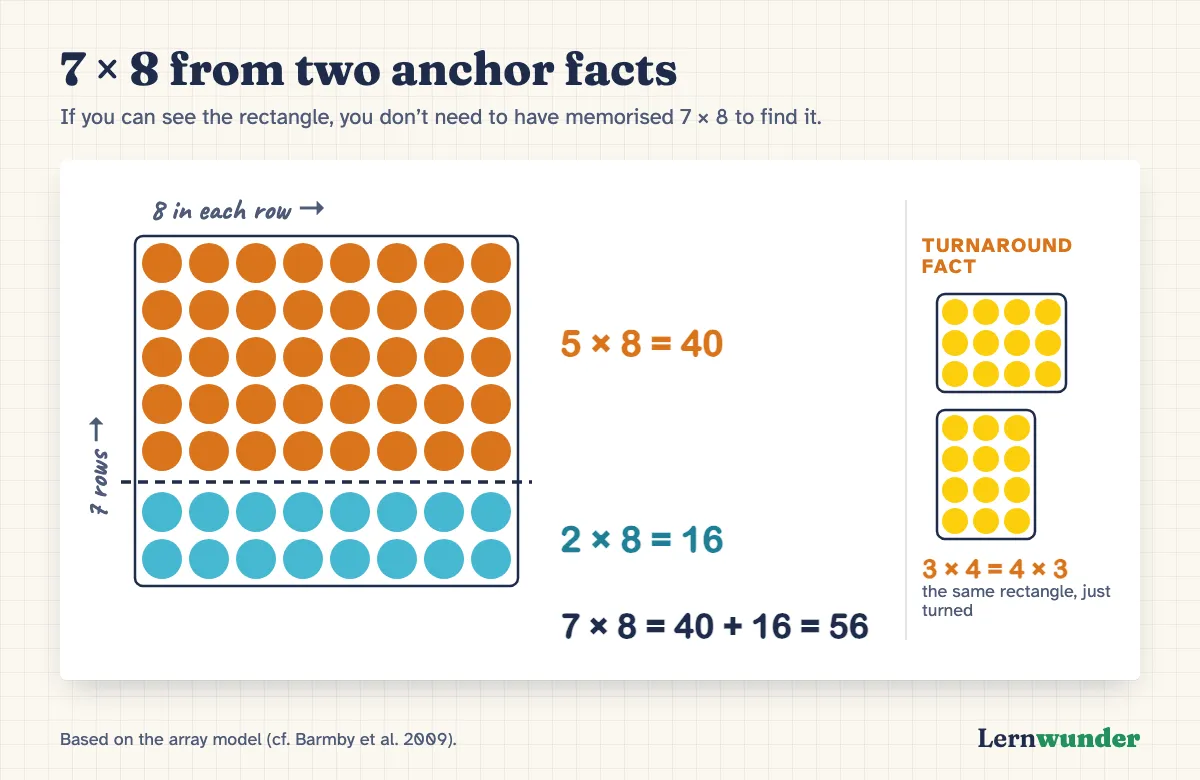
Anchor facts (sometimes called core facts) are the ones that are especially easy to remember and lead to all the others: the 1×, 2×, 5× and 10× tables. An example:
- Your child doesn’t know 7 × 8 securely yet.
- They know 5 × 8 = 40 (half of 10 × 8).
- They know 2 × 8 = 16 (double 8).
- So 7 × 8 = 40 + 16 = 56.
Then there are turnaround facts: 3 × 4 and 4 × 3 have the same answer. Children who understand this only have to learn about half of the facts from scratch. The German standards also explicitly expect children to recognise and use laws such as commutativity (KMK, 2022).
Why the rectangle?
A multiplication fact can be laid out as a rectangle of dots or squares: 3 rows of 4 dots is 3 × 4. This picture contains almost everything needed for understanding. Turn the rectangle and you see the turnaround fact. Split it and you see how 7 × 8 is made from 5 × 8 and 2 × 8.
A study of primary school children working with arrays on a computer concluded that the array model can support understanding and reasoning in multiplication. It also showed where children struggled with it. So the picture doesn’t work on its own; children need to learn how to read it (Barmby et al., 2009).
A finding from perception research fits this: people take in equal groups, such as three groups of three dots, faster than unstructured sets, and the patterns of errors and response times suggested that the brain is actually multiplying (Ciccione & Dehaene, 2020). Ordered arrays invite multiplication.
So when does practice come in?
Understanding doesn’t replace practice. A study with 58 fourth graders compared two approaches: timed practice drills alone, or strategy instruction combined with timed drills. Both groups became faster at recall. But the children taught strategies were better at applying their knowledge to larger facts and to estimation (Woodward, 2006).
So the order is: understand first, secure the anchor facts, then derive, then practise until it sticks.
What you can do
- Make a dot array. Draw a 10 × 10 grid of dots on card. Use two paper strips as an L-shaped frame to cover what you don’t need: 3 rows of 4 dots. “How many are there? How did you count?”
- Start with the anchor facts. First 2×, 10× and 5×. These tables have easy-to-spot patterns.
- Practise deriving out loud. “You don’t know 6 × 7 yet. Which fact do you know that’s close?” For example, 5 × 7 = 35, then one more 7.
- Discover turnaround facts. Turn the dot array through 90 degrees. “Has the number changed?”
- Only then add speed. Short recall rounds with flashcards are great once your child can work the facts out. No races against siblings, no pressure.
Why this matters to us
Ever since Zahlzerlegung launched, we’ve been asking ourselves what comes after the number 10. Times tables are the next big step, and they are often treated as pure memorisation. We are working on an idea, under the working title Droptiply, for how children could experience the rectangle behind every multiplication fact through play. For now it is just an idea; nothing is finished. We’ll share more here when there is more to show.
Frequently asked questions
Is it wrong to chant the times tables? No. Counting in multiples is a useful strategy, especially at the beginning. It becomes a problem when a child only knows the sequences and starts from the top for every fact.
Which facts should my child learn first? The anchor facts: the 1×, 2×, 5× and 10× tables. The others can be derived from them, such as 7 × 8 from 5 × 8 and 2 × 8.
Do timed drills help? Yes, but not on their own. In one study, children doing only timed drills became faster. Those who also learned strategies could apply their knowledge better (Woodward, 2006).
My child mixes up 6 × 8 and 6 × 9. What helps? Go back to the picture: lay both rectangles side by side. 6 × 9 is exactly one column of six dots bigger than 6 × 8.
Sources
- Barmby, P., Harries, T., Higgins, S. & Suggate, J. (2009). The array representation and primary children’s understanding and reasoning in multiplication. Educational Studies in Mathematics, 70(3), 217–241. https://doi.org/10.1007/s10649-008-9145-1
- Ciccione, L. & Dehaene, S. (2020). Grouping mechanisms in numerosity perception. Open Mind, 4, 102–118. https://doi.org/10.1162/opmi_a_00037
- Kultusministerkonferenz (2022). Bildungsstandards für das Fach Mathematik Primarbereich [National education standards for primary mathematics] (resolution of 15 Oct 2004, as amended 23 Jun 2022). https://www.kmk.org/fileadmin/Dateien/veroeffentlichungen_beschluesse/2022/2022_06_23-Bista-Primarbereich-Mathe.pdf
- Price, G. R., Mazzocco, M. M. M. & Ansari, D. (2013). Why mental arithmetic counts: Brain activation during single digit arithmetic predicts high school math scores. The Journal of Neuroscience, 33(1), 156–163. https://doi.org/10.1523/JNEUROSCI.2936-12.2013
- Sherin, B. & Fuson, K. (2005). Multiplication strategies and the appropriation of computational resources. Journal for Research in Mathematics Education, 36(4), 347–395. https://www.jstor.org/stable/30035044
- Siegler, R. S. (1988). Strategy choice procedures and the development of multiplication skill. Journal of Experimental Psychology: General, 117(3), 258–275. https://doi.org/10.1037/0096-3445.117.3.258
- Woodward, J. (2006). Developing automaticity in multiplication facts: Integrating strategy instruction with timed practice drills. Learning Disability Quarterly, 29(4), 269–289. https://doi.org/10.2307/30035554
Lernwunder editorial team · Chaolan Lu