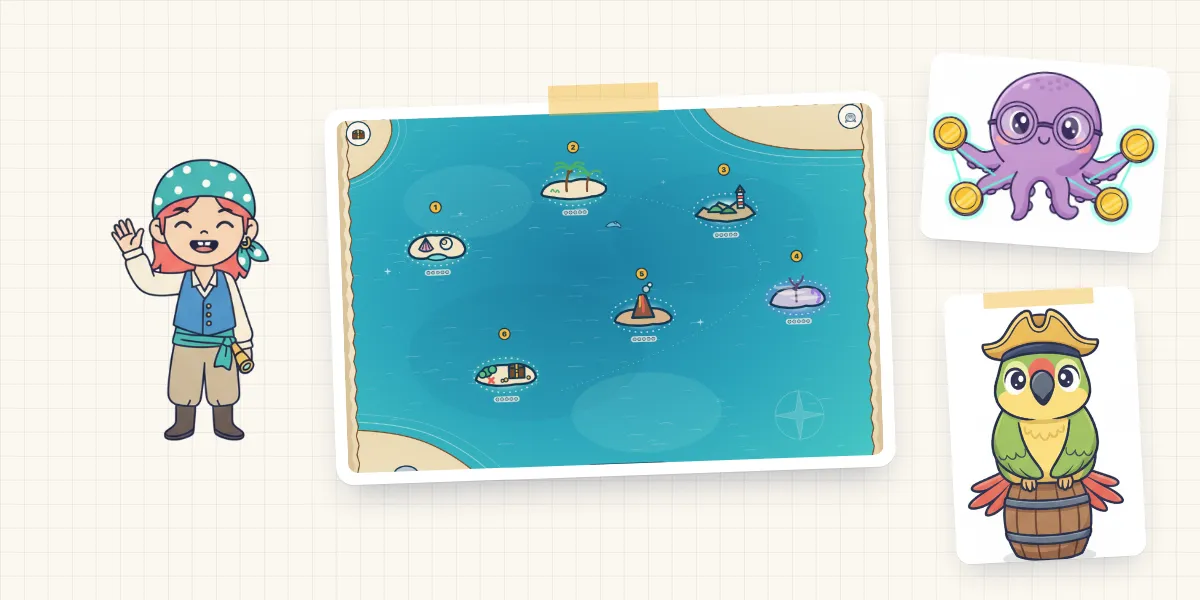
In short: Number Pirates (Mengenpiraten in German) has been on the App Store since 7 August, for iPad. Children aged 5 to 8 roll dice, place coins, say who has more and capture exactly the difference, with a partner or alone, across six islands of increasing difficulty. The app is fully voiced in six languages, has no ads and no in-app purchases, and works offline.
Since May we have written here about what matters to us in comparing: why comparing comes before calculating, how children learn > and <, how a dice game at the kitchen table became a game idea, and why two children belong at one iPad. Now the game is out. Here is a plain account of what it does and what it doesn’t.
What does Number Pirates practise?
Comparing quantities: who has more, who has less, do we have the same amount? And how many more is it? Children practise three fixed phrases, “more than”, “less than” and “the same amount”, and work out the difference between two amounts, first by pairing, later in their heads. This is no side issue: how well children compare amounts and numbers is associated with their maths achievement across all age groups (Schneider et al., 2017).
Three characters come along: Captain Coral explains and speaks every instruction. Piet the parrot is the opponent when a child plays alone. And Kalle the octopus helps when a child gets stuck.
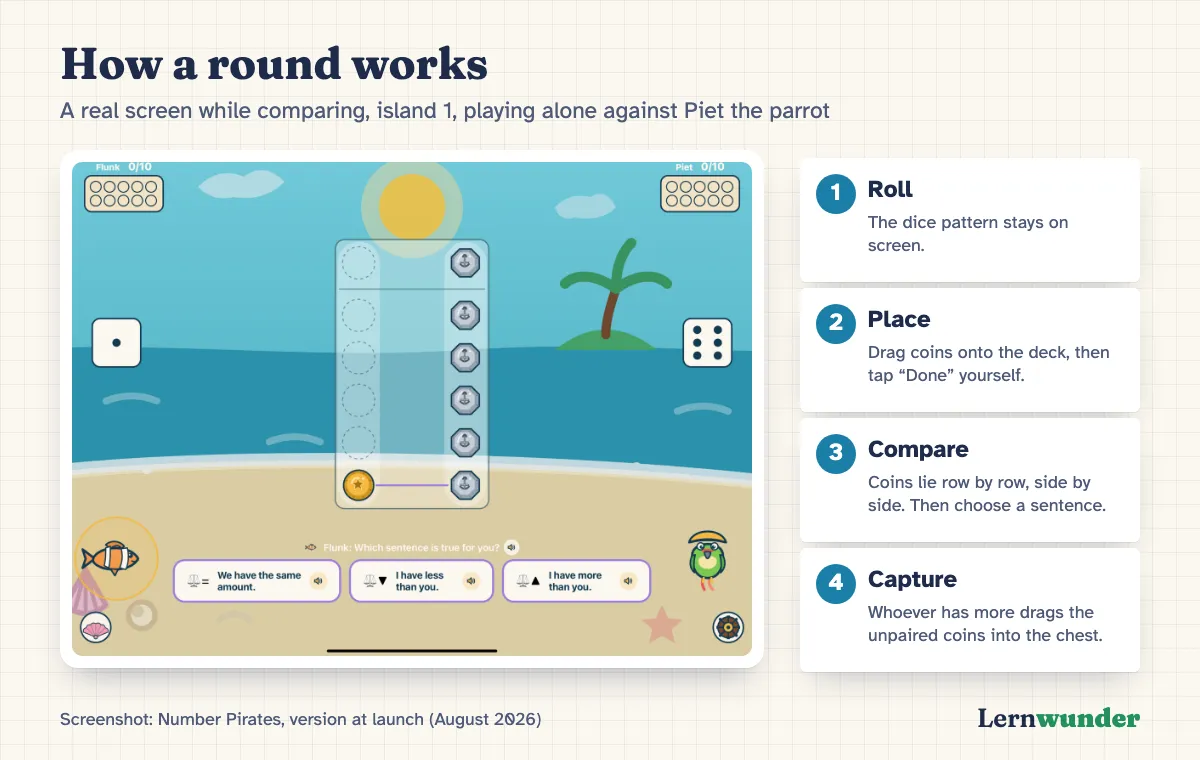
How does a round work?
- Roll. Both players roll; the dice pattern stays on screen.
- Place. Each child drags that many coins onto their deck. Nothing is checked until the child taps “Done”.
- Compare. The coins from both sides lie row by row, side by side. The child chooses one of three sentences: “I have more than you”, “I have less than you” or “We have the same amount”. Each sentence can be read aloud.
- Capture. Whoever has more drags the coins without a partner, one by one, into their treasure chest. The loot is exactly the difference. With the same amount, nobody captures anything.
The fourth step is the heart of the app. Many children answer “How many more birds than worms are there?” wrongly, but often get “How many birds won’t get a worm?” right (Hudson, 1983). In Number Pirates that second question becomes an action, and the “more than” sentence comes right along with it.
Afterwards Captain Coral sums up the round in one sentence, such as “Five is more than three. The difference is two.” The chest is a ten-frame, and from island 3 a twenty-frame with a gap after every five. Whoever fills it first wins a piece of the treasure map. A game ends after ten rounds at most; if it is a draw then, both children get a piece.
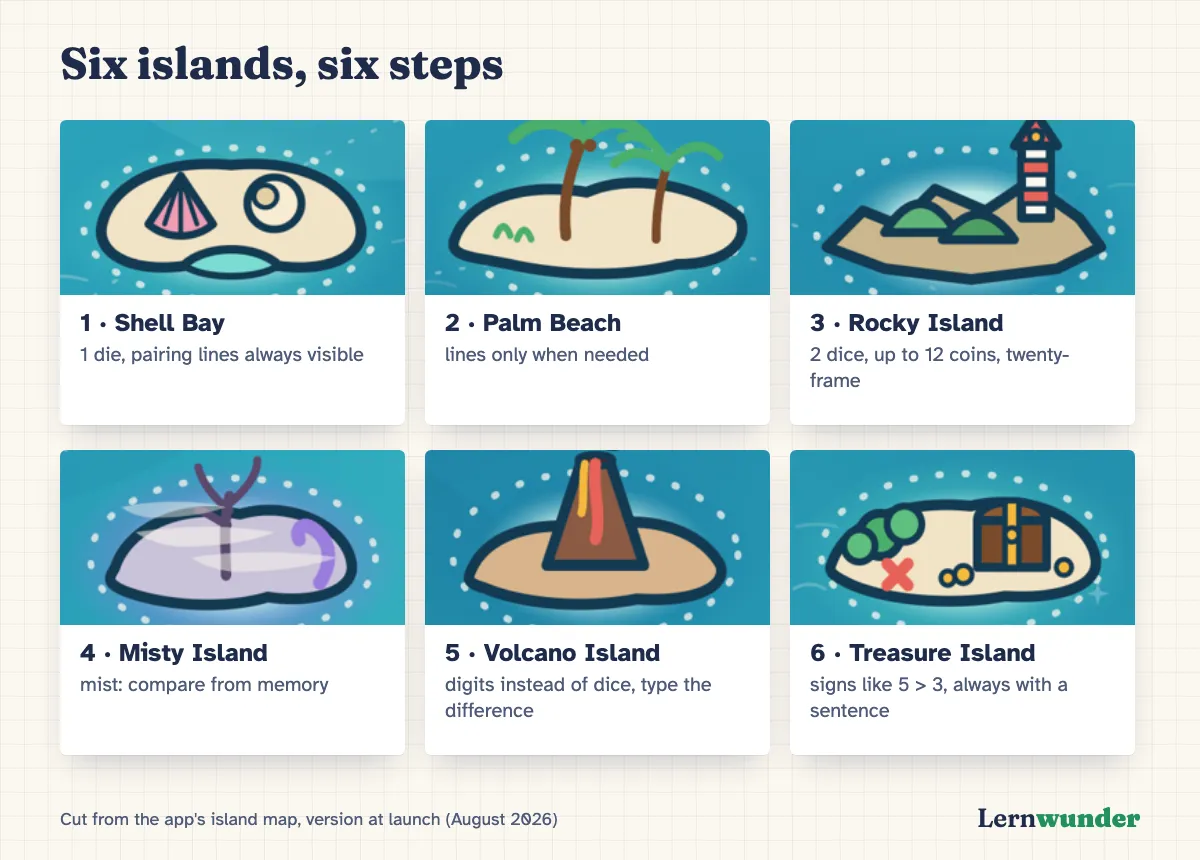
What changes from island to island?
| Island | What’s new |
|---|---|
| 1 Shell Bay | one die, six spaces, the pairing lines are always visible |
| 2 Palm Beach | like island 1, but the lines only appear when needed |
| 3 Rocky Island | two dice, up to twelve coins, the chest becomes a twenty-frame |
| 4 Misty Island | the coins are visible for three seconds, then mist rolls in: compare from memory |
| 5 Volcano Island | digits instead of dice patterns; the child types the difference as a number |
| 6 Treasure Island | above each sentence, the same comparison is also written with signs, such as 5 > 3 |
The next island opens as soon as a puzzle piece has been won on the previous one. Sailing back is always possible; children are never moved down. On Treasure Island a sign never appears without its sentence, and depending on the round it is >, < or =. In one study, children understood the equal sign better after comparing it with > and < (Hattikudur & Alibali, 2010). More in our post on greater than and less than signs.
With a partner or against Piet
With a partner, two children play on one iPad on the same board, one with round gold coins, the other with octagonal silver ones. Shape and colour both differ so that colour-blind children can also tell the sides apart. The child who answers changes every round. Why we built it this way is explained in Two players, one iPad.
Alone, a child plays against Piet the parrot. Piet’s dice are fair, with no hidden help for either side. Now and then he deliberately miscounts by one. Then the child gets to correct his coins and so shows what is right.
What happens after a mistake?
No error sound, no red, no “wrong”. If a child has placed too many or too few coins, Captain Coral says: “Almost! Count again.” The coins stay where they are and the child can fix them. After the second miss, guide lines appear. If a child picks the wrong sentence, Kalle the octopus appears, lines join the pairs of coins, and Coral says: “Kalle will help you. Look at the lines!” Then the child chooses again. The app does not give the answer away; the child decides. Why we avoid red is explained in Why mistakes should not be red in our apps.
What else is there?
- Quick Loot: from island 2, a practice mode with twelve short comparison tasks, no clock and no countdown.
- Word chest: tapping the shell lets children hear the sentence frames “… has more than …”, “… has less than …” and “… have the same amount” at any time.
- Pirate question: at most once per game, Coral asks a bonus question, for example how many coins are still missing from a full chest. A right answer earns a bonus coin; a wrong one has no consequences.
- Parent area behind an adult gate: progress per child for placing, comparing and loot as traffic lights in green, yellow and orange, plus island progress and sessions. Settings for language, sound, music, subtitles, “help always on” and a gentle break reminder.
What Number Pirates deliberately doesn’t do
- No ads, no in-app purchases, no external links. In a study of 135 popular apps for children up to age five, 95% contained some form of advertising, and apps labelled “educational” were hardly any different (Meyer et al., 2019).
- No account, no internet. All data stays on the device.
- No time pressure, no lives, no leaderboards. How long a child takes is only recorded quietly and shown in the parent area as a trend, with a note that time is never a condition of the game.
- No substitute for conversation or assessment. The app practises foundations. It does not replace a professional assessment or learning therapy.
Good learning apps support active, engaged, meaningful and socially interactive learning (Hirsh-Pasek et al., 2015). We have built in the social part with the partner game. An adult sitting alongside now and then is still valuable.
Who is Number Pirates for?
For children aged 5 to 8, from the last year of preschool to the end of second grade. They don’t need to read: every instruction is spoken, can be repeated by tapping the character, and can appear as subtitles. More in Maths without reading.
The app is available in German, English, French, Spanish, Chinese and Russian, each with every spoken sentence. It runs on iPad only, because the shared board, the large coins and the partner game need the space of a tablet.
What you can do
- Ask why. “How can you tell who has more?” gets your child explaining the pairs.
- Say the sentences together. “I have two more than you” is the sentence that matters. Use it in everyday life too.
- Play the table version. Dice, buttons and an egg carton are enough, as described in A pirate island for comparing quantities.
- Short and regular. A game lasts ten rounds at most, which makes a good session.
Frequently asked questions
Is Number Pirates available for iPhone or Android? At launch, Number Pirates is only on the App Store for iPad.
Can siblings play on one iPad? Yes. Each child chooses their own sea creature, from ten options, and each creature keeps its own progress.
Does my child need an account or internet? No. The app works without an account and without an internet connection.
Is it the same app as Mengenpiraten? Yes. Mengenpiraten is its German name; in the English App Store it is called Number Pirates.
Find out more on the Number Pirates page.
Sources
- Hattikudur, S. & Alibali, M. W. (2010). Learning about the equal sign: Does comparing with inequality symbols help? Journal of Experimental Child Psychology, 107(1), 15–30. https://doi.org/10.1016/j.jecp.2010.03.004
- Hirsh-Pasek, K., Zosh, J. M., Golinkoff, R. M., Gray, J. H., Robb, M. B. & Kaufman, J. (2015). Putting education in “educational” apps: Lessons from the science of learning. Psychological Science in the Public Interest, 16(1), 3–34. https://doi.org/10.1177/1529100615569721
- Hudson, T. (1983). Correspondences and numerical differences between disjoint sets. Child Development, 54(1), 84–90. https://doi.org/10.2307/1129864
- Meyer, M., Adkins, V., Yuan, N., Weeks, H. M., Chang, Y.-J. & Radesky, J. (2019). Advertising in young children’s apps: A content analysis. Journal of Developmental & Behavioral Pediatrics, 40(1), 32–39. https://doi.org/10.1097/DBP.0000000000000622
- Schneider, M., Beeres, K., Coban, L., Merz, S., Susan Schmidt, S., Stricker, J. & De Smedt, B. (2017). Associations of non-symbolic and symbolic numerical magnitude processing with mathematical competence: A meta-analysis. Developmental Science, 20(3), e12372. https://doi.org/10.1111/desc.12372
Lernwunder editorial team · Chaolan Lu