In short: Children learn their times tables best in stages: first understand what “times” means, then secure the core facts for 1, 2, 5 and 10, then derive the other facts from them, and finally build fluent recall in short, spaced, mixed sessions. Ten minutes a day is enough. Patience matters: children are expected to know all the facts by the end of primary school, not after six weeks.
The maths book has reached multiplication, and with it comes the question many parents ask in the autumn of Year 2 (second grade): how do we actually practise this? Chant one table after another? Quiz every fact every evening? And teachers wonder how to plan the first weeks so children don’t get stuck at reciting tables.
We explained why understanding comes before memorising in Learning times tables by heart?, and how deriving facts from core facts works in Core facts. This article is about practice: a plan for the first six weeks.
What should children know by the end of Year 2?
That depends on where you are. In England, the national curriculum expects Year 2 pupils to recall and use the facts for the 2, 5 and 10 times tables, Year 3 the 3, 4 and 8 tables, and Year 4 all facts up to 12 × 12 (Department for Education, 2013). In Germany, the Bavarian curriculum expects children at the end of Year 2 to use the core facts with 1, 2, 5 and 10 and the square facts fluently, and to derive others from them, such as 9 × 8 as 10 × 8 − 1 × 8 (ISB Bayern, LehrplanPLUS). Germany’s national standards expect all basic facts to be known by heart by the end of primary school (KMK, 2022).
A longitudinal study from Baden-Württemberg shows how long this takes: of 535 children, 223 met the goal for multiplication and division facts at the end of Year 3, while 145 were still at the lowest level (Gleißberg et al., 2025). Times tables need time, much more than a few weeks.
Deriving or drilling: what builds fluency?
Both have their place, in the right order. A study with 58 fourth graders compared timed practice drills alone with teaching that combined strategies and drills. Both groups became fluent. But the children who had learned strategies were better at applying their knowledge to extended facts and estimation, including later on (Woodward, 2006).
Two further findings help with practice itself. First, spacing pays off. Third graders who split the same practice time into several short sessions across the day gained fluency in addition facts faster than children who practised in one block (Schutte et al., 2015). Second, mixing pays off. Children who practised four kinds of maths problems interleaved rather than one type at a time did worse during practice but twice as well on a test the next day (Taylor & Rohrer, 2010). That study was not about times tables, so applying it here is a plausible assumption, not proof.
What does a six-week plan look like?
The plan below is our suggestion. It follows the logic “core facts → derived facts → fluent recall”. Adapt it to what your school is doing, and slow down if a stage is still shaky.

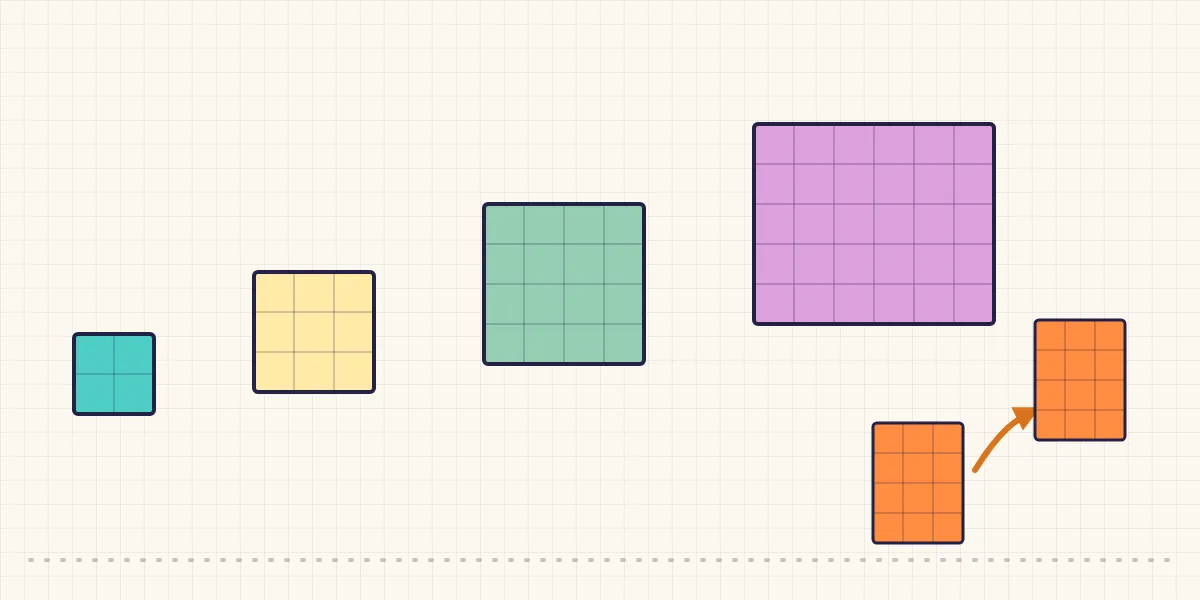
Week 1: What does “times” mean? Look for equal groups everywhere: egg boxes, muffin trays, window panes. Then build one: 3 rows of 4 buttons. How many? What changes if you turn the rectangle? That shows the turnaround fact before anyone learns it. More in Times tables as rectangles.
Week 2: The easy tables. Times 2 is doubling, times 10 adds a zero, times 5 is half of times 10: “10 × 6 = 60, half of that is 30.” Times 1 leaves the number as it is.
Week 3: Secure the core facts. Recall a few core facts every day, mixed, not in table order. Add the square facts such as 3 × 3 or 6 × 6, which children often remember well. Say the turnaround fact every time.
Week 4: Derive from 10 and 5. 9 × 6 is one six less than 10 × 6. 6 × 7 is one seven more than 5 × 7. Ask your child to say out loud which fact they start from.
Week 5: Derive the 3, 4, 6, 7 and 8 facts. Times 4 is double times 2, times 8 is double times 4. For hard facts like 7 × 8, ask: “Which fact nearby do you already know?”
Week 6: Mix and recall. Now comes fluency: short rounds of mixed facts, answered from memory. Put shaky facts on a separate note and practise them more often. After these six weeks, keep going with short reviews across the school year.
What you can do
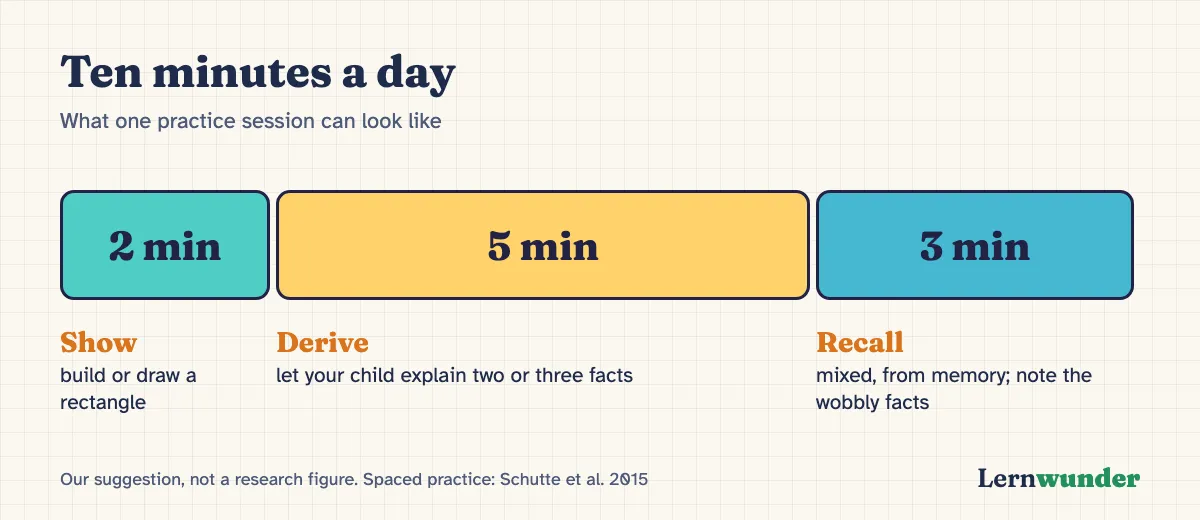
- Ten minutes, not an hour. Short and daily beats long at the weekend. If you can, split the ten minutes again, say five after school and five before dinner.
- Show first, then calculate. Build or draw every new fact once. A rectangle of squares in an exercise book is enough.
- Ask about the strategy. “How did you work it out?” matters more than “Correct!”. A child who gets 9 × 6 via 10 × 6 is on a good path, even if it still takes a bit longer.
- Mix instead of chanting. Reciting the seven times table forwards is not recall. Ask facts in random order.
- Collect the shaky facts. A note on the fridge with three to five “wobbly facts”. Two days in a row without a slip and a fact comes off.
- Start without a timer. Speed comes with confidence. If you want to work on speed, do it once the strategies are secure, and never by comparing with other children.
- Read the mistakes. 7 × 8 = 48 is a neighbouring-fact error, 3 × 4 = 7 a mix-up with adding. What such mistakes reveal is in Common times tables mistakes.
How Droptiply fits in
Droptiply practises the times tables in eight worlds that add tables in an order similar to the plan: first 1 and 10, then 5, then 2 and 4, then 3, then 6 and 9, then 7 and finally 8. Each fact is a block whose height and width are the two numbers, the rectangle from Week 1. Shaky facts come up more often, and turnaround facts count too. In Zen mode nothing falls on its own; children place blocks at their own pace. For adults, an overview shows all 100 facts as a grid, so you can see which ones are still wobbly.
The app does not replace Weeks 1 and 4: building, drawing and talking about strategies happen at the table. It suits the short recall rounds from Week 3 onwards. More on the Droptiply page.
Frequently asked questions
My child can recite the tables. Isn’t that enough? Reciting shows the sequence is secure. Whether a child can recall 7 × 6 without starting at 7 × 1 only shows up in a mixed quiz. Both are fine, but the goal is direct recall.
School teaches one table after another. Should I practise differently? Follow the school and add to it: with every new table, show how it links to the core facts. Contradicting school confuses children more than a different route helps.
What if my child doesn’t know everything after six weeks? That is normal. In England, the full set up to 12 × 12 is a Year 4 expectation (Department for Education, 2013), and in the German study many children were not there yet at the end of Year 3 (Gleißberg et al., 2025). If a child still counts even for the core facts, talk to the teacher. An app does not replace an assessment.
How long should a practice session be? We suggest about ten minutes. That is not a research figure but a practical size that fits the findings on spaced practice (Schutte et al., 2015).
Sources
- Department for Education (2013). National curriculum in England: mathematics programmes of study (updated 2021). https://www.gov.uk/government/publications/national-curriculum-in-england-mathematics-programmes-of-study/national-curriculum-in-england-mathematics-programmes-of-study
- Gleißberg, S., Eichler, K.-P. & Seibold, M. (2025). Mastering the basic facts of multiplication and division till the end of grade 3 – selected results of a longitudinal study. Proceedings of CERME14, TWG02. https://hal.science/hal-05162091
- ISB Bayern (n.d.). LehrplanPLUS Grundschule, Mathematik, Jahrgangsstufe 1/2 (Bavarian primary curriculum). https://www.lehrplanplus.bayern.de/fachlehrplan/grundschule/2/mathematik
- Kultusministerkonferenz (2022). Bildungsstandards für das Fach Mathematik Primarbereich (German national standards for primary mathematics). https://www.kmk.org/fileadmin/Dateien/veroeffentlichungen_beschluesse/2022/2022_06_23-Bista-Primarbereich-Mathe.pdf
- Schutte, G. M., Duhon, G. J., Solomon, B. G., Poncy, B. C., Moore, K. & Story, B. (2015). A comparative analysis of massed vs. distributed practice on basic math fact fluency growth rates. Journal of School Psychology, 53(2), 149–159. https://doi.org/10.1016/j.jsp.2014.12.003
- Taylor, K. & Rohrer, D. (2010). The effects of interleaved practice. Applied Cognitive Psychology, 24(6), 837–848. https://doi.org/10.1002/acp.1598
- Woodward, J. (2006). Developing automaticity in multiplication facts: Integrating strategy instruction with timed practice drills. Learning Disability Quarterly, 29(4), 269–289. https://doi.org/10.2307/30035554
Lernwunder editorial team · Chaolan Lu