
In short: PflegeMate has been on the App Store since this week. The app helps internationally educated nurses learn the German words and sentences they need on a German ward: just over 400 nursing terms in 18 categories, each with a picture, a translation, a short explanation and three example sentences – for the patient, a colleague and the doctor. PflegeMate is purely a language learning aid. It is not a medical reference and not exam preparation.
Since last summer we have written here about what the first weeks on a German ward are like, why a B2 certificate often isn’t enough for nursing German and why one word needs three sentences. PflegeMate grew out of those ideas. Today we’re introducing the first version as plainly as we can: what it does, who it’s for and where its limits are.
Who is PflegeMate for?
For nurses who trained abroad and are starting out in Germany – whether still in the recognition process, in an adaptation course or already in their first year on the ward. Nursing trainees whose first language isn’t German, and practice instructors who onboard new colleagues, can use it too.
Why this group? In an interview study with nurses trained in Germany who work alongside internationally qualified colleagues, participants named limited German as one barrier to integration into the team. Among the things they described as helpful were a structured orientation programme, a dedicated preceptor and specific language training (Roth et al., 2023). A learning app can only support the last of these – and only in part.
What’s inside the app?
Just over 400 nursing terms in 18 categories. Grouped the way you need them on the ward: from the patient’s bed and room to positioning, personal care, elimination, breathing, medication and wound care, through to documentation, lab work and equipment. Every noun is shown with its German article – “der Lagerungskeil” (the positioning wedge), not just “Lagerungskeil”.
Picture, translation and explanation. Each term comes with a picture, a translation and a short explanation in your own language, including Polish, Turkish, Romanian, Ukrainian, Arabic and English. The explanation matters because many nursing words have no one-to-one translation.
Three sentences per term. Every term appears in three example sentences: one addressed to the patient, one to a colleague, one to the doctor. We explained the idea in detail in One word, three sentences.
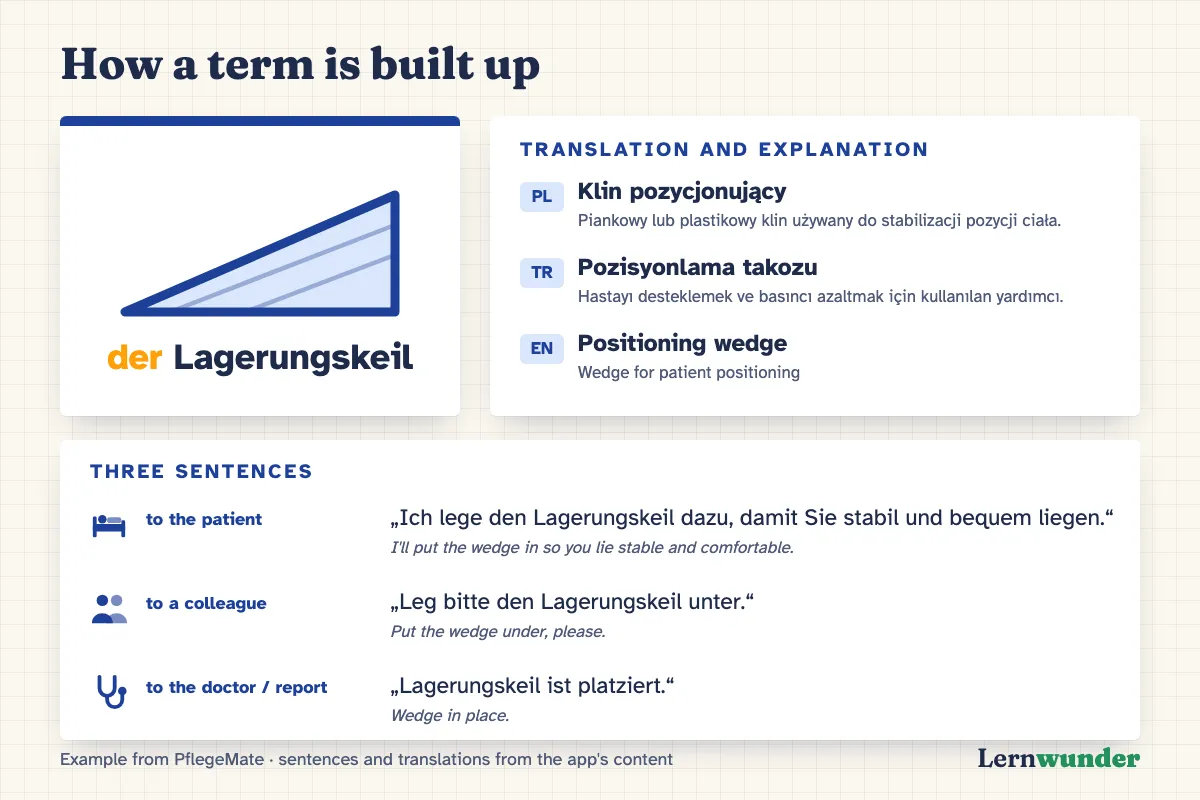
The example shows why the three sentences matter so much to us. To the patient: a full, friendly sentence using the formal “Sie” and a reason. To a colleague: a short request using the informal “du”. In the report: just the facts. A study in London hospitals describes exactly this work: nurses have to translate between everyday and medical language, reassure, instruct, ask questions and disagree politely – much of which general language tests barely assess (Sedgwick & Garner, 2017).
Built for everyday use. The app works offline, so it also works in the staff room without Wi-Fi. There is no account and no sign-up. You can mark difficult words as favourites and add your own notes to any term – for example what something is called on your own ward.
What PflegeMate is not
- Not a medical reference. The app explains words, not treatments. What applies on your ward is set out in your hospital’s standards and taught during onboarding.
- Not exam preparation. PflegeMate doesn’t specifically prepare you for a German medical language exam (Fachsprachprüfung) and doesn’t promise you’ll pass.
- Not a language course. Grammar, listening and free speaking are learned in a course and in conversation. A review of research on the oral communication challenges of internationally educated nurses stresses that learning a language is a long, multi-stage process that also includes the social and cultural sides of the profession (Lum et al., 2015). No app can do that alone.
- Not an emergency translator. Conversations about diagnoses or consent need interpreters or colleagues who speak the language – not a word list.
What’s still missing
A first version is a first version. Last autumn we wrote about two ideas that are not part of this release yet: a dedicated collection of ward abbreviations and audio in which every noun is spoken with its article. We’re still working on both. We’ll write about them here when they’re ready, and we won’t promise a date before then.
What you can do
If you’re learning nursing German:
- Five words a day rather than fifty on Sunday. Short sessions fit between two shifts more easily, and you come back to the same words more often.
- Say the three sentences out loud. Read them first, then say them without looking. Pay attention to the switch from “Sie” to “du”.
- Add your own ward. If a piece of equipment has a different name where you work, write it down. Your ward is your best vocabulary list.
- Ask. “Wie sagt man das hier?” (How do you say that here?) is a perfectly normal question on a German ward.
If you’re onboarding new colleagues: In the first week, walk through a patient room together once and name everything in it – with the article. It takes ten minutes and saves a lot of misunderstandings.
Frequently asked questions
Which languages are the explanations in? Among others Polish, Turkish, Croatian, Romanian, Ukrainian, Arabic, Spanish, French, Chinese and English. You choose your language when you first open the app.
Do I need internet or an account? No. All content is stored on the device, and there’s no sign-up.
Will PflegeMate help me pass the Fachsprachprüfung? The app practises vocabulary and typical sentences from everyday ward work. It isn’t targeted exam preparation, and we can’t and won’t promise that you’ll pass.
Is PflegeMate available for Android? At launch, PflegeMate is available on the App Store.
Find out more on the PflegeMate page.
Sources
- Lum, L., Dowedoff, P., Bradley, P., Kerekes, J. & Valeo, A. (2015). Challenges in oral communication for internationally educated nurses. Journal of Transcultural Nursing, 26(1), 83–91. https://doi.org/10.1177/1043659614524792
- Roth, C., Breckner, A., Wensing, M., Mahler, C., Krug, K. & Berger, S. (2023). Barriers and enabling factors for workplace integration of internationally qualified nurses: A qualitative study of perceptions of German nurses. Nursing Open, 10(8), 5225–5235. https://doi.org/10.1002/nop2.1760
- Sedgwick, C. & Garner, M. (2017). How appropriate are the English language test requirements for non-UK-trained nurses? A qualitative study of spoken communication in UK hospitals. International Journal of Nursing Studies, 71, 50–59. https://doi.org/10.1016/j.ijnurstu.2017.03.002
Lernwunder editorial team · Chaolan Lu