In short: A nursing handover (die Übergabe) follows a fixed pattern: who, what happened, current status, what’s still open. In German that means the perfect tense for what happened, the present tense for the current state, and “muss noch”, “ist geplant” or “bitte” for what’s coming – plus lots of clipped sentences. If you know the pattern and ask targeted questions, you’ll understand and speak with more confidence. Research shows that structure and questions make handovers more reliable.
A made-up but typical scene: 1:45 pm in the staff room. The colleague from the early shift hands over six rooms at speed. Sentences without verbs, abbreviations, a name you didn’t catch. After two minutes you’re three patients behind and don’t dare interrupt.
Many internationally educated nurses describe the handover as the hardest speaking situation of the day. That makes sense: everything we’ve covered in earlier posts comes together here, from switching registers to ward abbreviations. This post is purely about language: how handovers are built and how to practise them. What clinical content a handover must include is set by your hospital.
Why does handover matter so much?
At every handover, responsibility for patients changes hands. If information gets lost, it often only shows hours later. A systematic review of nursing handoffs grouped the barriers described in the literature into eight major categories and found remarkable consistency in the strategies recommended. High-quality studies on what actually works, however, were scarce at the time (Riesenberg et al., 2010).
That structure helps is shown by a large study across nine hospitals – among resident physicians rather than nurses: after a standardised handoff mnemonic and training were introduced, the rate of medical errors fell by 23 percent and preventable adverse events by 30 percent (Starmer et al., 2014). For the well-known SBAR format, a systematic review found moderate evidence of improved patient safety, especially for phone calls (Müller et al., 2018).
How is a handover built linguistically?
International research names typical problems: a lack of structure, incomplete handovers and too little explanation of what has been done and what still needs doing. An Australian research team recorded more than 800 real handovers and analysed their language. Their conclusion fits in one line: it isn’t the short handover that is good, but the interactive handover that is safe (Eggins & Slade, 2015).
Many hospitals use their own formats, often based on SBAR. Linguistically, nearly all of them come down to four steps, and each step has its typical German forms:
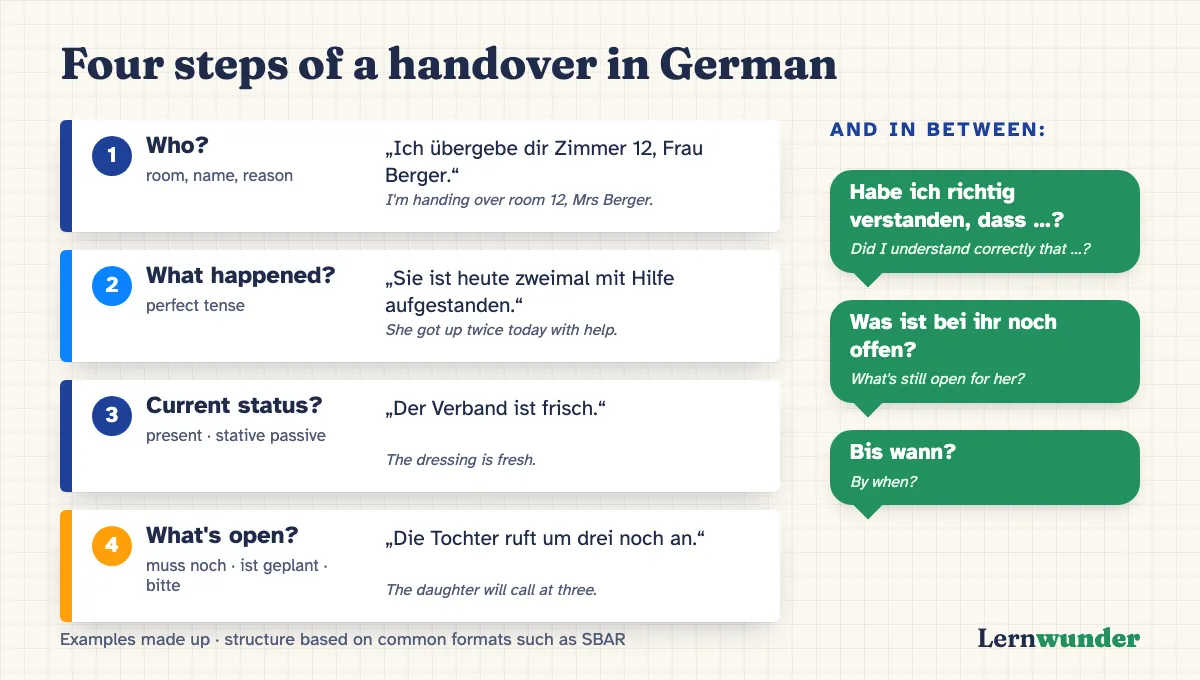
- Who? Room, name, often age and reason for admission: “Ich übergebe dir Zimmer 12, Frau Berger, 81, seit gestern bei uns.” (Room 12, Mrs Berger, 81, admitted yesterday.)
- What happened? Almost always in the perfect tense: “Sie hat gut geschlafen.” (She slept well.) “Sie ist zweimal mit Hilfe aufgestanden.” (She got up twice with help.) “Die Angehörigen waren da.” (Her family visited.)
- Current status? Present tense or stative passive: “Sie ist wach und orientiert.” (She’s awake and oriented.) “Der Verband ist frisch.” (The dressing is fresh.) “Sie ist gelagert.” (She has been repositioned.)
- What’s still open? Modal verbs and future: “Die Tochter ruft um drei noch an.” (The daughter will call at three.) “Ein Gespräch mit dem Sozialdienst ist für morgen geplant.” (A meeting with social services is planned for tomorrow.) “Bitte noch die Trinkmenge eintragen.” (Please still record her fluid intake.)
Names and situations in the examples are made up.
Where are the pitfalls?
Clipped sentences. In handovers, verbs and articles disappear: “Zimmer 5, alles ruhig, Verband gewechselt, Werte unauffällig.” (Room 5, all quiet, dressing changed, obs normal.) If you’re used to listening for full sentences, it’s easy to lose the thread. It helps to fill in the missing parts in your head: “Verband [wurde] gewechselt.”
Perfect tense, passive and separable verbs. “Der Arzt hat die Medikation umgestellt” (the doctor changed the medication), “Sie wird morgen verlegt” (she’s being transferred tomorrow), “Ich habe sie umgelagert” (I repositioned her): the key word often comes at the very end of the sentence. Stop listening too early and you may understand the opposite.
Numbers and times. “Um viertel vier”, “halb drei”, “am Vormittag”: German clock times vary by region and are a classic trap – “halb drei” means 2:30, not 3:30. When in doubt, check with digits: “Also 15.15 Uhr?”
Abbreviations and ward jargon. Every ward has its own. More in our post RR, BZ, i.v..
Not asking. The biggest pitfall is often not linguistic at all. New staff who feel unsure about their German ask fewer questions – yet questions are exactly what make a handover safe. In a bilingual hospital, nurses were trained to make handovers interactive. Before the training, handovers were mostly monologues with passive incoming nurses. Afterwards they became conversations in which both sides asked and clarified. Three things proved especially important: an explicit transfer of responsibility, actively engaged incoming nurses, and a clear structure (Pun et al., 2020).
What you can do
If you’re practising handovers in German:
- Learn the four steps by heart and always build your own handover in that order, even if your ward uses a different form.
- Practise the tenses separately. For a made-up patient, write three sentences in the perfect tense (what happened), three in the present (current status) and three with “muss noch” or “ist geplant” (what’s coming).
- Collect check-back questions you can say without thinking: “Kannst du das bitte noch mal sagen?” (Could you say that again?) “Was ist bei ihr noch offen?” (What’s still open for her?) “Bis wann?” (By when?) “Habe ich richtig verstanden, dass …?” (Did I understand correctly that …?)
- Summarise at the end. One sentence per room: “Also: Zimmer 12, Tochter ruft um drei an, Trinkmenge eintragen.” That way both sides notice if something is missing.
- Listen with a note sheet. A simple grid of your own – room, what happened, status, open – helps you keep up with the pace.
- Speak out loud, ideally with a colleague who gives you feedback. Handing over is speaking, not reading.
If you’re onboarding new colleagues: In the first weeks, speak a little more slowly, say room numbers and names clearly, and explicitly invite questions: “Frag ruhig, wenn was unklar ist.” (Just ask if anything’s unclear.) One sentence that takes away a lot of uncertainty.
How PflegeMate can help
PflegeMate isn’t handover software and isn’t a handover course. It does help with the vocabulary handovers are made of: for each term there’s a sentence for the patient, a short sentence for a colleague and a factual sentence for reporting to the doctor. Those last two often already sound like a piece of a handover. Saying them out loud practises exactly the clipped forms you’ll hear in the staff room.
PflegeMate is purely a language learning aid. It doesn’t replace your onboarding or your hospital’s handover rules. We described what the app does at launch; more on the PflegeMate page.
Frequently asked questions
How do I learn to give a handover in German? With a fixed sequence (who, what happened, status, what’s open), the right tenses and lots of speaking practice. Ask your ward for the template they use.
Is it rude to ask questions during handover? No. Questions are part of a safe handover (Eggins & Slade, 2015). Short, specific questions are professional.
What is SBAR? A format for reports and handovers: Situation, Background, Assessment, Recommendation. Many hospitals use it or their own variant (Müller et al., 2018).
Do colleagues use “du” during handover? In many teams yes, but not everywhere. If in doubt, ask.
Sources
- Eggins, S. & Slade, D. (2015). Communication in clinical handover: Improving the safety and quality of the patient experience. Journal of Public Health Research, 4(3), 666. https://doi.org/10.4081/jphr.2015.666
- Müller, M., Jürgens, J., Redaèlli, M., Klingberg, K., Hautz, W. E. & Stock, S. (2018). Impact of the communication and patient hand-off tool SBAR on patient safety: A systematic review. BMJ Open, 8(8), e022202. https://doi.org/10.1136/bmjopen-2018-022202
- Pun, J., Chan, E. A., Eggins, S. & Slade, D. (2020). Training in communication and interaction during shift-to-shift nursing handovers in a bilingual hospital: A case study. Nurse Education Today, 84, 104212. https://doi.org/10.1016/j.nedt.2019.104212
- Riesenberg, L. A., Leitzsch, J. & Cunningham, J. M. (2010). Nursing handoffs: A systematic review of the literature. American Journal of Nursing, 110(4), 24–34. https://doi.org/10.1097/01.NAJ.0000370154.79857.09
- Starmer, A. J., Spector, N. D., Srivastava, R., West, D. C., Rosenbluth, G., Allen, A. D. et al. (2014). Changes in medical errors after implementation of a handoff program. New England Journal of Medicine, 371(19), 1803–1812. https://doi.org/10.1056/NEJMsa1405556
Lernwunder editorial team · Chaolan Lu