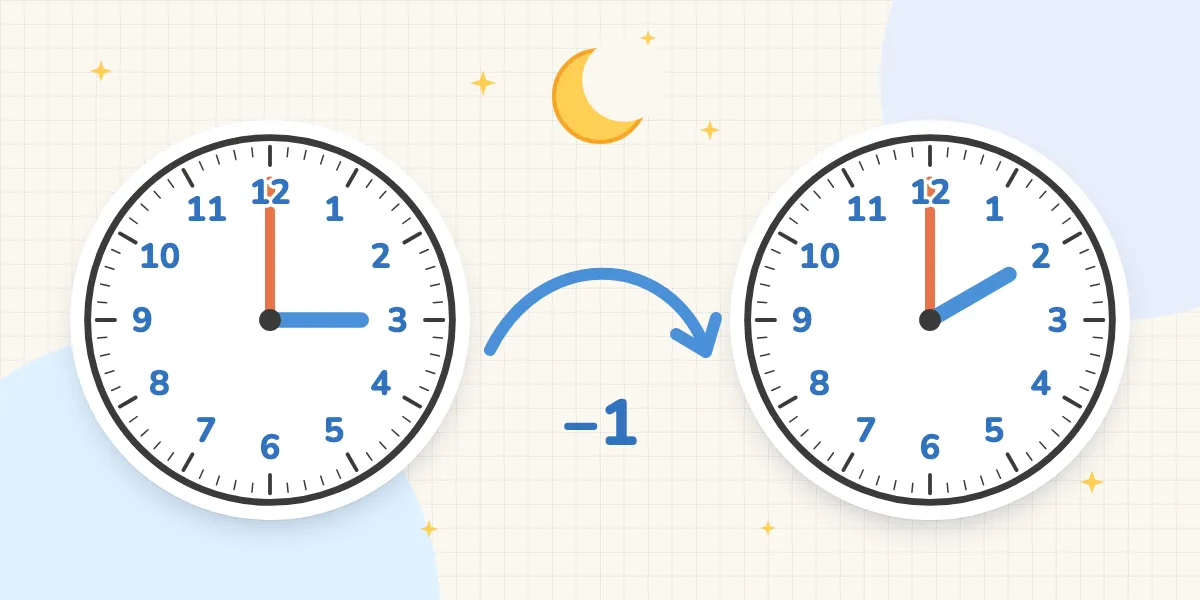
Short answer: On Sunday 25 October 2026 the clocks go back one hour, in the UK at 2 am British Summer Time and across the EU at 3 am Central European Summer Time. One hour happens twice, so that Sunday has 25 hours. A learning clock makes this easy to show: time itself does not change, only the number on the clock. Most people find the autumn change easier than the spring one, but the famous “extra hour in bed” is not guaranteed.
A made-up but typical breakfast scene: “The clocks go back tonight.” The child looks puzzled: “So tomorrow I’ll be back in yesterday?” It is a clever question. It shows that young children still treat clock time and time itself as the same thing. The clock change is a good moment to pull the two apart, through play.
What happens on the night of 24 to 25 October?
In the UK, the clocks go back one hour at 2 am on the last Sunday in October, from British Summer Time (BST) to Greenwich Mean Time (GMT). In 2026 that is 25 October (GOV.UK). The EU follows the same calendar: since 2001, a directive has required all member states to switch on the last Sunday of March and the last Sunday of October (European Commission). In Germany, for example, the official timekeeping institute PTB lists the end of summer time on 25 October 2026 at 3 am, when clocks return to 2 am. It even has names for the hour that happens twice: “2A” and “2B” (PTB).
Two details are worth knowing. First, the UK and the EU change at exactly the same moment, so the one-hour difference between London and Paris or Berlin stays the same. Second, the European Commission proposed ending seasonal clock changes in 2018, but no final decision has been taken (European Commission).
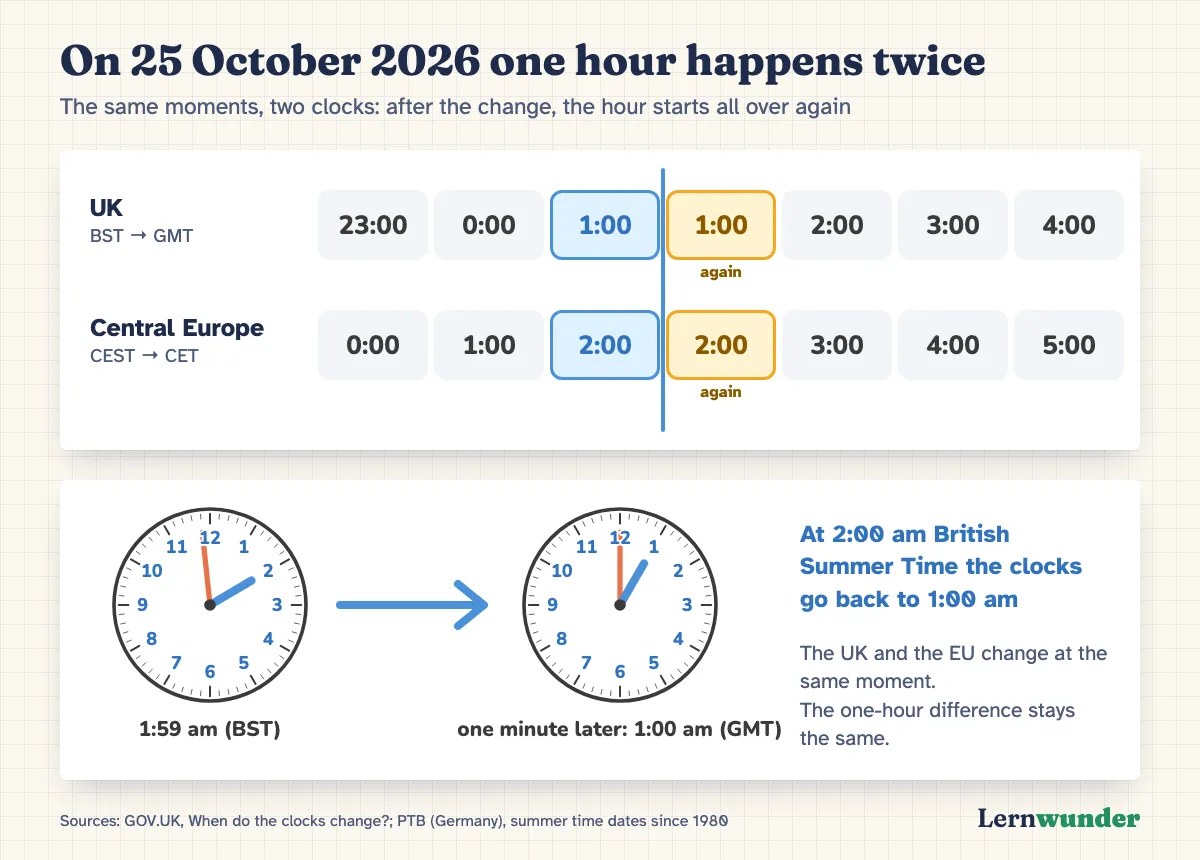
How do you explain the clocks going back to a child?
One sentence does most of the work: Time keeps going as usual, we only change the clock. Nobody gets younger, no day is repeated. We simply agree that from now on the time is “called” one hour earlier.
Why do we do it at all? Standard time, which in the UK is GMT, fits the sun better: at Greenwich the sun is highest in the sky at about midday GMT. Summer time moves the clock one hour forward, so mornings stay dark longer and evenings stay light longer. Supporters mainly point to that extra evening light after school and work (Crawford et al., 2024). From Sunday, the clock that matches the sun is back.
For children who can already read o’clock times, this explanation is often enough. When children typically manage which times is covered in When can children tell the time?. For younger ones it is enough to say: “Tonight we turn all the clocks back one hour.”
How does the clock change affect children’s sleep?
An honest answer starts with a caveat: research on children is thin. A systematic review of 27 studies covering ages 6 to 85 found mixed results. Negative effects on sleep duration, sleep quality and sleepiness showed up mainly after the spring change and in “evening types” (Romigi et al., 2025).
The autumn change is generally the gentler one. In a small study, 14 university students wore a wrist activity monitor for a week before and after each change. Sleep got noticeably worse after the spring change, much less so after the autumn one (Tonetti et al., 2013). Even in autumn, though, they got up earlier and slept slightly less overall. A review reached a similar conclusion: there is little evidence that people really gain an extra hour of sleep, and many wake earlier for several days afterwards (Harrison, 2013).
Families will recognise this. A child who usually wakes at 6:30 is likely to wake at 5:30 by the new clock at first, because their body clock does not know about the change. That is our own reasoning: we did not find a study of young children and the autumn change.
Sleep medicine societies in the US and the UK recommend ending the clock changes and keeping standard time all year (Rishi et al., 2020; Crawford et al., 2024). For your child that is no reason to worry, but it is a reason to be patient for a few days.
What you can do: six clock games for clock-change week
All you need is a learning clock with moving hands, ideally a home-made one. If your clock has colour-coded hands, the usual rule applies: hour hand blue, minute hand orange.
- Play the repeated hour. Set the clock to midnight and let your child turn the minute hand round and round. Just before 2 o’clock (or 3 o’clock if you live in central Europe) you call out “Clocks go back!”, and your child moves the hour hand back one hour. Then on again to 2. Ask: “How many times did the minute hand go round?” Three times, for two hours on the clock.
- Clock detectives. On Saturday, walk round your home and list every clock: oven, alarm clock, kitchen clock, car, phone. On Sunday morning, check: which ones changed by themselves, and which ones do we have to change? Phones usually do it on their own.
- Puzzle: how long did you sleep? Bed at 7:30 pm, awake at 6:30 am. On the clock that is 11 hours. That night it was really 12, because one hour happened twice. Count the whole hours on the learning clock first, then add the extra hour. This is elapsed time with a twist.
- The 25-hour day. Draw a strip with one box for every hour of Sunday, from midnight to midnight. Your child counts: 25 boxes. When was breakfast, when was lunch? Elapsed time, practised along the way.
- When does the sun set? Look at the clock at dusk on Saturday and on Sunday. On Sunday it shows roughly an hour less. The sun did not hurry, only the clock changed.
- Grandma abroad. Do you have family in another country? Ask: “What time is it at Grandma’s now?” Between London and Paris it is one hour, before and after the change, because both switch at the same moment.

And sleep? Some families move bedtime later in small steps over the days before; others simply expect an early wake-up on Sunday and plan a quiet morning. Both are practical rules of thumb, not research findings. Expect a few days on which your child is awake earlier than usual (Harrison, 2013).
How Tinu Time fits in
Tinu Time has no lesson on the clock change itself. It does practise the skills the change relies on, step by step. In the last stage, elapsed time, a green segment on the clock face shows how much time passes between two times. Tinu gives the same tip as our sleep puzzle: count the whole hours first, then the remaining minutes.
From the 24-hour stage onwards, two games open up that suit clock-change week. In Train Schedule, children read departure and arrival times and work out how long a journey takes. In Tinu’s World Trip, they work out the time difference between cities. The game deliberately uses standard-time differences, without summer time. How the app handles regional ways of saying the time, such as “quarter past” and “quarter after”, is described in our article on regional clock language.
An app does not replace the conversation at the kitchen table. In clock-change week, the real clocks around the house are the best learning material.
Frequently asked questions
Do the clocks go forward or back in autumn? Back, by one hour. The classic memory aid: spring forward, fall back.
Will my child get an extra hour of sleep? Not necessarily. Studies find little evidence of the extra hour, and many people wake earlier for several days afterwards (Harrison, 2013).
At what age can children understand the clock change? Even preschoolers can follow “we turn the clocks back” if they are allowed to turn a clock themselves. The repeated-hour puzzle needs a child who can read o’clock times confidently and count hours.
Are the clock changes being abolished? It was proposed in the EU in 2018 but has not been decided (European Commission). In the UK, the clocks go forward again on the last Sunday in March (GOV.UK).
You can find more about the app on the Tinu Time page.
Sources
- Crawford, M. R., Winnebeck, E. C., von Schantz, M., Gardani, M., Miller, M. A., Revell, V., Hare, A., Horton, C. L., Durrant, S. & Steier, J. (2024). The British Sleep Society position statement on Daylight Saving Time in the UK. Journal of Sleep Research, 34(2025), e14352. https://doi.org/10.1111/jsr.14352
- European Commission. Summertime (Directive 2000/84/EC; proposal of 12 September 2018). https://transport.ec.europa.eu/transport-themes/summertime_en
- GOV.UK. When do the clocks change? https://www.gov.uk/when-do-the-clocks-change
- Harrison, Y. (2013). The impact of daylight saving time on sleep and related behaviours. Sleep Medicine Reviews, 17(4), 285–292. https://doi.org/10.1016/j.smrv.2012.10.001
- Physikalisch-Technische Bundesanstalt (PTB). Sommerzeiten in der Bundesrepublik Deutschland ab 1980 [Summer time in Germany since 1980]. https://www.ptb.de/cms/ptb/fachabteilungen/abt4/fb-44/ag-441/darstellung-der-gesetzlichen-zeit/sommerzeiten-in-der-bundesrepublik-deutschland-ab-1980.html
- Rishi, M. A., Ahmed, O., Barrantes Perez, J. H. et al. (2020). Daylight saving time: An American Academy of Sleep Medicine position statement. Journal of Clinical Sleep Medicine, 16(10), 1781–1784. https://doi.org/10.5664/jcsm.8780
- Romigi, A., Franco, V., Scoditti, E., Milan, G., Ceriello, F., Centonze, D. & Garbarino, S. (2025). The effects of daylight saving time and clock time transitions on sleep and sleepiness: A systematic review. Sleep Medicine Reviews, 84, 102161. https://doi.org/10.1016/j.smrv.2025.102161
- Tonetti, L., Erbacci, A., Fabbri, M., Martoni, M. & Natale, V. (2013). Effects of transitions into and out of daylight saving time on the quality of the sleep/wake cycle: An actigraphic study in healthy university students. Chronobiology International, 30(10), 1218–1222. https://doi.org/10.3109/07420528.2013.812651
Lernwunder editorial team · Chaolan Lu