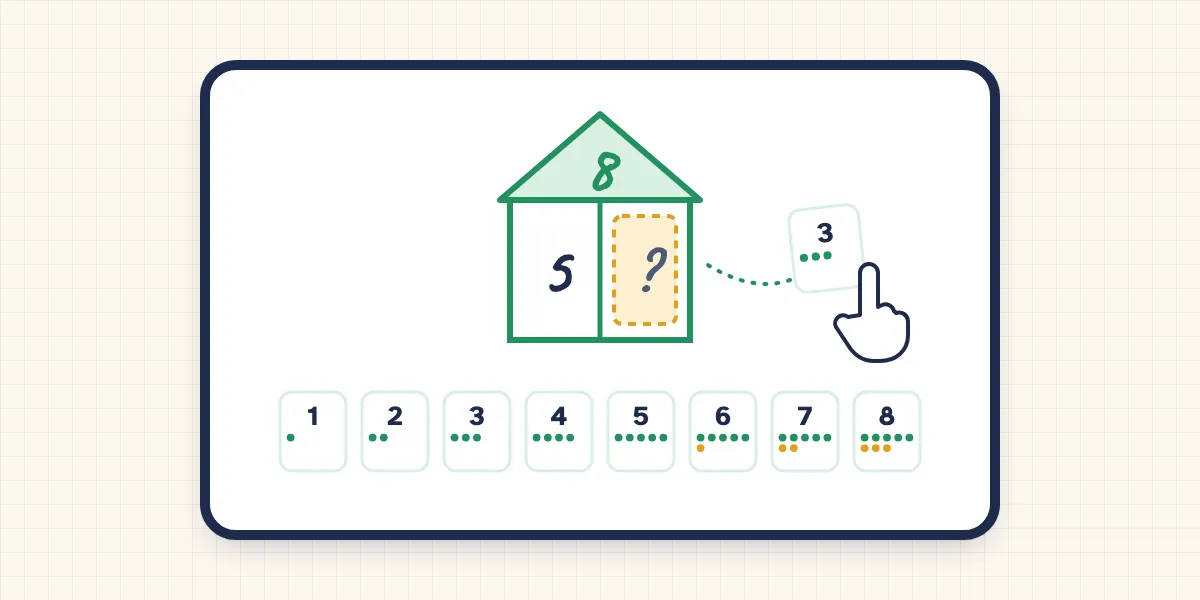
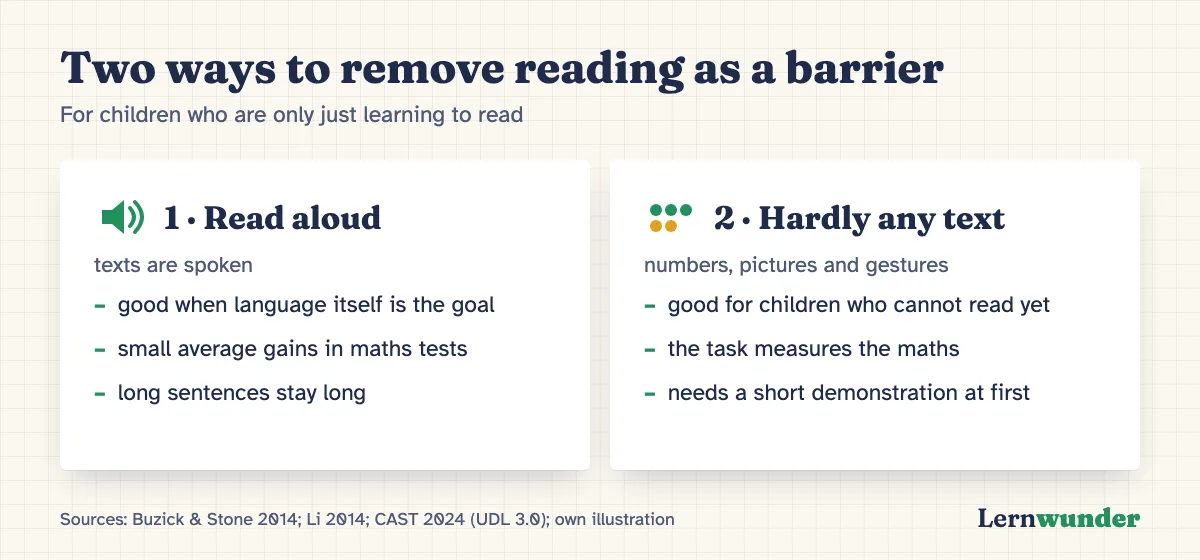
In short: Many children in their first year of school are only just learning to read. A maths app that requires reading then measures reading rather than maths. Language and maths skills are closely linked, and linguistically simpler tasks help especially those children for whom language is a barrier. There are two ways to remove reading from the equation: read texts aloud, or design an app so that it barely needs text. In Zahlzerlegung we chose the second way.
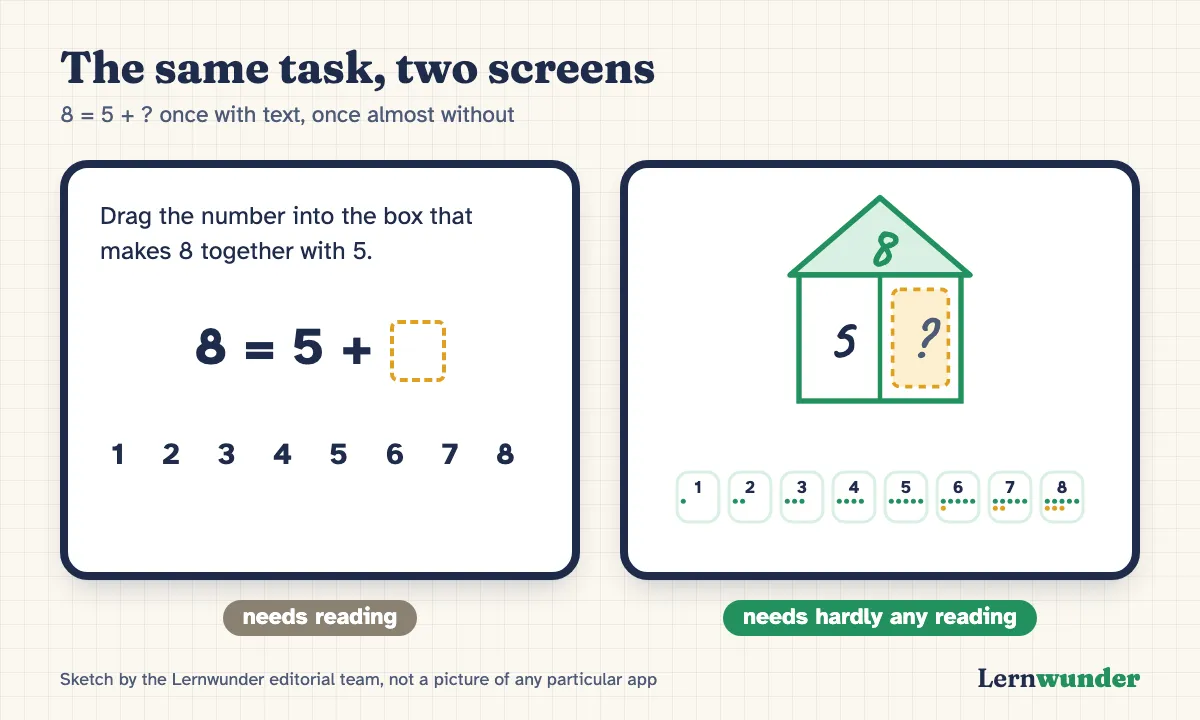
A made-up but typical scene: a six-year-old boy, half a year into school, opens a maths app. At the top it says: “Drag the number into the box that makes 8 together with 3.” He taps somewhere, then somewhere else, then calls out: “Mum, what am I supposed to do?” He has known that 8 = 3 + 5 for a while. The sentence above it, not yet.
How closely are reading and maths linked?
More closely than many people think. A meta-analysis of 344 studies with more than 360,000 participants found a moderate relationship between language and mathematics skills (r = .42). The more complex the tasks, the stronger the link. And each area predicted the development of the other, even after taking the starting level into account (Peng et al., 2020).
Word problems make this especially clear. In a study of 225 Grade 4 children, performance on maths word problems was strongly related to reading comprehension, even after accounting for how fluently the children read (Vilenius-Tuohimaa, Aunola & Nurmi, 2008). A child who does not understand a word problem cannot solve it, however good they are at calculating.
What happens when the language is simplified?
A research group tested this with maths items from a large US school assessment. They rewrote the items in simpler language without changing the maths. In interviews, students usually preferred the simplified versions, and in a test with 1,174 eighth graders they scored slightly higher on them. Students in lower-level maths classes, English language learners and students from low-income families benefited most (Abedi & Lord, 2001).
The study involved eighth graders, not first graders. But the idea transfers, and this is our own view: the less reading a task requires, the more likely it is to measure what it is meant to measure.
Does reading the text aloud help?
Partly. Two meta-analyses examined what read-aloud accommodations achieve in tests. Both found that students with and without disabilities benefit, students with disabilities more so. But the effect was clearly larger in reading tests than in maths tests. In maths, the average gains were small (Buzick & Stone, 2014; Li, 2014). Reading by a person also worked better than a computer voice or recording (Li, 2014).
These studies mostly concern older students and exams, not learning apps for six-year-olds. Still, they show that reading aloud is a help, not a cure-all. A child who hears a task but cannot hold the long sentence in mind faces the same barrier.
What is Universal Design for Learning?
Universal Design for Learning (UDL) is a framework for designing learning so that it is accessible to as many learners as possible from the start. The current guidelines recommend, among other things, offering several ways to perceive information, supporting the decoding of text, mathematical notation and symbols, and illustrating content through multiple media (CAST, 2024).
For a maths app for six-year-olds, this means reading should never be the entry ticket to maths. Whether that is solved with speech, pictures or both depends on what the app is meant to teach.
What you can do
- The no-explanation test. Give your child a new app and say nothing. Can they manage alone? If not, text is often the reason.
- Read word problems aloud. With homework, reading is a separate task. Read maths stories aloud so the maths stays in focus.
- Tell maths stories. “There are eight biscuits on the plate. You eat three. How many are left?” Spoken maths is the best preparation for written maths.
- Pictures before words. Dot patterns, fingers and dice patterns carry quantities without a single word.
- Talk about maths in your home language. Language and maths strengthen each other (Peng et al., 2020), in any language.
- Show first, then step back. A short demonstration is often enough for a child to use a text-free app independently.
How we approached it in Zahlzerlegung
Our app Zahlzerlegung does not talk. It has no voice output and no sounds at all. Instead, we chose the second way: the app works almost without text.
- The task is the picture. The whole number is at the top, two parts below it, one of them missing. There is no instruction to read.
- Numbers with quantity pictures. Every number key shows the numeral and a quantity picture. A child who does not yet recognise the 7 with confidence sees seven dots. Why we offer different quantity pictures is explained in a separate article.
- Feedback without words. A coloured frame and the solution show whether an answer is right, not a sentence.
- Text only where adults act. Words appear almost only when creating a child profile and in the settings.
This has limits too, and we are open about them: without language, the app cannot explain anything. The first time, a child usually needs a short demonstration by an adult. And so far the app has only been released in German, even though it needs hardly any German to use.
Speech can still make sense in an app, namely when language itself is the learning goal. In PflegeMate, our language learning aid for German nursing terminology, every term and every example sentence is recorded, because pronunciation and listening are exactly what it is about. More on this in our article on PflegeMate’s launch.
Frequently asked questions
Does a maths app for Year 1 have to talk? Not necessarily. It has to work without reading. That can be done with voice output or with a design that needs almost no text.
Does reading maths problems aloud help? A little. In meta-analyses, gains in maths tests were small on average and larger in reading tests (Buzick & Stone, 2014; Li, 2014).
My child already reads well. Does this still matter? Less so. But good readers also benefit when a task does not demand more language than necessary (Abedi & Lord, 2001).
Is Zahlzerlegung suitable for children who speak another language at home? The app needs hardly any German to use. But it has only been released in German and does not explain anything in other languages.
Sources
- Abedi, J. & Lord, C. (2001). The language factor in mathematics tests. Applied Measurement in Education, 14(3), 219–234. https://doi.org/10.1207/S15324818AME1403_2
- Buzick, H. & Stone, E. (2014). A meta-analysis of research on the read aloud accommodation. Educational Measurement: Issues and Practice, 33(3), 17–30. https://doi.org/10.1111/emip.12040
- CAST (2024). Universal Design for Learning Guidelines version 3.0. https://udlguidelines.cast.org/
- Li, H. (2014). The effects of read-aloud accommodations for students with and without disabilities: A meta-analysis. Educational Measurement: Issues and Practice, 33(3), 3–16. https://doi.org/10.1111/emip.12027
- Peng, P., Lin, X., Ünal, Z. E., Lee, K., Namkung, J., Chow, J. & Sales, A. (2020). Examining the mutual relations between language and mathematics: A meta-analysis. Psychological Bulletin, 146(7), 595–634. https://doi.org/10.1037/bul0000231
- Vilenius-Tuohimaa, P. M., Aunola, K. & Nurmi, J.-E. (2008). The association between mathematical word problems and reading comprehension. Educational Psychology, 28(4), 409–426. https://doi.org/10.1080/01443410701708228
Lernwunder editorial team · Chaolan Lu