In short: There is no single right way to group students. Group work does slightly better on average than teaching without groups, but composition affects students differently: lower attainers gain from mixed-ability groups, while high attainers often do better in similar-ability groups. At the start of the year, a rotation works well: frequent visibly random groups, deliberate grouping for practice tasks, and friendship wishes where trust matters.
First week back, a new class, 26 names on the register, and some of them you still can’t match to a face (an invented scene, but a familiar one). Even so, the first group task is planned for Thursday. Who works with whom? You know little about strengths and friendships yet. The students know a great deal about both, which is exactly what makes the question tricky.
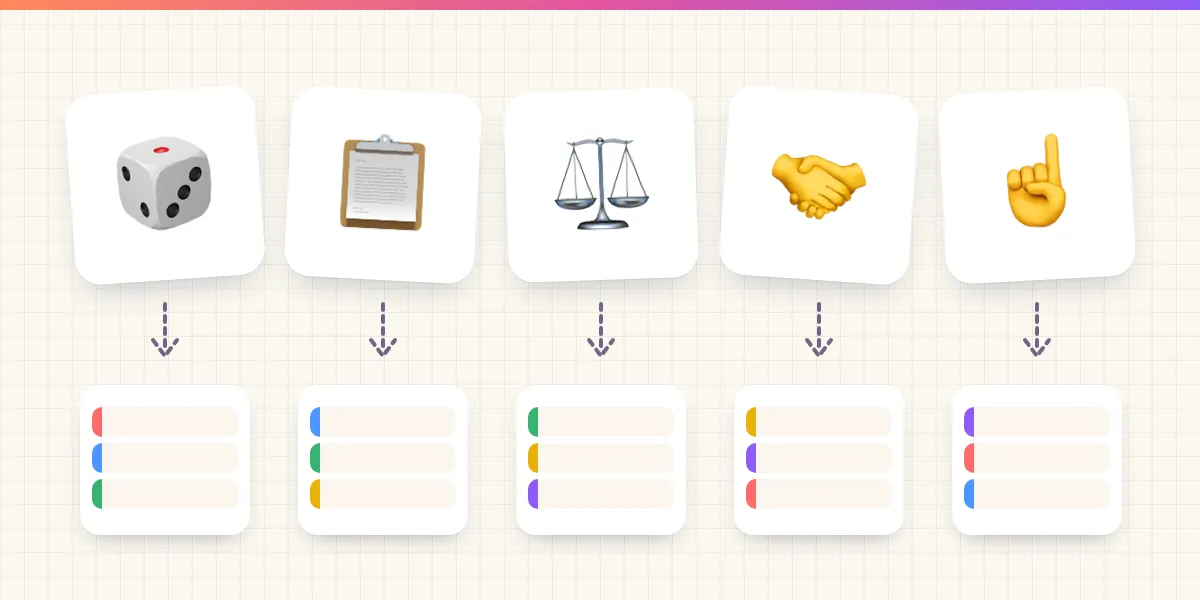
Grouping students simply means deciding by which rule students come together for a task. Five rules are common. Each has strengths, and none fits every lesson.
Is group work worth it at all?
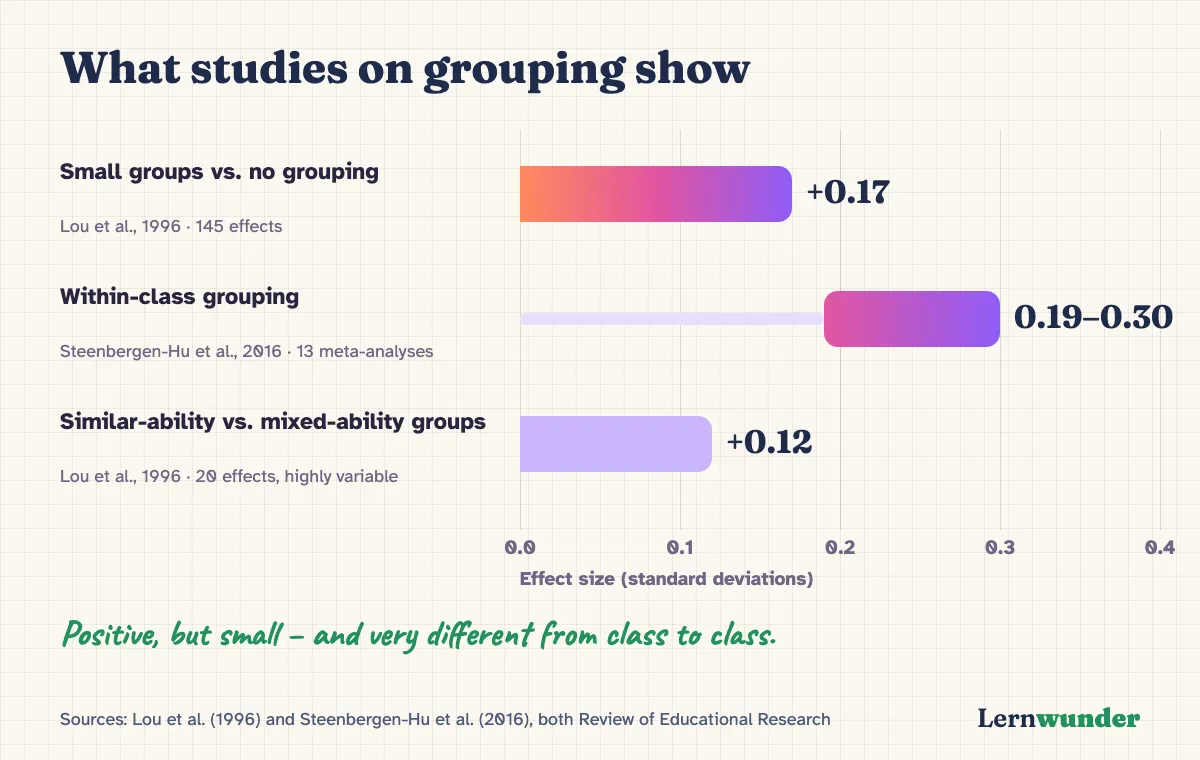
Yes, a little, on average. A large meta-analysis pooled 145 effects from studies that compared small-group learning with teaching without groups. The average advantage was 0.17 standard deviations in favour of small groups. Results varied widely, though, and the authors stress that group work only pays off when methods and materials are adapted for it (Lou et al., 1996).
A later review of 13 meta-analyses covering about a hundred years of research puts the effect of within-class grouping between 0.19 and 0.30, with similar gains for high, average and lower attainers (Steenbergen-Hu et al., 2016). Not a miracle, but noticeable in everyday teaching.
Mixed-ability or similar-ability: who benefits?
This is where it gets interesting, because the answer depends on whom you look at. In the same meta-analysis, 20 effects directly compared similar-ability with mixed-ability groups. On average the similar-ability groups came out slightly ahead (0.12), but again the results were spread widely (Lou et al., 1996).
One study looked more closely, in 21 eighth-grade science classes. Students worked on tasks alone, then in groups, then alone again. Groups with at least one above-average student explained better and answered more accurately. Lower attainers who had worked with stronger peers scored higher afterwards than lower attainers who hadn’t. High attainers generally did a little better in similar-ability groups, yet the gain for lower attainers was bigger than the cost for high attainers (Webb et al., 1998).
The key is explaining. A review of the teacher’s role finds one thread running through many observation studies: students learn most when they explain their thinking, and when the teacher encourages this from the moment groups are formed and the task is set (Webb, 2009).
Five ways to group students: what speaks for each?
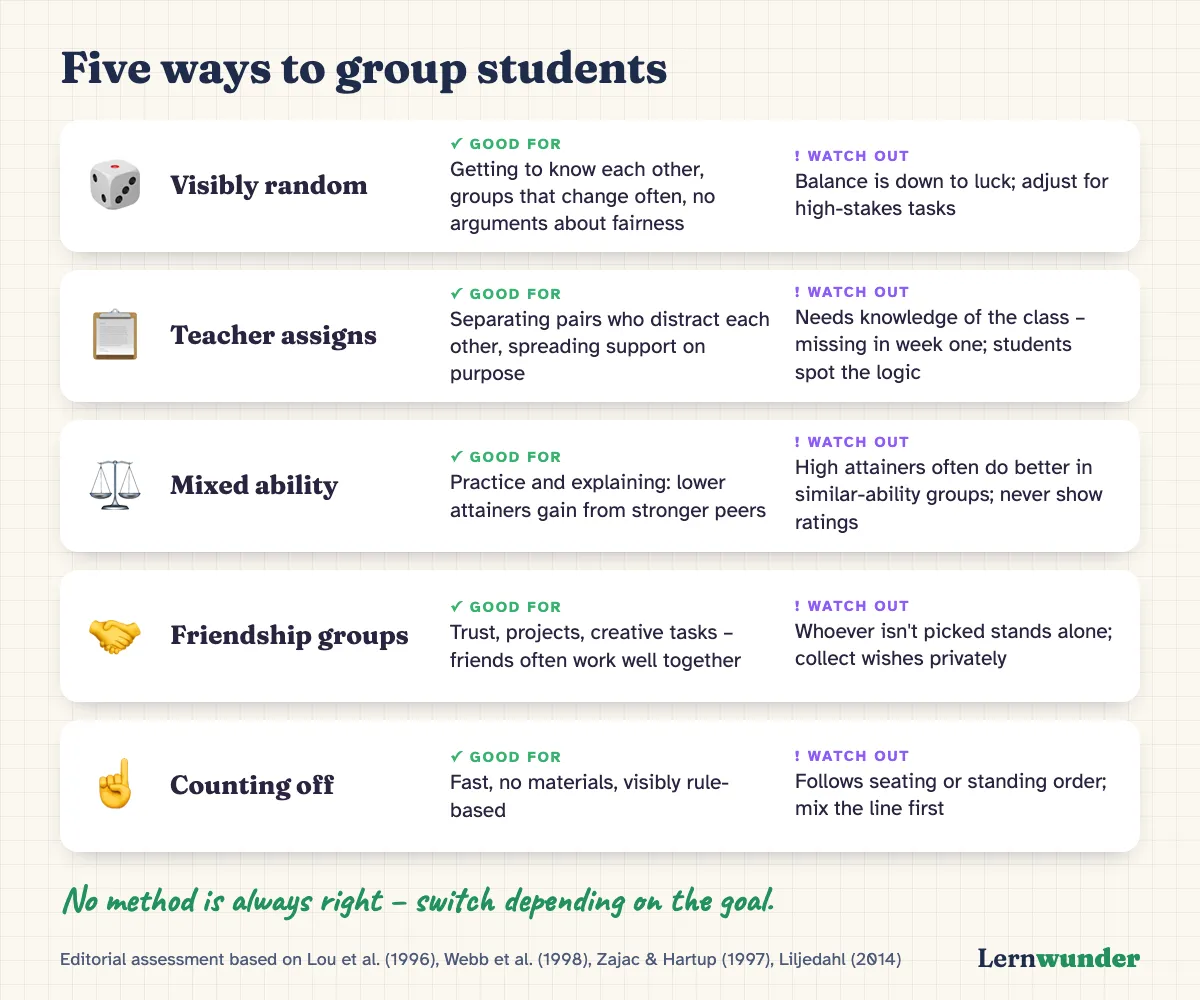
1. Visibly random groups. In a Canadian maths class of 30 students, everyone drew a playing card at the start of the lesson, matching values formed groups of three, new every day. At first some students swapped cards to end up with friends. After three to four weeks the researcher observed that students worked with any group, social barriers in the class faded, knowledge moved between groups and students relied less on the teacher (Liljedahl, 2014). It is an observation study of one class without a comparison group. The idea still convinces: when everyone sees that chance decided, nobody needs to argue about fairness.
2. The teacher assigns groups. You stay in control, separate pairs who distract each other and spread support. In the first week you often lack the knowledge to do this well. And students quickly work out the logic, especially if there is “the clever group”.
3. Mixed-ability groups. For practice tasks where explaining helps, there is a lot to be said for them (Webb et al., 1998). What matters is that ratings are never made public.
4. Friendship groups. A review of 13 studies found that friends usually work better together than non-friends on problem solving, creative tasks and reaching agreement in discussion, though mostly studied in pairs (Zajac & Hartup, 1997). The catch: free choice produces children nobody chooses. We wrote about what that does in “Picked last?”.
5. Counting off. Quick and needs no materials, but it follows the seating or standing order. Anyone standing next to their best friend knows where to stand.
What you can do in class
For the first weeks we suggest rotating methods. This is our recommendation drawn from the findings above, not a rule from the studies.
- Start with visibly random groups. Playing cards, coloured pegs, lolly sticks with names. Groups of three or four, new every day or every week. Everyone gets to know everyone, and you get to know the class.
- Draw in front of the class. The effect depends on everyone seeing that nobody stacked the deck.
- Collect wishes privately. Each student writes two names on a slip and you guarantee one. You keep the benefit of friendship without leaving anyone out.
- Mix before counting off. Line up by birthday first, then “one, two, three, four”. Desk neighbours no longer land together automatically.
- Assign groups deliberately for practice. From about week three you know enough to mix abilities and separate distracting pairs.
- Practise explaining. Sentence starters on the board help: “I did it this way because …”, “Can you show how you …”.
- Say why. “Random today, I’m choosing tomorrow.” Students who know the rule argue less about the result.
How we solved it in Ene Mene Miste
Ene Mene Miste is our tool for exactly this moment. On the projector the app shuffles visibly: a box rattles, then the teams appear. That is the visible randomness of method 1.
If you want mixed-ability teams, you give a person a skill level of one to three stars in their personal panel, and the app balances the teams. The stars appear only in that panel on your device, never on the team cards and never on the projector. The app does not build similar-ability groups; for that, it’s better to assign groups yourself. Wishes can be stored as “Always together with …”, distracting pairs as “Better apart from …”.
Since version 1.1 the app avoids putting the same people together time after time, and one tap turns the teams into expert groups for a jigsaw. If something doesn’t fit, tap a person to move them. The app suggests, you decide.
Frequently asked questions
How big should groups be? The studies cited here don’t give a fixed number. Liljedahl’s class used groups of three. For discussion, three or four tends to work in practice; bigger groups easily split into subgroups.
How often should I reshuffle? Often at the start of the year, so everyone works with everyone. Fixed groups pay off for longer projects once the class knows each other.
Are high attainers held back in mixed groups? Slightly, on average. In the study by Webb and colleagues the cost for high attainers was smaller than the gain for lower attainers. So rotate between mixed-ability and other groups.
Should I take friendships into account? Yes, but privately. Ask for written wishes instead of public picking, and nobody is left standing.
Sources
- Liljedahl, P. (2014). The affordances of using visibly random groups in a mathematics classroom. In Y. Li, E. Silver & S. Li (Eds.), Transforming Mathematics Instruction (pp. 127–144). Springer. https://doi.org/10.1007/978-3-319-04993-9_8
- Lou, Y., Abrami, P. C., Spence, J. C., Poulsen, C., Chambers, B. & d’Apollonia, S. (1996). Within-class grouping: A meta-analysis. Review of Educational Research, 66(4), 423–458. https://doi.org/10.3102/00346543066004423
- Steenbergen-Hu, S., Makel, M. C. & Olszewski-Kubilius, P. (2016). What one hundred years of research says about the effects of ability grouping and acceleration on K–12 students’ academic achievement. Review of Educational Research, 86(4), 849–899. https://doi.org/10.3102/0034654316675417
- Webb, N. M. (2009). The teacher’s role in promoting collaborative dialogue in the classroom. British Journal of Educational Psychology, 79(1), 1–28. https://doi.org/10.1348/000709908X380772
- Webb, N. M., Nemer, K. M., Chizhik, A. W. & Sugrue, B. (1998). Equity issues in collaborative group assessment: Group composition and performance. American Educational Research Journal, 35(4), 607–651. https://doi.org/10.3102/00028312035004607
- Zajac, R. J. & Hartup, W. W. (1997). Friends as coworkers: Research review and classroom implications. The Elementary School Journal, 98(1), 3–13. https://doi.org/10.1086/461881
Lernwunder editorial team · Chaolan Lu