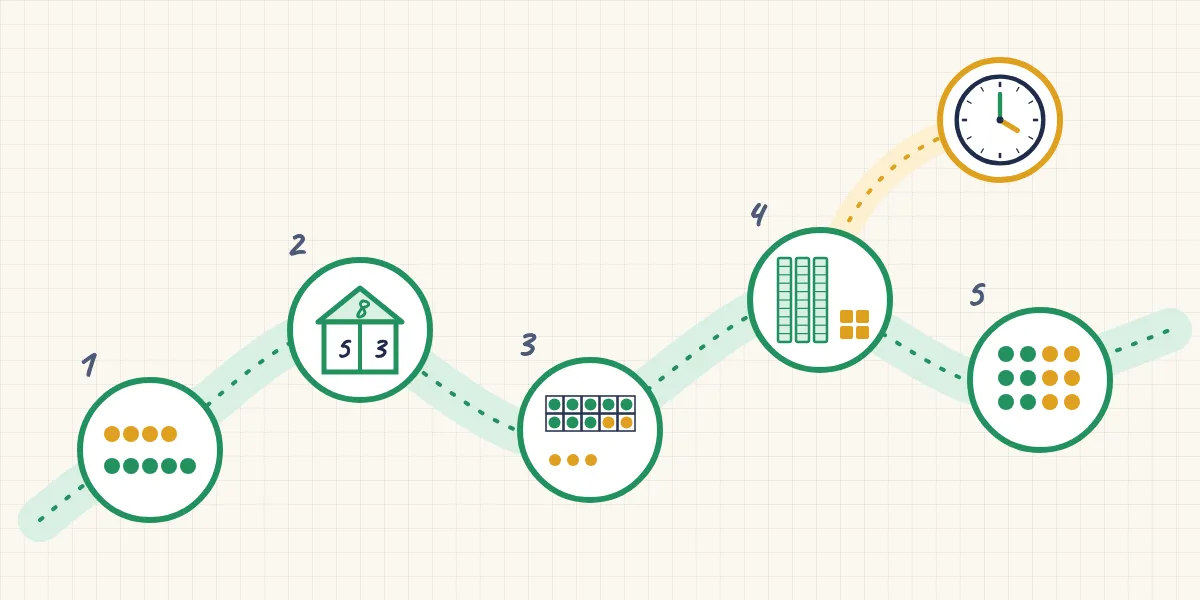
In short: The foundations of primary maths build on each other: comparing and recognising quantities, number bonds, bridging ten, place value, then the times tables. Telling the time is an application that needs many of these steps. Developmental models and longitudinal studies support this order; education standards describe the destination. Two stations already exist as Lernwunder apps, and we are working on two more.
An invented but typical scene: a girl in year 2 is learning her times tables. For 6 × 4 she goes 4, 8, 12 and then counts on her fingers from there. Her parents practise the four times table every evening, but she does not get faster. The problem is not the times tables. It sits two or three stations earlier: at 12 + 4, at bridging ten, at splitting small numbers.
Primary maths is not a pile of separate topics. It is a path. We call it the learning path. In this article we show which stations it has, why they come in this order and what we offer along the way.
Why does primary maths have an order?
Because each station provides tools that the next one needs. Researchers speak of learning trajectories: children move through typical levels of thinking, and teaching works best one level above where a child is now.
A small study tested exactly that. Thirteen kindergarten children were taught addition and subtraction one level above their current level. Twelve children got the same amount of teaching, but at least two levels higher, skipping levels. More children in the first group learned more (Clements et al., 2020). The groups were very small, so this is a hint, not proof.
What about national standards? The German education standards for primary maths, for example, describe what children should be able to do by the end of year 4 (in Germany, age 9 to 10): understand the place value system, know basic facts such as number bonds, addition facts and the times tables by heart, and work with quantities such as time spans (KMK, 2022). They explicitly do not set an order. Standards describe the goal, not the route.
What does research say about the first steps?
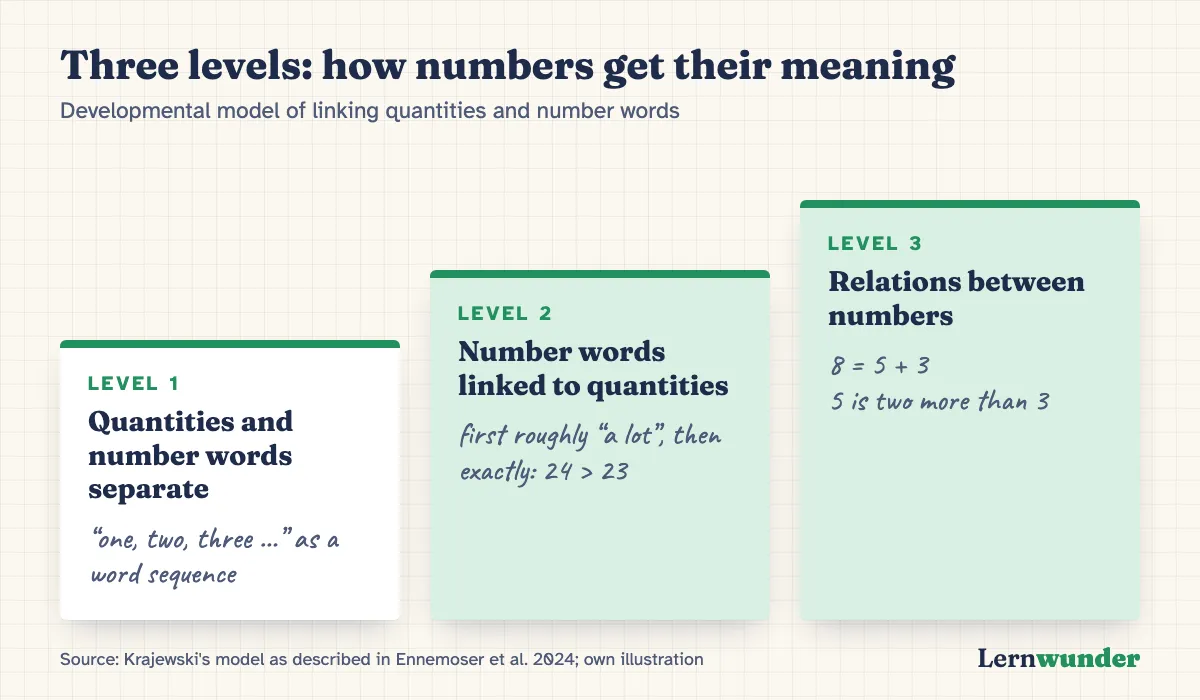
For the beginning there is a well-studied developmental model, Krajewski’s model of linking quantities and number words. Ennemoser and colleagues describe it like this (Ennemoser et al., 2024):
- Level 1: children tell quantities apart and know number words, but the two are not yet linked. “Three” is just a word in a sequence.
- Level 2: number words are linked to quantities, first roughly (“a lot”, “a little”), then exactly: 24 is more than 23.
- Level 3: children understand relations between numbers. 8 can be split into 5 and 3, and 5 is exactly two more than 3.
The same paper followed 575 first graders. 119 of them were at risk of maths difficulties. Children who received twelve support sessions built on these levels did better in school maths six months later, and the advantage was still there 15 months after the sessions (Ennemoser et al., 2024). Right after the sessions the effect was not yet visible. Foundations take time to show up in school maths.
What are the stations of the learning path?

1. Comparing and recognising quantities. Where is more, where is less, how many are there without counting? A meta-analysis with 17,201 participants found that comparing quantities (r = .24) and digits (r = .30) is reliably linked to maths achievement (Schneider et al., 2017). In a study with 378 children, first graders already used groups in dot patterns to recognise amounts faster; kindergarten children did not yet (Starkey & McCandliss, 2014). This is the step from subitizing to seeing structure. More in More, less or the same? and The power of five.
2. Number bonds. 8 is 5 and 3, 6 and 2, 4 and 4. That is level 3 in the model above and the basis for moving beyond counting-based calculation. Why it matters so much is explained in Number bonds: why 8 = 5 + 3 is the key to arithmetic.
3. Bridging ten. Many children work out 8 + 5 as 8 + 2 + 3. For that they need to know that 8 and 2 make 10 and that 5 splits into 2 and 3. This is not a study finding but the logic of the task: without number bonds, the only way across ten is counting on.
4. Place value. The 3 in 34 means three tens. In a longitudinal study, first graders’ place value understanding reliably predicted specific aspects of their addition performance in year 3 (Moeller et al., 2011).
5. Times tables. Most multiplication facts can be derived from a few core facts, for example 6 × 4 from 5 × 4 plus 4. That requires confident calculation up to 100, which means all the stations before. More in Core facts.
Side path: telling the time. Reading a clock is applied maths: counting in fives, halves, quarters, crossing the full hour. In a study with 725 children, those with maths difficulties struggled especially with five-minute and one-minute times, and their errors pointed to immature counting strategies and weak fact retrieval (Burny et al., 2012). Why clocks are so hard is the topic of Telling the time: why reading an analogue clock is so hard.
Does every child have to follow this order strictly?
No. The stations overlap. A child may already read o’clock times while still practising number bonds to 10. Many children count to 100 before they can bridge ten. The learning path is a guide, not a railway track.
It helps most when something gets stuck. Our own conclusion, based on the studies above: if a child is stuck at one station, look at the one before. More practice of the same material usually helps less than a step back.
What you can do
- Find the current station. Five short questions, one per station: “Which plate has more biscuits?” – “How many dots can you see without counting?” – “How many more from 7 to make 10?” – “How do you work out 8 + 5?” – “What does the 3 in 34 mean?”
- Step back when stuck. If the times tables are hard, check addition and subtraction to 20. If bridging ten is hard, check number bonds to 10.
- Structure instead of counting. Lay out amounts in rows of five, in egg boxes or on ten frames so your child can see them at a glance.
- Ask about the method. “How did you work that out?” tells you more than the answer.
- The clock on the side. O’clock and half past can be talked about early in everyday life; minutes come later.
- If worries persist, our article Recognising maths difficulties can help.
What already exists and what we are working on
We build our apps along this path, one app per station, based on proven primary maths teaching. As of today:
- Number bonds: Zahlzerlegung has been available since October 2025. It practises number bonds to 10 with children aged about 5 to 7 and is available in German only.
- Times tables: Droptiply has been available since April 2026, for children aged about 6 to 12.
- Telling the time: we are working on Tinu Time. How we picture the route in nine stages is described in Analogue before digital.
- Comparing quantities: we are working on a pirate game in which children compare quantities.
- Further topics such as bridging ten and place value are on our list.
An app does not replace teaching or a diagnosis. It can help practise one station. Children walk the path with people.
Frequently asked questions
In what order do children learn maths in primary school? Roughly: comparing and recognising quantities, number bonds, addition and subtraction to 20 including bridging ten, place value up to 100, then the times tables. How this is spread over school years differs between curricula.
Do education standards prescribe this order? No. The German standards, for example, describe what children should be able to do at the end of year 4 and state explicitly that the order of the list implies no weighting (KMK, 2022).
My child is in year 2 and still counts. Is it too late? No. Go back to quantities and number bonds. Support along the early stations still worked for at-risk first graders in research (Ennemoser et al., 2024).
Where does the clock fit in? It is not a station on the main path but an application that combines counting in fives, fractions such as half and quarter, and calculating across a boundary.
Sources
- Burny, E., Valcke, M. & Desoete, A. (2012). Clock reading: An underestimated topic in children with mathematics difficulties. Journal of Learning Disabilities, 45(4), 351–360. https://doi.org/10.1177/0022219411407773
- Clements, D. H., Sarama, J., Baroody, A. J. & Joswick, C. (2020). Efficacy of a learning trajectory approach compared to a teach-to-target approach for addition and subtraction. ZDM Mathematics Education, 52(4), 637–648. https://doi.org/10.1007/s11858-019-01122-z
- Ennemoser, M., Sinner, D., Nguyen, L. & Krajewski, K. (2024). From developmental theory to effective training: Long-term and transfer effects of promoting the quantity–to–number word linkage in first-graders at risk for mathematical difficulties. Frontiers in Psychology, 15. https://doi.org/10.3389/fpsyg.2024.1380036
- Kultusministerkonferenz (2022). Bildungsstandards für das Fach Mathematik. Primarbereich (as amended 23 June 2022). https://www.kmk.org/fileadmin/Dateien/veroeffentlichungen_beschluesse/2022/2022_06_23-Bista-Primarbereich-Mathe.pdf
- Moeller, K., Pixner, S., Zuber, J., Kaufmann, L. & Nuerk, H.-C. (2011). Early place-value understanding as a precursor for later arithmetic performance: A longitudinal study on numerical development. Research in Developmental Disabilities, 32(5), 1837–1851. https://doi.org/10.1016/j.ridd.2011.03.012
- Schneider, M., Beeres, K., Coban, L., Merz, S., Schmidt, S. S., Stricker, J. & De Smedt, B. (2017). Associations of non-symbolic and symbolic numerical magnitude processing with mathematical competence: A meta-analysis. Developmental Science, 20(3), e12372. https://doi.org/10.1111/desc.12372
- Starkey, G. S. & McCandliss, B. D. (2014). The emergence of “groupitizing” in children’s numerical cognition. Journal of Experimental Child Psychology, 126, 120–137. https://doi.org/10.1016/j.jecp.2014.03.006
Lernwunder editorial team · Chaolan Lu