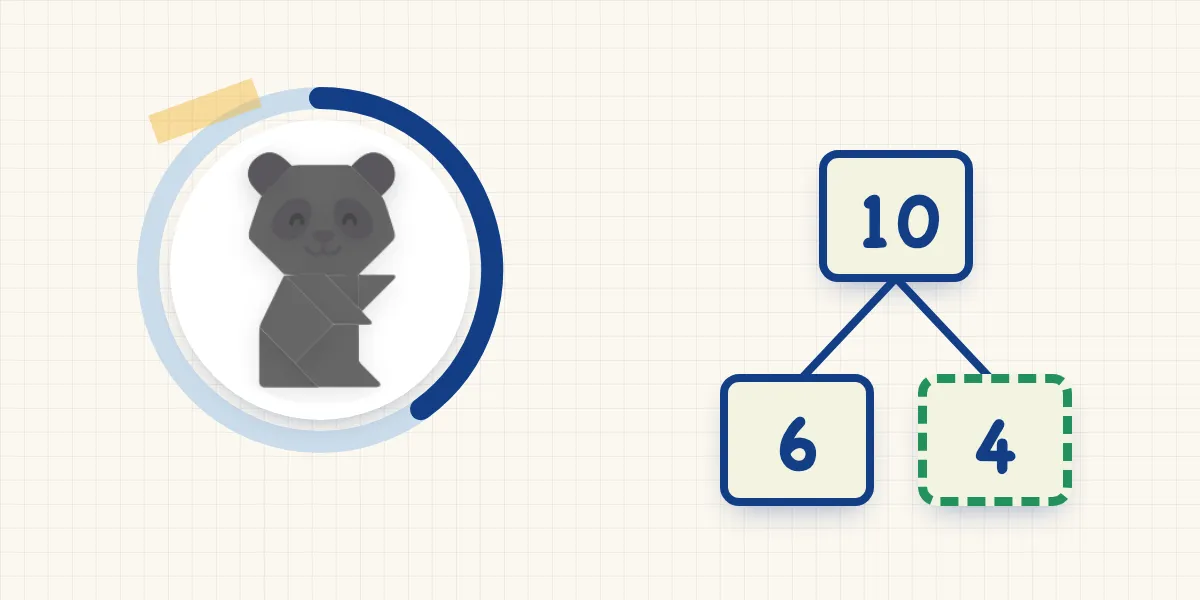
In short: When children practise number bonds, the goal is for them to recall facts like 10 = 6 + 4 from memory instead of counting them out. Speed is the clearest sign of recall. But time pressure can cause stress and push children towards weaker strategies. That is why, in the Zahlzerlegung app, a ring measures for five seconds whether an answer was recalled, yet never ends a task or takes anything away.
A made-up but typical scene: a child looks at 10 = 6 + ?. She doesn’t know the 4 straight away, so she quietly counts on: seven, eight, nine, ten, four fingers. The answer is right. Has she learned the number bond? Not quite yet. She has worked it out. Between “correct” and “known” there is a difference, and it shows mostly in time.
Last week we wrote about counting-based calculation. Today we explain how our newly released app deals with that difference.
What does “automatic recall” of number bonds mean?
A child can solve 6 + ? = 10 in three ways:
- Counting on: count from 6 to 10 and keep track of the steps.
- Deriving: start from a known fact, such as “5 + 5 = 10, so 6 + 4”.
- Recalling: simply know the 4.

A number bond is automatic when it can be recalled. Deriving is not a detour but an important stepping stone towards fluency. Gaidoschik and colleagues stress in a position paper that children who have neither automatised the bonds to 10 nor learned to derive them are left with counting alone. And children who keep counting find it harder to automatise (Gaidoschik et al., 2021).
Why does recall matter so much?
Because everything later builds on it. In a study of 152 first graders from the United States and Taiwan, fluency with basic facts and the use of decomposition predicted how accurately children solved two-digit problems (Vasilyeva, Laski & Shen, 2015).
It is measurable even years later. Price, Mazzocco and Ansari (2013) studied students at the end of high school solving single-digit arithmetic. Those who relied more on brain regions linked to retrieving arithmetic facts scored higher on a standardised maths test. Those who relied more on quantity processing, calculating rather than recalling, scored lower.
So why not just practise against the clock?
Because time pressure can come at a cost. Caviola, Carey, Mammarella and Szucs (2017) reviewed the research on stress, time pressure and strategy choice in arithmetic. Their cautious conclusion: time pressure generally acts as a stressor and tends to lead to less suitable strategies. They also stress that the evidence is thin and that there is no support for the claim that time pressure causes maths anxiety.
Two studies by Ramirez and colleagues show that anxiety already plays a role in the first school years. Among 154 children in first and second grade, maths anxiety was linked to lower achievement, especially in children with good working memory (Ramirez et al., 2013). A follow-up study pointed to one possible reason: anxious children used advanced problem-solving strategies less often and therefore performed worse (Ramirez et al., 2016). More on this in our post on maths anxiety in children.
That is the dilemma: speed is the best sign of recall, but pressure on speed can crowd out the very strategies we want to encourage.
What you can do at home or in class
- No stopwatches, no races while children are learning new number bonds. Speed follows confidence, not the other way round.
- Ask how they did it. “Did you know that, or did you work it out?” Both answers are fine, and you learn where your child stands.
- Praise deriving. “I know 5 + 5, so 6 + 4 is 10 as well” is a big step away from counting. Tell your child so.
- Quick-fire rounds only with known facts. If you ask questions at speed for fun, stick to number bonds your child already knows well.
- Little and often. A few minutes a day help more than one long practice session.
How we solved it in Zahlzerlegung
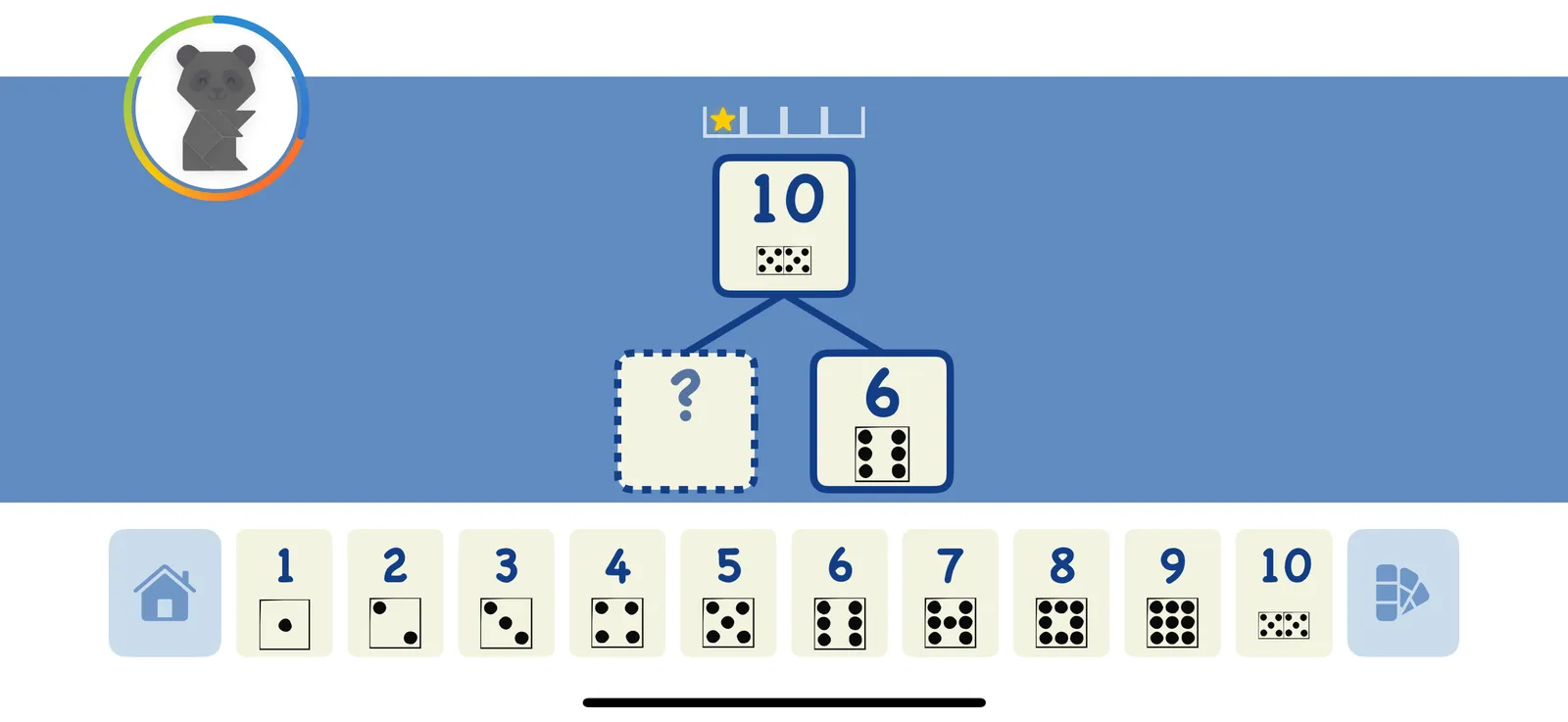
In the Zahlzerlegung app, a ring runs around the child’s tangram animal during every task. It lasts five seconds.

The ring measures. If the correct answer comes while it is running, the flashcard system counts the bond as recalled and moves it up a box. Only then can a bond be considered secure.
The ring doesn’t rush. There is no numerical countdown, no sound and no signal when time is up. The ring simply disappears. The task stays on screen, and the child can keep thinking, derive or even count. A correct answer gets the green frame however long it took.
The child barely notices the difference. A slow correct answer just doesn’t yet count as recalled: the star doesn’t move up, and the bond comes back soon. The answer to slow knowledge is practice, not pressure.
Why five seconds? That is our own choice, not a figure from research. It is deliberately generous, so that dragging the number with small fingers fits in comfortably. Please note that the app is available in German only.
Frequently asked questions
Isn’t five seconds too short? It doesn’t have to be enough. The ring only decides whether a bond counts as recalled. The task itself has no time limit.
Can the ring be switched off? No. But it doesn’t take anything away either: there are no lost points and no cancelled rounds.
My child is fast but makes mistakes. What then? A wrong answer sends the bond back to the start of the flashcard system, and the child sees the correct answer. Speed alone doesn’t count.
Is fast calculation the real goal? No. The goal is for number bonds to be secure, so that children can use them when calculating, for example when bridging through ten. Speed is only the sign of that.
Sources
- Caviola, S., Carey, E., Mammarella, I. C. & Szucs, D. (2017). Stress, time pressure, strategy selection and math anxiety in mathematics: A review of the literature. Frontiers in Psychology, 8, 1488. https://doi.org/10.3389/fpsyg.2017.01488
- Gaidoschik, M., Moser Opitz, E., Nührenbörger, M. & Rathgeb-Schnierer, E. (2021). Besondere Schwierigkeiten beim Mathematiklernen [Particular difficulties in learning mathematics]. Mitteilungen der Gesellschaft für Didaktik der Mathematik, 47(111S). https://ojs.didaktik-der-mathematik.de/index.php/mgdm/article/download/1042/1156
- Price, G. R., Mazzocco, M. M. M. & Ansari, D. (2013). Why mental arithmetic counts: Brain activation during single digit arithmetic predicts high school math scores. The Journal of Neuroscience, 33(1), 156–163. https://doi.org/10.1523/JNEUROSCI.2936-12.2013
- Ramirez, G., Gunderson, E. A., Levine, S. C. & Beilock, S. L. (2013). Math anxiety, working memory, and math achievement in early elementary school. Journal of Cognition and Development, 14(2), 187–202. https://doi.org/10.1080/15248372.2012.664593
- Ramirez, G., Chang, H., Maloney, E. A., Levine, S. C. & Beilock, S. L. (2016). On the relationship between math anxiety and math achievement in early elementary school: The role of problem solving strategies. Journal of Experimental Child Psychology, 141, 83–100. https://doi.org/10.1016/j.jecp.2015.07.014
- Vasilyeva, M., Laski, E. V. & Shen, C. (2015). Computational fluency and strategy choice predict individual and cross-national differences in complex arithmetic. Developmental Psychology, 51(10), 1489–1500. https://doi.org/10.1037/dev0000045
Lernwunder editorial team · Chaolan Lu