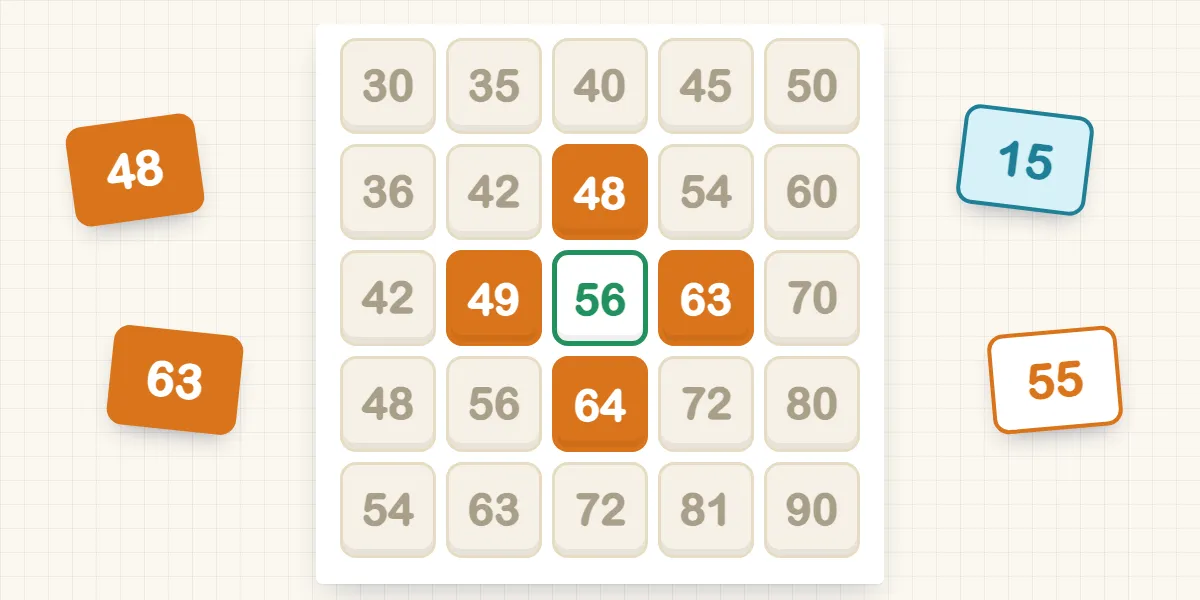
In short: Times tables mistakes are rarely random. Most wrong answers come from the table of one of the two numbers (7 × 8 = 48); others mix up multiplication with addition (3 × 4 = 7) or with a rule (0 × 5 = 5). Once you recognise the type of mistake, you know whether a child still needs to understand, to tell similar facts apart, or simply to recall more often.
A made-up example, but one you’ll find in plenty of exercise books: a worksheet says 7 × 8 = 48, 6 × 7 = 13 and 9 × 6 = 36. Three mistakes, three crosses. Yet they tell three very different stories. With 48 the child was in the right table and slipped by one fact. With 13 they added. And with 36 a number from the question crept into the answer.
Why are times tables mistakes so often “nearly right”?
Because the 100 facts are very alike: the same numbers, similar answers, and many answers turn up in more than one table. Researchers therefore describe this knowledge as a network of associations in which each fact is linked not only to its correct answer but also to wrong ones. The more similar two facts are, the easier it is for memory to grab the wrong one (summarised in Dotan & Zviran-Ginat, 2022).
In adolescents with learning difficulties, the wrong answers mostly belonged to the table of one of the two numbers, and the hard facts were the same ones that children and adults without difficulties find hard (Barrouillet et al., 1997). The mistakes follow the structure of the times tables.
What types of mistakes are there?
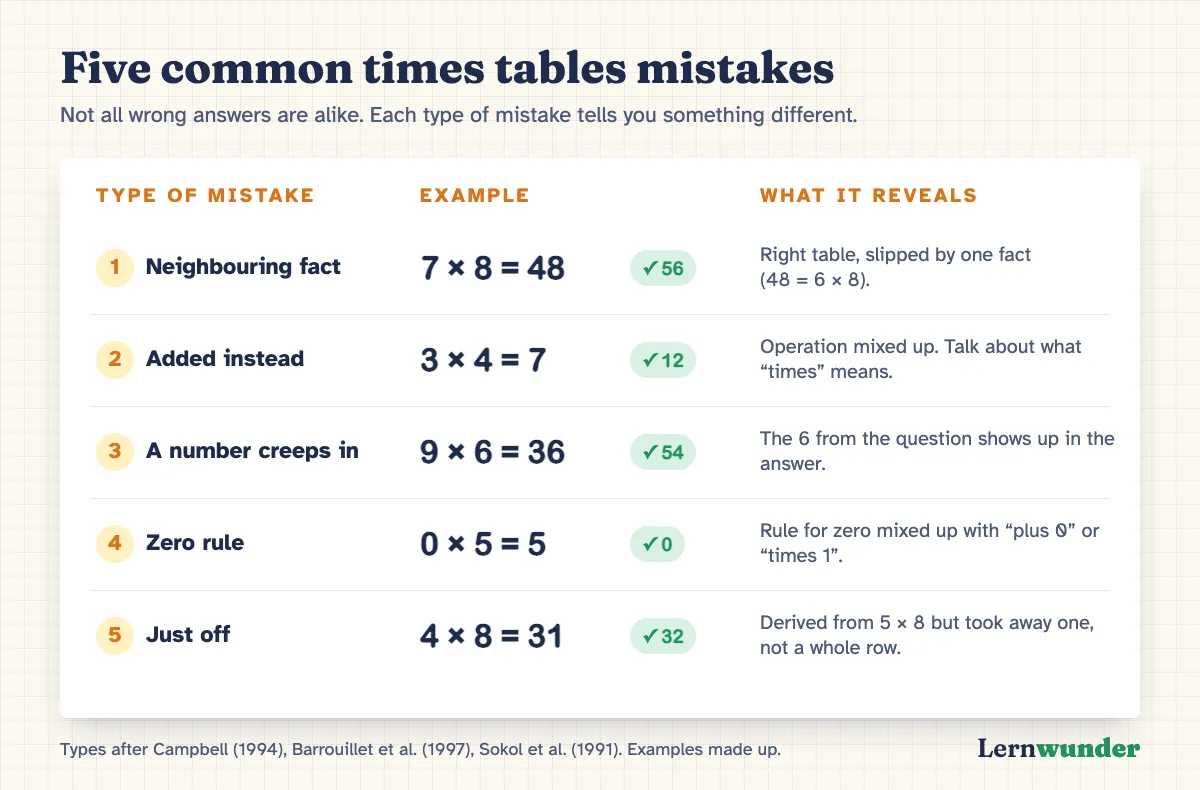
1. Neighbouring fact. 7 × 8 = 48 or 63. The answer belongs to 6 × 8 or 7 × 9. This is the most common type. It shows the child knows which table to look in, but the facts within it aren’t cleanly separated yet.
2. Added instead of multiplied. 3 × 4 = 7 or 6 × 7 = 13. Operation mix-ups like this also occurred in experiments with adults, for example 2 + 4 = 8 (Campbell, 1994). In children they are a cue to look at meaning: “3 times 4” means three fours.
3. A number creeps in. 9 × 6 = 36: the 6 from the question shows up in the answer, and 36 happens to be a times tables answer too. Researchers call these operand-intrusion errors. Campbell (1994) found them in adults, with different patterns depending on whether problems were shown as digits or as number words. Reading the numbers and retrieving the answer seem to interact.
4. The zero rule. 0 × 5 = 5. Facts with zero are probably not stored one by one but as a rule: “times 0 makes 0”. Detailed error analyses of two adults with acquired calculation difficulties point that way (Sokol et al., 1991). In children, a mix-up with “plus 0” or “times 1” seems likely. That is our own reasoning, not a measured frequency.
5. Just off. 4 × 8 = 31 instead of 32. Often there’s a nearly-right strategy behind it: starting from 5 × 8 = 40 and taking away one instead of a whole row of eight. We described this in our post on core facts, and seeing multiplication as a rectangle helps children spot it.
What do the mistakes tell you about learning?
Above all: not every mistake needs the same help.
Neighbouring-fact mistakes are mostly a problem of telling facts apart. Fourth graders who found multiplication facts hard to memorise were also unusually sensitive to similar, interfering material in other memory tasks (De Visscher & Noël, 2014). They don’t lack understanding; the facts get in each other’s way.
That has a practical consequence. In a study with 17 children aged six and seven who didn’t yet know their times tables, the children learned four facts a week. In two weeks the four facts were dissimilar, in two weeks similar. The dissimilar facts were learned better, and the difference was still measurable seven weeks after training (Dotan & Zviran-Ginat, 2022). The study is small, but it fits the error research.
Addition and zero mistakes are more about meaning: what does “times” mean? Just-off mistakes when deriving show a gap in the picture of multiplication. And if a child finds the right answer after a moment’s thought, what’s missing may simply be recall, practised over several days.
What you can do at home or in class
- Collect mistakes for a week, don’t count them. Write down each wrong answer with its question and sort it into the five types. After a few days you’ll see a pattern.
- For neighbouring-fact mistakes: keep similar facts apart. Don’t practise 7 × 8 right next to 6 × 8 and 7 × 9; mix it with dissimilar facts such as 3 × 4 and 9 × 5. Similar facts get a different day.
- For addition mistakes: say what it means. “Three fours” rather than “three times four”, and draw a rectangle on squared paper. A child who sees three rows of four squares won’t write 7.
- For zero mistakes: tell a story. “Zero plates with five biscuits each, how many biscuits?” and “five plates with zero biscuits?” Both make 0.
- Mistake detective, with reasons. Offer four answers to a question, say for 7 × 8: 56, 48, 15, 63. The child picks one and explains where each wrong one might come from. In two experiments, well-built multiple-choice questions with plausible wrong answers also strengthened knowledge about the wrong options (Little et al., 2012).
- Always reveal the answer. Wrong options can stick in memory too (Roediger & Marsh, 2005). Feedback with the correct answer clearly reduces this effect (Butler & Roediger, 2008). Never leave a multiple-choice question without the solution.
And if you can, skip the big crosses: here a mistake is information, not a verdict.
How we built it into Droptiply
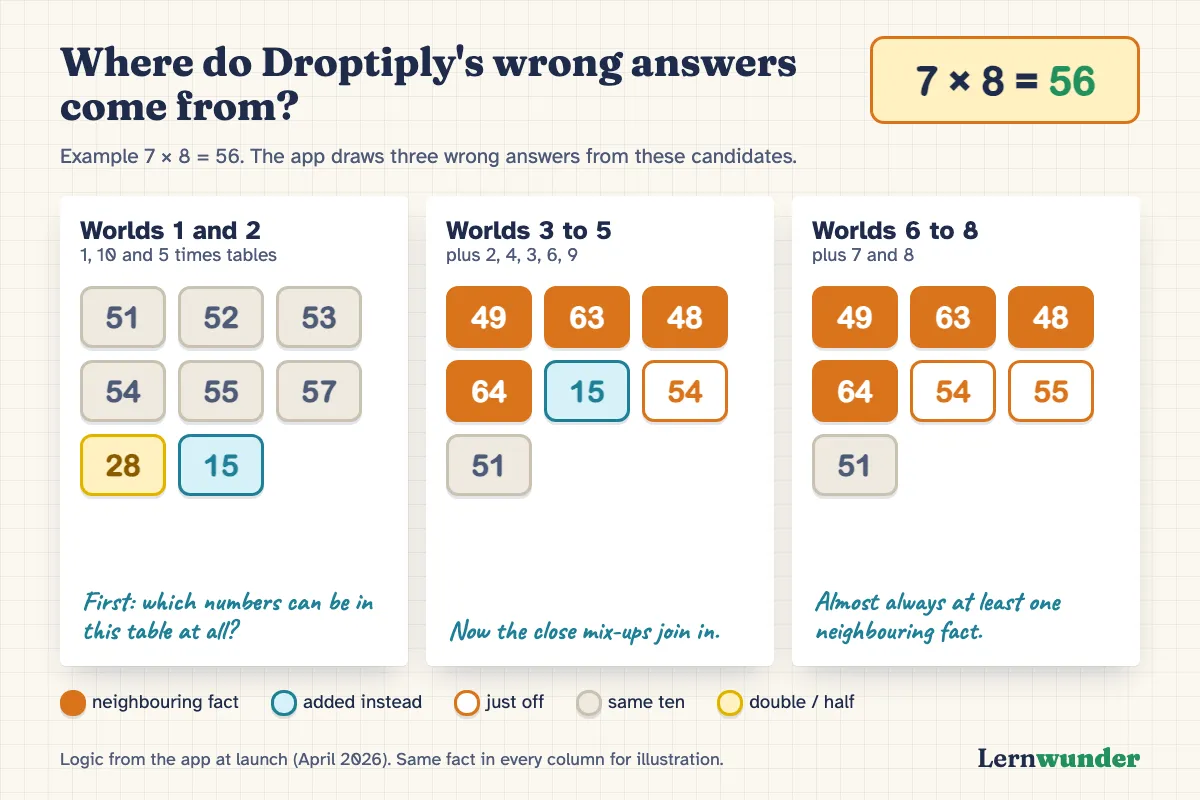
In Droptiply a child answers every fact by choosing from four options. The three wrong ones aren’t random. The app draws them from a pool of typical mistakes, and the pool depends on which of the eight worlds the child is playing in.
Worlds 1 and 2 (the 1, 10 and 5 times tables): the wrong answers are mostly other numbers from the same ten, plus double or half the answer and the addition mix-up.
Worlds 3 to 5: neighbouring facts join in, along with addition and numbers just off the answer.
Worlds 6 to 8 (with the 7 and 8 times tables): neighbouring facts and numbers just off. Calculated over all 100 facts, the options here include at least one neighbouring fact in more than nine out of ten cases.
The idea comes from an experiment with multiple-choice questions: wrong options from the table of one of the two numbers led to far more errors than numbers that never appear in the times tables (Barrouillet et al., 1997). So at first the child mainly learns which numbers can be an answer in that table at all. Later they have to tell closely neighbouring facts apart. Whether this staging works exactly like this for primary school children hasn’t been studied directly. It’s our own transfer.
After a wrong answer, the child can try again. After the second wrong try the correct answer pulses gently; after the third it is shown. So no fact ends without the right answer, and facts that cause trouble come back soon. How that works is explained in our post on spaced repetition.
Two things we want to say openly. Droptiply has no facts with zero, so it doesn’t practise the zero rule. And the worlds introduce the tables one after another. New facts from one table are similar to each other, which, according to Dotan and Zviran-Ginat (2022), can make them harder to learn. Mixing in the earlier tables only softens this. An app can’t replace talking about mistakes, and it doesn’t replace a professional assessment.
Frequently asked questions
Is it bad if my child keeps saying 7 × 8 = 48? No. It shows your child is looking in the right table. It helps to practise 7 × 8 apart from 6 × 8 for a while and to recall it over several days.
Are lots of addition mistakes a warning sign? At the start they’re normal. If they persist for weeks, check whether your child has understood what “times” means, for example with rectangles on squared paper.
When should I be concerned? If a child can hardly recall any facts despite regular practice and is losing enjoyment and confidence, talk to the teacher. A mistake list like the one above is a good basis for that conversation.
Find out more on the Droptiply page.
Sources
- Barrouillet, P., Fayol, M. & Lathulière, E. (1997). Selecting between competitors in multiplication tasks: An explanation of the errors produced by adolescents with learning difficulties. International Journal of Behavioral Development, 21(2), 253–275. https://doi.org/10.1080/016502597384857
- Butler, A. C. & Roediger, H. L. (2008). Feedback enhances the positive effects and reduces the negative effects of multiple-choice testing. Memory & Cognition, 36(3), 604–616. https://doi.org/10.3758/MC.36.3.604
- Campbell, J. I. D. (1994). Architectures for numerical cognition. Cognition, 53(1), 1–44. https://doi.org/10.1016/0010-0277(94)90075-2
- De Visscher, A. & Noël, M.-P. (2014). Arithmetic facts storage deficit: The hypersensitivity-to-interference in memory hypothesis. Developmental Science, 17(3), 434–442. https://doi.org/10.1111/desc.12135
- Dotan, D. & Zviran-Ginat, S. (2022). Elementary math in elementary school: The effect of interference on learning the multiplication table. Cognitive Research: Principles and Implications, 7, 101. https://doi.org/10.1186/s41235-022-00451-0
- Little, J. L., Bjork, E. L., Bjork, R. A. & Angello, G. (2012). Multiple-choice tests exonerated, at least of some charges: Fostering test-induced learning and avoiding test-induced forgetting. Psychological Science, 23(11), 1337–1344. https://doi.org/10.1177/0956797612443370
- Roediger, H. L. & Marsh, E. J. (2005). The positive and negative consequences of multiple-choice testing. Journal of Experimental Psychology: Learning, Memory, and Cognition, 31(5), 1155–1159. https://doi.org/10.1037/0278-7393.31.5.1155
- Sokol, S. M., McCloskey, M., Cohen, N. J. & Aliminosa, D. (1991). Cognitive representations and processes in arithmetic: Inferences from the performance of brain-damaged subjects. Journal of Experimental Psychology: Learning, Memory, and Cognition, 17(3), 355–376. https://doi.org/10.1037/0278-7393.17.3.355
Lernwunder editorial team · Chaolan Lu